
Definition
Potting resin for motors is a high-performance composite material designed to protect electric and mechanical motors from environmental and operational stresses. These resins are injected into motor windings, stators, and other sensitive components in liquid form, where they cure to create durable, sealed structures with excellent electrical insulation, mechanical protection, and thermal stability.
The primary purpose of potting resin is to shield motors from moisture, dust, chemicals, vibration, and thermal cycling, extending the motor’s operational lifespan while ensuring consistent performance. Epoxy resins dominate due to their strong adhesion and thermal resistance, while silicone-based variants are increasingly adopted for high-temperature or flame-retardant applications.
Potting resins are used extensively across electric vehicles (EVs), industrial automation, renewable energy systems, aerospace, and consumer electronics. The growing adoption of electric traction motors and miniaturized industrial motors has driven innovation in low-viscosity, thermally conductive formulations. Advanced potting materials now incorporate nanomaterials, EMI shielding fillers, and self-healing chemistries, enhancing both protective and functional properties.
Manufacturers like ELANTAS, Henkel Loctite, and Dow Corning focus on creating formulations that balance mechanical strength, thermal conductivity, processability, and compliance with environmental regulations, positioning potting resin as a critical component in next-generation motors.
Recent Developments in Potting Resin for Motors
The potting resin market for motors is seeing a significant shift towards more specialized and high-performance materials. A key trend is the development of thermally conductive compounds, particularly crucial for electric vehicle (EV) motors. As motors become more powerful and compact, they generate more heat, and traditional cooling methods are often insufficient. Companies are innovating with new formulations to provide superior heat dissipation, electrical insulation, and protection against vibration and moisture. There is also a growing focus on sustainability, with manufacturers introducing bio-based and recyclable materials to meet environmental regulations and consumer demand for “green” solutions. Finally, advancements in curing technology, like UV curing, are allowing for faster production times and energy efficiency.
Major Distribution Channels
The distribution of potting resins for motors is primarily handled through a network of specialized channels that connect manufacturers with end-users. The most common channels include direct sales from the manufacturer to large-scale industrial customers, particularly in the automotive and aerospace industries. Additionally, a significant portion of the market is served by chemical distributors and specialty material suppliers who act as intermediaries, providing a wider range of products and technical support to a diverse customer base, including small and medium-sized enterprises. The growth of e-commerce platforms and online marketplaces is also becoming a notable channel for some product segments, offering a convenient way for smaller companies to access a variety of potting compounds.
Market Size
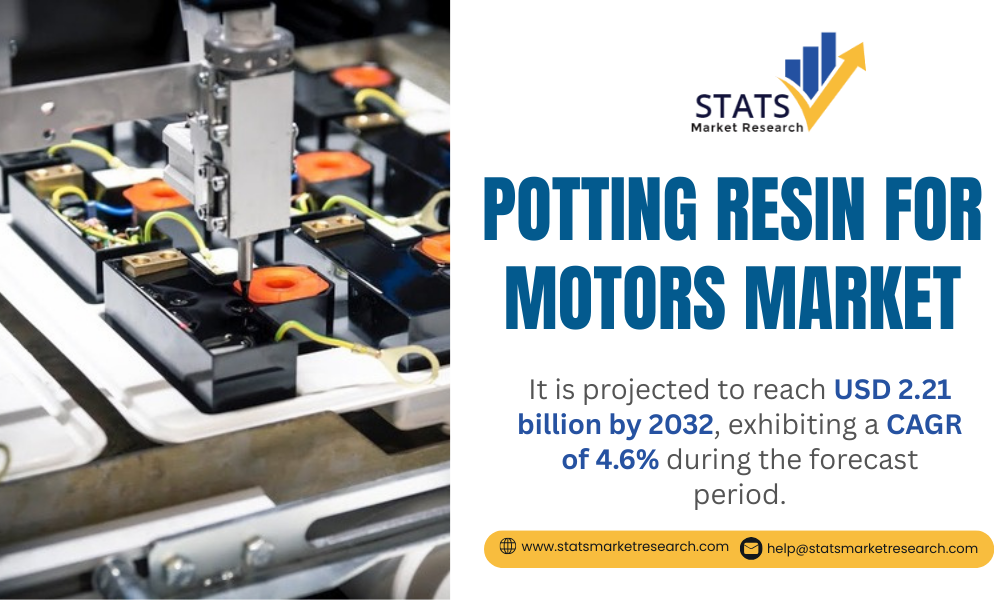
Global potting resin for motors market was valued at USD 1.51 billion in 2024. The market is projected to grow from USD 1.58 billion in 2025 to USD 2.21 billion by 2032, representing a CAGR of 4.6% during the forecast period.
Download FREE Sample of this Report @ https://www.statsmarketresearch.com/download-free-sample/8060201/global-potting-resin-for-motors-forecast-market
Historical Growth Trends
- The market has expanded steadily due to the global EV revolution and increasing industrial automation adoption.
- Epoxy resin has historically dominated the product segment, contributing more than 55% of market share due to its mechanical durability and thermal stability.
- The Asia-Pacific region has seen rapid growth in potting resin demand, reflecting increasing EV production, industrial motor manufacturing, and electronics assembly.
Key Statistics
- The electric vehicle segment contributes nearly 30% of total potting resin demand, driven by traction motors and high-voltage battery insulation requirements.
- Industrial automation motors account for over 40% of global consumption, particularly in servo motors, linear actuators, and precision rotary equipment.
- Aerospace and defense applications are forecast to grow at 7.3% CAGR, reflecting demand for lightweight, flame-retardant, and thermally stable resin solutions.
The market size is shaped by regulatory pressure for high-efficiency, low-emission motor systems, increasing the adoption of premium-grade potting resins in diverse industrial applications.
Market Dynamics (Drivers, Restraints, Opportunities, and Challenges)
Drivers
- Surging Electric Vehicle Demand:
Global EV production is projected to grow at over 20% CAGR through 2030, driving the adoption of potting resins in traction motors. Potting resins provide vibration damping, insulation, and thermal protection in high-voltage architectures, enabling reliable EV performance across temperatures ranging from -40°C to 180°C. - Industrial Automation Growth:
With over 240 million industrial motors shipped globally in 2024, including servo and motion control systems, potting resins protect precision motors from chemicals, moisture, and mechanical stress. Industry 4.0 initiatives have increased potting resin requirements by ~40% due to smart factory deployments. - Thermal Management and Regulatory Compliance:
Potting resins aid in heat dissipation and comply with energy efficiency standards, particularly in high-speed or high-power motors. Their thermal properties ensure stable performance in demanding industrial environments.
Restraints
- Raw Material Volatility:
Fluctuating prices of epoxy and silicone polymers, often linked to petrochemical supply disruptions, create pricing pressures and margin constraints. In 2024, epoxy resin prices showed 15–20% volatility, impacting smaller formulators and motor manufacturers. - Processing Complexity:
High-performance resins require controlled temperature curing cycles due to exothermic reactions. This complicates large-scale production and can introduce thermal stresses if improperly managed. - REACH Compliance Costs:
Environmental regulations, especially in Europe, increase formulation development costs, with single-substance evaluations often exceeding €50,000, challenging small specialty resin producers.
Opportunities
- Aerospace and Defense Applications:
Aircraft electrification and composite-intensive designs require lightweight, flame-retardant, and thermally stable potting resins. Aviation-grade resins with CTE matching are crucial to prevent delamination, offering high-value growth potential. - Smart Material Innovations:
Advanced nanomaterial additives, EMI shielding fillers, and self-healing chemistries allow manufacturers to differentiate products. Such premium formulations command 25–40% higher pricing, creating profitable niches in medical devices, EVs, and 5G infrastructure motors. - Regional Expansion:
Growth in Asia-Pacific, particularly China and India, offers opportunities for localized production of cost-competitive potting resins. Government incentives for EVs and industrial automation further enhance market potential.
Challenges
- Extreme Environment Performance:
Resins currently face limitations under temperatures above 200°C, high-pressure chemicals, and intense vibration, common in downhole drilling and aerospace propulsion systems. - Workforce Specialization Barriers:
Optimizing curing kinetics and adhesion properties requires certified polymer chemists and application engineers, whose scarcity slows market growth in emerging regions.
Regional Analysis
- North America: Dominated by industrial motors and EV traction motors, particularly in the U.S., with high adoption of premium epoxy and silicone resins.
- Europe: Strong adoption in automotive, aerospace, and defense sectors, with Germany, France, and the U.K. leading in innovation.
- Asia-Pacific: Fastest-growing market due to China, India, and Japan, driven by EV production, industrial motor manufacturing, and electronics assembly.
- Middle East & Africa: Niche adoption, mostly in aerospace and industrial applications.
- Latin America: Steady growth in industrial equipment and automotive motors, led by Brazil and Mexico.
Get the Complete Report & TOC @ https://www.statsmarketresearch.com/global-potting-resin-for-motors-forecast-market-8060201
Competitor Analysis (in brief)
The global potting resin market is moderately consolidated:
- ELANTAS (Germany) and Henkel Loctite (Germany): Market leaders due to polymer expertise and vertically integrated supply chains.
- Dow Corning (U.S.): Strong presence with silicone-based solutions for high-temperature motor applications.
- Evonik Industries (Germany): Specialized epoxy formulations with enhanced thermal conductivity, recently expanded production in Asia.
- Mid-tier Players: EFI Polymers and Zhejiang Rongtai focus on cost-competitive, mass-market solutions, particularly in Asia’s EV segment.
- Sustainable Initiatives: Sika and Protavic International develop bio-based, environmentally friendly resins for compliant applications.
Global Potting Resin for Motors Market: Market Segmentation Analysis
This report provides a deep insight into the global Potting Resin for Motors Market, covering all its essential aspects. This ranges from a macro overview of the market to micro details of the market size, competitive landscape, development trend, niche market, key market drivers and challenges, SWOT analysis, value chain analysis, etc.
The analysis helps the reader to shape the competition within the industries and strategies for the competitive environment to enhance the potential profit. Furthermore, it provides a simple framework for evaluating and assessing the position of the business organization. The report structure also focuses on the competitive landscape of the Global Potting Resin for Motors Market. This report introduces in detail the market share, market performance, product situation, operation situation, etc., of the main players, which helps the readers in the industry to identify the main competitors and deeply understand the competition pattern of the market.
In a word, this report is a must-read for industry players, investors, researchers, consultants, business strategists, and all those who have any kind of stake or are planning to foray into the Potting Resin for Motors Market in any manner.
Market Segmentation (by Application)
- Rotary Motors
- Linear Motors
- Servo Motors
- DC Motors
- Others
Market Segmentation (by Type)
- Epoxy Resin
- Silicone Resin
- Polyurethane Resin
- Others
Key Company
- ELANTAS (Germany)
- Henkel Loctite (Germany)
- Dow Corning (U.S.)
- Huntsman Corporation (U.S.)
- EFI Polymers (U.K.)
- Evonik Industries (Germany)
- Sika AG (Switzerland)
- Zhejiang Rongtai Technical Enterprise (China)
- Shanghai Beginor Polymer Materials (China)
- Protavic International (France)
Geographic Segmentation
- North America
- Europe
- Asia-Pacific
- Latin America
- Middle East & Africa
FAQ Section
- What is the current market size of the Potting Resin for Motors Market?
The global market was valued at USD 1.51 billion in 2024 and is projected to reach USD 2.21 billion by 2032, growing at a CAGR of 4.6%. - Which are the key companies operating in the Potting Resin for Motors Market?
Key players include ELANTAS, Henkel Loctite, Dow Corning, Huntsman Corporation, EFI Polymers, Evonik Industries, Sika AG, Zhejiang Rongtai, Shanghai Beginor Polymer Materials, and Protavic International. - What are the key growth drivers in the Potting Resin for Motors Market?
Growth is driven by surging electric vehicle production, industrial automation expansion, thermal management requirements, and aerospace and defense applications. - Which regions dominate the Potting Resin for Motors Market?
North America and Europe lead in premium motor applications, while Asia-Pacific is the fastest-growing region due to EV and industrial motor manufacturing. - What are the emerging trends in the Potting Resin for Motors Market?
Emerging trends include nanomaterial-enhanced resins, EMI shielding formulations, self-healing chemistries, sustainable bio-based resins, and growth in aerospace and 5G infrastructure motors.
About Us
☎️ International: +1 (332) 2424 294
📄 Website: www.statsmarketresearch.com
Join us on LinkedIn:- https://www.linkedin.com/company/statsmarketresearch




