
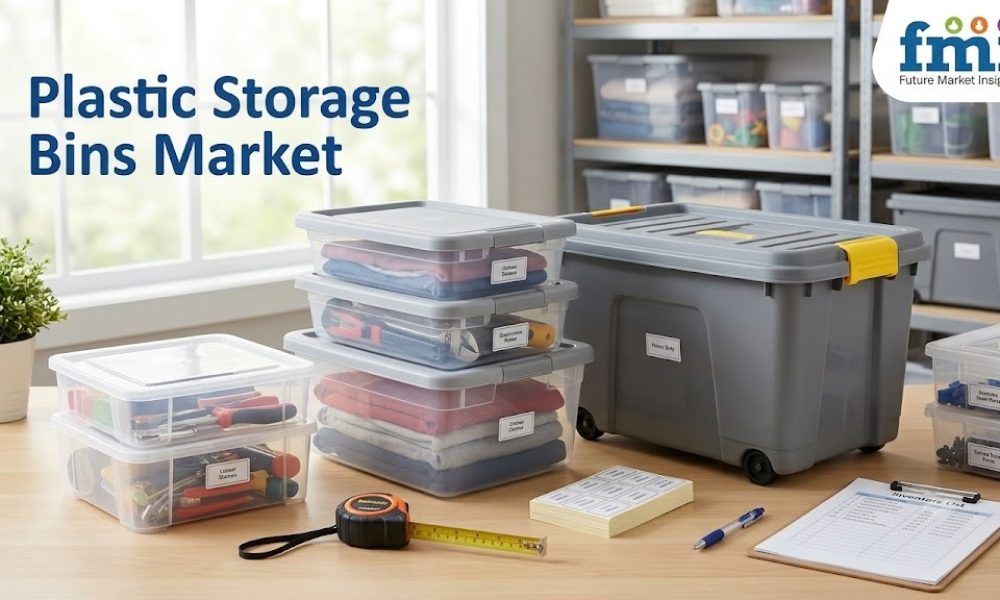
The global plastic storage bins market is entering a period of steady expansion as warehouse automation, higher picking intensity, and standardized material-handling systems increase demand for reusable storage formats. According to Future Market Insights (FMI), the market is valued at USD 2.9 billion in 2026 and is projected to reach USD 4.6 billion by 2036, expanding at a 4.7% CAGR during the forecast period. The market was valued at USD 2.7 billion in 2025.
The latest FMI analysis, published September 23, 2026, finds that storage bins are increasingly being treated not only as containers but also as interfaces between storage, picking, replenishment, and automated handling systems. As warehouse operations become more automated, dimensional consistency, base stability, label placement, and compatibility with installed equipment are becoming important purchasing considerations.
Get detailed market forecasts, competitive benchmarking, and pricing trends: https://www.futuremarketinsights.com/reports/sample/rep-gb-35526
Automation Raises Demand for Standardized Storage Formats
Warehousing is expected to represent 30.0% of end-use demand in 2026, supported by recurring picking and replenishment cycles that create defined bin positions throughout distribution facilities. Goods-to-person systems further increase the role of totes and bins as they move between storage and picking environments.
The shift toward automation also increases the importance of repeatable product geometry. FMI notes that automation-specific tote designs are making dimensional repeatability part of system fit. A distorted base, cracked rim, or inconsistent identification area can disrupt conveyor movement, scanning, or automated handling.
Recent industry activity reflects this transition. In August 2026, ORBIS announced that its PACK EXPO International display would include its AROS tote family and AutoStore-compatible bins, highlighting the growing intersection between storage containers and automated fulfillment infrastructure.
Stackable Bins and HDPE Maintain Strong Positions
- By bin type, stackable bins are expected to hold 29.0% in 2026, supported by their ability to use vertical storage while maintaining modular footprints across shelving and work cells. Their portability also allows the same container format to move between reserve storage, forward-pick locations, carts, and work areas.
- HDPE is expected to account for 0% of the material category in 2026. Its stiffness, impact tolerance, and moisture resistance support repeated handling across warehouses and manufacturing environments. Recycled plastic is also gaining relevance as circularity requirements become more important for reusable logistics applications.
- Within capacity, the 10–30 L range is expected to represent 36.0% of the market in 2026. The segment provides a balance between shelf density and practical manual handling, making it suitable for small parts, mixed kits, receiving operations, and line-side supply.
- Industrial distributors are expected to hold 0% of sales channels in 2026, reflecting the value of stocked product breadth and rapid replacement access when damaged bins need to be replaced.
Regulatory and Operational Considerations Create New Opportunities
Reusable transport packaging requirements are creating additional opportunities for durable plastic storage formats. The European Commission’s Packaging and Packaging Waste Regulation (PPWR) applies across the European Union from August 12, 2026. Reuse targets beginning in 2030 increase the relevance of reusable formats, service-life documentation, and recovery systems for eligible transport packaging applications.
However, installed infrastructure remains a key restraint. Once bins are integrated with racks, conveyors, shelving, or automated storage systems, switching suppliers can require dimensional and loaded-performance testing. A lower purchase price may not compensate for qualification costs if a replacement bin fails to meet established system tolerances.
South Korea Records Highest CAGR Among Profiled Markets
Country-level forecasts show differing growth patterns across major markets. South Korea is expected to register a 6.2% CAGR, followed by Mexico at 5.9%, Canada at 5.5%, the USA at 5.2%, Germany at 4.9%, France at 4.5%, and Japan at 4.2%.
South Korea’s growth is linked to e-commerce activity and automated fulfillment. The Ministry of Data and Statistics reported July 2026 online shopping transaction value of KRW 25.0954 trillion, up 7.3% year over year. In the USA, second-quarter 2026 retail e-commerce sales reached USD 329.5 billion, according to the U.S. Census Bureau, supporting continued activity across fulfillment and distribution networks.
Competitive Landscape
The competitive environment includes industrial storage-bin specialists, intralogistics providers, and reusable logistics-container manufacturers. Key companies profiled by FMI include Akro-Mils, IPL Schoeller, SSI Schaefer, Quantum Storage Systems, ORBIS Corporation, Uline, BITO Lagertechnik, Craemer, Rehrig Pacific, and Buckhorn.
Recent developments include SSI Schaefer’s June 2026 selection as the intralogistics solution provider for Oriola’s new pharmaceutical distribution center in Järvenpää, Finland. Quantum Storage Systems also introduced new stackable shelf bins in early 2026, while ORBIS expanded attention around automation-oriented tote applications.
Access the Complete Report in PDF Format: https://www.futuremarketinsights.com/reports/brochure/rep-gb-35526
Report Scope
The Plastic Storage Bins Market covers bin type, material, end use, capacity, sales channel, and region. The study covers North America, Latin America, Western Europe, Eastern Europe, East Asia, South Asia and Pacific, and the Middle East and Africa, with the USA, Germany, Japan, South Korea, Canada, France, Mexico, and more than 25 additional countries analyzed.
The forecast period spans 2026 to 2036. The study uses primary and secondary research, market triangulation, segment analysis, country-level assessment, and data validation. The defined market covers revenue from completed rigid plastic storage bins sold for commercial, industrial, and institutional storage or handling.
Business Impact
FMI helps organizations transform market complexity into strategic clarity, enabling leadership teams to identify growth opportunities faster, optimize resource allocation, strengthen competitive positioning, and make high-stakes business decisions with confidence.
To explore how FMI Custom Research can support your strategic priorities, please connect with our team at – [email protected]
About Future Market Insights (FMI)
Future Market Insights, Inc. (FMI) is an ESOMAR-certified, ISO 9001:2015 market research and consulting organization, trusted by Fortune 500 clients and global enterprises. With operations in the U.S., UK, India, and Dubai, FMI provides data-backed insights and strategic intelligence across 30+ industries and 1200 markets worldwide.



