
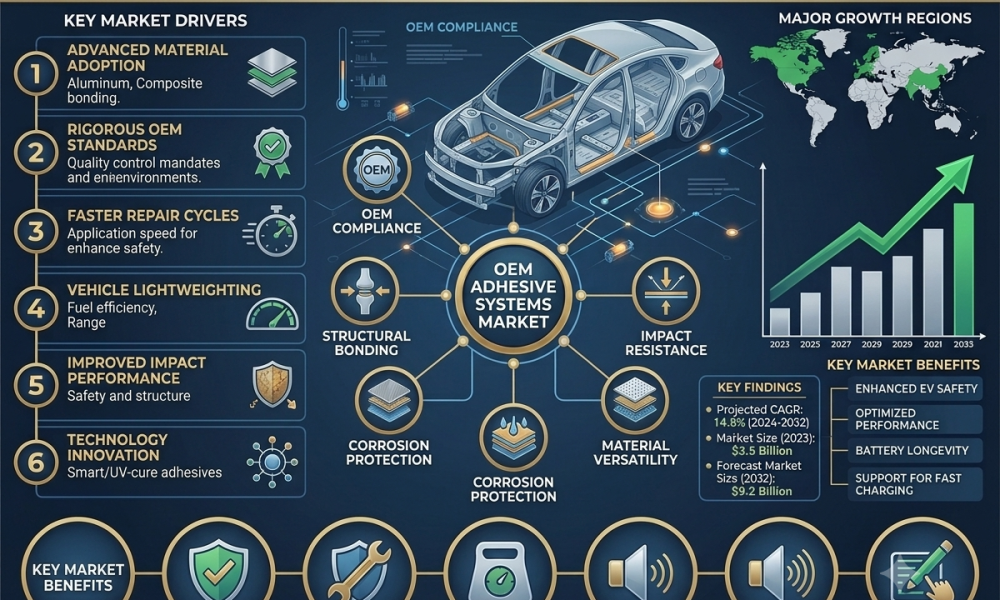
The global OEM-approved collision repair adhesive systems market is projected to grow from USD 1.4 billion in 2026 to USD 2.4 billion by 2036, registering a 5.4% CAGR during the forecast period.
Demand is being supported by certified body-shop procedures, increasing use of mixed-material vehicle structures, and greater emphasis on documented repair processes. Two-part epoxy systems are expected to account for 44.8% share of adhesive type demand in 2026, while passenger cars are projected to contribute 66.3% of vehicle class demand.
Get detailed market forecasts, competitive benchmarking, and pricing trends:
https://www.futuremarketinsights.com/reports/sample/rep-gb-33314
Why are OEM-approved adhesives becoming more important in collision repair?
Vehicle repair is becoming increasingly procedure-driven as automakers specify how damaged body structures should be restored. Collision centers need products that correspond with OEM repair instructions, including adhesive type, surface preparation, application method, cure time, and bonding requirements.
This is particularly important for repairs involving bonded panels and mixed-material structures. Body shops cannot rely solely on general adhesive specifications when vehicle manufacturers provide model-specific repair procedures.
Federal Motor Vehicle Safety Standard No. 214 establishes side-impact protection requirements for vehicles. Repair procedures therefore need to maintain the intended structural characteristics of vehicle body systems following a collision.
Tesla, for example, stated in September 2024 that structural repairs should use adhesives specified through its Service website. Its January 2026 Model Y Structural Pack repair procedure also instructs technicians to apply structural adhesive to specified mating surfaces and maintain a minimum 25 mm overlap in applicable areas.
These requirements are reinforcing the importance of traceable, procedure-specific adhesive selection.
How are two-part epoxy systems supporting market growth?
Two-part epoxy systems are projected to account for 44.8% share of the market in 2026. Their use in structural panel bonding reflects the need for strong and durable joints during professional collision repair.
Panel bonding is expected to account for 38.6% share of repair application demand. Bonded panels can require carefully controlled adhesive application where welding or mechanical fastening alone does not replicate the approved repair method.
Epoxy systems also support repair requirements involving mixed-material vehicle structures. Modern vehicle bodies increasingly combine high-strength steel, aluminum, and other lightweight materials, creating greater sensitivity to surface preparation and joining methods.
Henkel introduced Teroson EP 52 in May 2026 as a structural adhesive designed to provide vibration damping and body joint strength. Such developments reflect the broader movement toward repair materials that address structural and comfort-related requirements within a single system.
Drive Your Business Growth Strategy: Checkout the Report for Key Insights!
https://www.futuremarketinsights.com/checkout/33314
Why are cartridge systems becoming the preferred package format?
Cartridge systems are expected to represent 62.7% share of package format demand in 2026. Their growing use reflects the need for controlled adhesive dispensing and consistent mixing during professional repairs.
Cartridge packaging can simplify application and help technicians reduce material-mixing errors. It can also make adhesive consumption and repair documentation easier to track within standardized repair workflows.
For certified repair centers, packaging therefore becomes part of process control rather than simply a product-delivery choice.
Clear application instructions, controlled cure requirements, and traceable product identification can help body shops maintain consistency across repair jobs and support documentation requested by insurers or repair networks.
How are mixed-material vehicle structures changing adhesive requirements?
Vehicle manufacturers increasingly use different materials to reduce weight while maintaining structural performance. Aluminum and high-strength steel can require different surface preparation and joining approaches.
This makes adhesive selection more important during collision repair. Technicians need to understand substrate preparation, adhesive compatibility, curing requirements, and corrosion protection before restoring damaged panels.
Ford Crash Parts stated in July 2025 that abraded surfaces must be coated with adhesive while e-coat should remain intact. Such requirements place greater emphasis on surface preparation as part of corrosion-risk management.
The market is therefore moving beyond simple adhesive supply toward complete repair systems that combine material selection, application guidance, curing control, and documentation.
How are insurers and certified repair networks influencing adhesive demand?
Insurance-reviewed repair files are creating additional demand for traceable repair processes. Body shops increasingly need to document the products and procedures used during collision repairs.
In September 2025, 3M stated that its OEM product recommendations are tied to vehicle make, model, year, and repair procedure. This type of procedure-specific guidance can help repair networks align adhesive selection with vehicle manufacturer requirements.
OEM-certified shops are projected to account for 57.4% share of repair route demand in 2026. Dealer body shops, independent repair shops, and insurance repair networks also form part of the market.
For adhesive suppliers, OEM procedure coverage and technician training can therefore become important factors when establishing relationships with certified repair networks.
About the OEM-Approved Collision Repair Adhesive Systems Market Report
Future Market Insights’ study covers professional adhesive systems approved by vehicle manufacturers for collision repair applications.
The report analyzes the market by adhesive type, repair application, vehicle class, repair route, package format, and region. Adhesive types include two-part epoxy systems, polyurethane, acrylic, SMP systems, and hybrid systems.
Repair applications include panel bonding, seam sealing, plastic repair, glass bonding, and NVH repair. Vehicle classes include passenger cars, light commercial vehicles, heavy vehicles, and EV platforms.
Repair routes include OEM-certified shops, independent repair shops, dealer body shops, and insurance repair networks. Package formats include cartridge systems, bulk packs, repair kits, and aerosol formats.
The scope excludes household and craft adhesives, non-automotive construction sealants, factory-only assembly adhesives, paints and body fillers unless included in a documented adhesive repair package, and mechanical fasteners and body panels unless supplied as part of a bonded repair kit.
About Future Market Insights
Future Market Insights, Inc. is an ESOMAR-certified market research and consulting firm and a member of the Greater New York Chamber of Commerce. FMI provides syndicated and custom market intelligence across automotive, industrial, technology, chemicals, energy, and other sectors, helping organizations identify market opportunities and make data-driven business decisions.



