
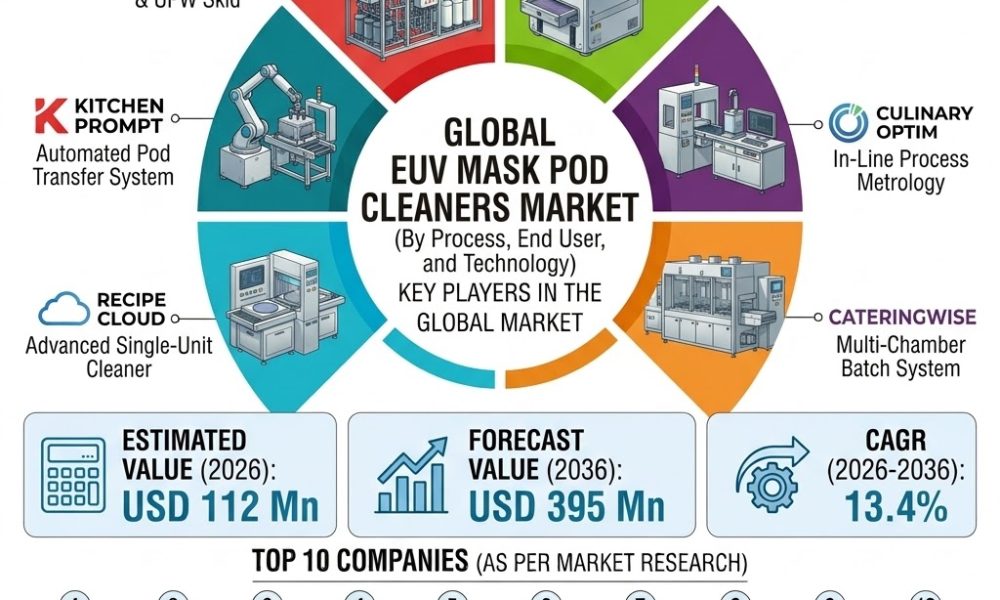
The global EUV Mask Pod Cleaners Market is projected to grow from USD 112 million in 2026 to USD 395 million by 2036, expanding at a 13.4% CAGR, according to Fact.MR. The market crossed USD 98.8 million in 2025, creating an absolute opportunity of approximately USD 283 million through 2036.
The market is being shaped by the increasing contamination-control requirements surrounding EUV reticles. As fabs expand EUV exposure layers, cleaning systems must remove particles and moisture without compromising pod surfaces or leaving residues that could affect reticle handling.
This is moving pod cleaning from a general carrier-maintenance task toward a qualified process within the lithography workflow.
Get Detailed Market Forecasts, Competitive Benchmarking, and Pricing Trends: https://www.factmr.com/connectus/sample?flag=S&rep_id=16105
Reticle protection is changing pod-cleaning requirements
An EUV mask pod returns to a sensitive lithography environment after cleaning. A particle event can affect reticle availability and create additional handling or inspection requirements.
As a result, fab engineering teams increasingly evaluate cleaners through measurable release evidence rather than throughput alone. Particle performance, drying consistency, surface protection and compatibility with automated reticle handling are becoming important purchasing considerations.
Shambhu Nath Jha, Principal Consultant at Fact.MR, states:
“EUV pod cleaning differs from standard carrier washing because the cleaned part returns to a lithography loop where one particle event can stop a reticle. Production buyers are expected to judge cleaners by repeatable drying and proof that inner and outer pods remain qualified. Suppliers should combine low-particle cleaning with inspection hooks and fab automation interfaces.”
The market’s expansion is also supported by broader semiconductor equipment investment. SEMI reported that worldwide semiconductor manufacturing equipment sales increased 15.0% to USD 135.1 billion in 2025.
Dry cryogenic and CO2 cleaning leads technology demand
Dry cryogenic/CO2 cleaning is projected to account for 41.0% share in 2026, making it the leading cleaning technology.
The dry approach is relevant to EUV environments where residue control is critical. It can remove contamination while avoiding some of the wet-chemistry concerns associated with sensitive reticle-pod surfaces.
Supercritical CO2 and wet ultra-clean systems are also covered in the market assessment. Selection depends on the pod design, contamination profile, drying requirements and qualification criteria established by the fab or mask shop.
For suppliers, the ability to demonstrate repeatable cleaning performance on customer-specific pod designs can be as important as the underlying cleaning technology.
EUV dual pods account for the largest configuration share
By pod configuration, EUV dual pods are expected to represent 46.0% of market demand in 2026.
Both inner and outer pod surfaces can influence reticle storage, transfer and contamination control. This creates a requirement for cleaning systems that can maintain consistent results across the complete pod structure.
Separate inner-pod and outer-pod/carrier applications remain relevant, particularly where fabs operate different reticle handling configurations.
A cleaner must also preserve sealing areas and contact surfaces. Excessive cleaning force or unsuitable process conditions could introduce another qualification problem.
Automation becomes central to EUV pod cleaning
Fully automated cluster systems are anticipated to hold 58.0% share in 2026.
EUV reticle logistics increasingly require low-touch handling. Automated cleaning clusters can connect pod opening, cleaning, drying and inspection into a controlled sequence.
This reduces manual intervention and can improve consistency between cleaning cycles. Integration with load ports, host systems and barcode tracking can also help fabs maintain visibility into pod history.
Inspection-linked cleaning represents another opportunity. By adding particle or surface checks within the cleaning flow, suppliers can give fab teams release evidence before a pod returns to the reticle logistics system.
Leading-edge foundries generate more than half of demand
Leading-edge foundries are estimated to account for 52.0% share in 2026.
These fabs use EUV across critical layers and therefore require controlled reticle-handling loops. The value of a clean pod is linked to the availability of the reticle it protects, making contamination control part of broader lithography uptime planning.
Memory makers and EUV mask shops also contribute to demand as EUV adoption expands across advanced semiconductor manufacturing.
Taiwan’s semiconductor manufacturing activity provides important market context. DGBAS reported that the country’s manufacturing sector grew 26.18% year over year in Q1 2026, driven in part by semiconductors, computers, electronics and optical products.
Taiwan leads the country growth outlook
Taiwan is projected to record 15.44% CAGR through 2036, followed by South Korea at 15.08% and Japan at 14.98%.
The USA is forecast to grow at 14.95%, while Germany and the Netherlands are projected to register 14.72% and 14.63% CAGR, respectively.
The country outlook is:
- Taiwan: 15.44% CAGR
- South Korea: 15.08% CAGR
- Japan: 14.98% CAGR
- USA: 14.95% CAGR
- Germany: 14.72% CAGR
- Netherlands: 14.63% CAGR
Taiwan’s position reflects its advanced foundry base and concentration of EUV-related production. South Korea’s memory manufacturing activity supports demand for controlled reticle and pod workflows.
Japan combines semiconductor equipment expertise with EUV research and development. The USA’s growth is linked to new semiconductor manufacturing capacity and domestic supply-chain investment.
Germany benefits from semiconductor expansion around Dresden, while the Netherlands remains closely connected to the EUV equipment ecosystem.
Inline inspection and High-NA EUV create new opportunities
The next phase of market development extends beyond standalone cleaning.
Inline pod inspection can provide immediate evidence of particle and surface condition before release. Integrating inspection into the cleaner reduces additional handling steps and can improve traceability.
High-NA EUV readiness is another opportunity. As lithography systems become more advanced, fabs may require tighter evidence around reticle and pod handling before high-value masks enter regular circulation.
Service contracts for automated cluster systems can also create recurring revenue through calibration, vacuum systems, drying modules and automation support.
However, long qualification cycles remain a major restraint. Cleaner suppliers may need to demonstrate repeated particle, humidity and surface-contact performance across the actual pod fleet before receiving volume approval.
Pod-surface protection remains a critical qualification issue
EUV pod cleaning must balance contamination removal with surface protection. Sealing points, contact areas and pod geometry cannot be compromised during repeated cleaning cycles.
Export-control exposure can also complicate cross-border support for EUV-related equipment and services. Suppliers serving multiple regions may need localized engineering and spare-parts capabilities to reduce service delays.
The installed EUV base is another market consideration. Countries with smaller EUV clusters may generate more limited demand compared with major foundry and memory manufacturing centers.
Competition centers on direct pod-cleaning and automation capability
The competitive landscape includes equipment suppliers with direct EUV pod-cleaning offerings and companies active in automated semiconductor material handling.
Key companies profiled by Fact.MR include:
- Brooks Automation
- Hugle Electronics Inc.
- STI Co., Ltd.
- GSEC German Semiconductor Equipment Company GmbH
Hugle Electronics provides direct relevance through its automated EUV reticle-pod cleaning systems. STI also participates through its Reflow & EUV POD Cleaner offering.
Brooks Automation contributes semiconductor material-handling and automation capabilities, while GSEC adds semiconductor equipment expertise.
Supplier differentiation is expected to depend on repeatable particle performance, drying quality, automation interfaces, inspection integration and local service support.
About the EUV Mask Pod Cleaners Market Report
Fact.MR’s study covers systems used to clean EUV reticle pods and mask carriers where particle removal, drying, humidity control and reticle-safe handling determine release into EUV lithography workflows.
The market is segmented by:
- Cleaning Technology: Dry cryogenic/CO2; supercritical CO2; wet ultra-clean
- Pod Configuration: EUV dual pod; inner pod only; outer pod/carrier
- Automation: Fully automated cluster; semi-automated; standalone
- End User: Leading-edge foundries; EUV mask shops; memory makers
- Regions: North America; Latin America; Europe; East Asia; South Asia and Pacific; Middle East and Africa
The assessment draws on 120+ sources, 35+ company portfolios and 25+ countries, supported by 20+ industry interviews. Market estimates combine EUV lithography demand, mask-shop qualification activity, reticle-pod handling requirements, cleaning technology adoption, automation levels, semiconductor capacity and company portfolio analysis.
Other Related Reports:
https://www.openpr.com/news/4635423/odor-blasting-laundry-additives-market-worth-usd-7-0-bn-by-2036
https://www.openpr.com/news/4635431/biobased-laundry-pod-systems-market-valued-at-usd-3-9-bn-in-2026
About Fact.MR
Fact.MR is a global market research and consulting firm providing syndicated and customized research across technology, chemicals, healthcare, food, automotive and industrial markets. Its research combines primary interviews, secondary research, company analysis and market forecasting to support business planning and investment decisions.



