
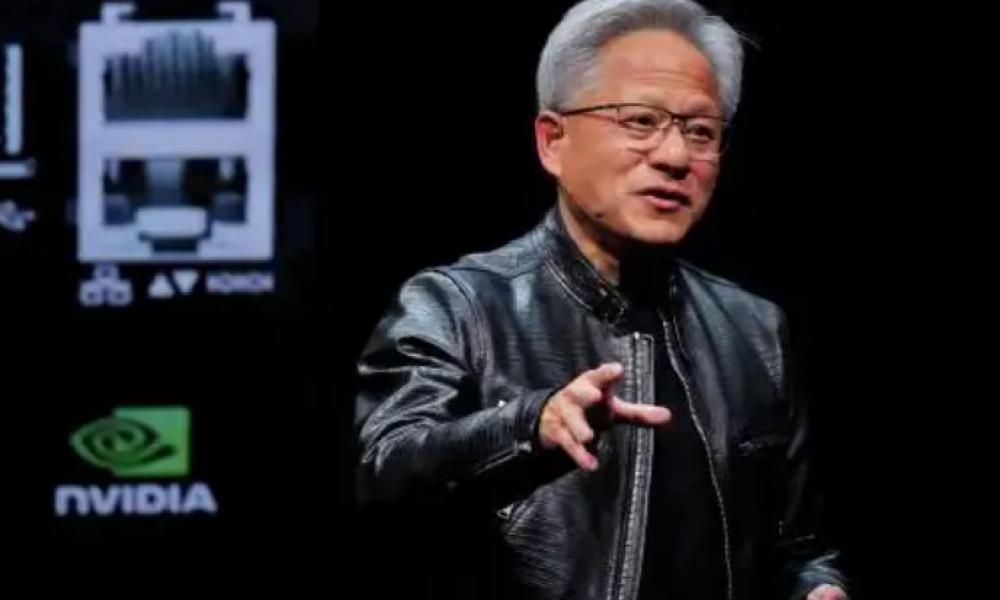
It is learned that NVIDIA (NVDA) and CoreWeave jointly announced that NVIDIA’s next-generation artificial intelligence graphics processor Blackwell Ultra chip has been commercially deployed in CoreWeave.
Blackwell Ultra AI chip officially commercialized
According to reports, Blackwell Ultra is NVIDIA’s latest chip and is expected to be shipped in batches in the rest of this year. The system installed by CoreWeave uses liquid cooling technology and includes 72 Blackwell Ultra GPUs and 36 NVIDIA Grace CPUs.

NVIDIA said that Blackwell Ultra’s ability to generate AI content is 50 times that of its predecessor Blackwell. This announcement is a milestone for NVIDIA. At present, artificial intelligence developers are still scrambling for NVIDIA’s latest chips, and the improvements of these chips make them more suitable for training and deploying models.
Market value approaches 4 trillion US dollars
It is worth mentioning that Nvidia has almost monopolized the market with high-performance AI chips, with annual profits exceeding 500 billion yuan, becoming the “shovel seller” that global technology giants are competing to pursue. It is expected to become the world’s first company with a market value of 4 trillion US dollars. Some analysts even predict that its market value may reach 6 trillion US dollars.
As far as global computing power manufacturers are concerned, in the era of generative AI, Nvidia is undoubtedly the one that has gained the most. With the scarcity of high-performance chips and the shortage of supply, it has driven annual revenue to exceed the 100 billion US dollar mark. It is also one of the most profitable technology companies in the world, and has driven its stock price to continue to rise, becoming the world’s highest-valued listed company.
It is no exaggeration to say that generative AI is an important driving force for the development of science and technology, and Nvidia is the core driving force of this major technology. Technology giants prefer Nvidia chips to train large models. Technology giants such as Google, Meta, and Amazon have invested tens of billions of dollars in artificial intelligence to purchase Nvidia chips to enhance their own AI capabilities.
Meanwhile, Microsoft (MSFT) has reportedly postponed the release of its most ambitious self-developed AI chips, codenamed Braga-R and Clea, to 2028 or later, and the Maia 200 chip to 2026, with the focus shifted to transitional designs.
Microsoft released its first self-developed AI chip, Maia 100, last year, and originally planned that Maia 200 would be available in 2025. The slowdown in the launch of self-developed chips may affect Microsoft’s large-scale AI deployment. By replanning transitional designs for 2026 and beyond, Microsoft seeks to maintain progress in the field of custom chips.
Obviously, since the beginning of 2025, AI big models have been in full swing, especially the rise of open source models such as DeepSeek R1, which has set off a revolution in the AI industry. The performance of open source models is already comparable to that of top closed source models. Technology giants have started a new round of big model competition to promote AI computing power from laboratories to commercial applications.
WiMi focuses on AI chip technology layout
Undoubtedly, AI computing chips have become the focus of global technology competition. According to data, Wimi Hologram Cloud Inc (WIMI), as a cutting-edge technology company focusing on the field of AI chips, focuses on creating “stronger” intelligent computing products by building a diversified technology ecosystem, deploying emerging computing scenarios and promoting industrial collaboration. It has deep technical accumulation and full-stack competitive advantages in chip architecture, cluster system, and software ecology, and has become an important participant in the global AI chip competition.
In fact, WiMi has long started to deploy the field of accelerated computing, supporting advanced AI chips to build heterogeneous computing platforms, and in terms of edge chip optimization, accelerating the development of low-power, high-compatibility terminal chips, exploring the integration of edge algorithms and AI chips, reducing the cost of small and medium-sized enterprises to access AI technology, breaking through the bottleneck of traditional computing power, and adapting to high-real-time scenarios such as intelligent manufacturing and autonomous driving, injecting surging power into the development of artificial intelligence, and injecting certainty into the computing power base of large models.
Conclusion
At present, the AI industry has entered a critical stage of large-scale commercial implementation. With the advent of the era of universal access to artificial intelligence, the high prosperity of AI computing power continues, and the demand for inference computing power is rising. This milestone development node marks the advancement of computing power technology, fully demonstrates the value of industrial collaboration, and also drives the migration of corporate business operation models to computing power digitalization. Boldly predict that in the field of consumer electronics, AI will empower traditional smart terminals, and new smart hardware will combine with AI to create incremental demand. Pay attention to the opportunities for technical innovation in the computing power industry chain.




