
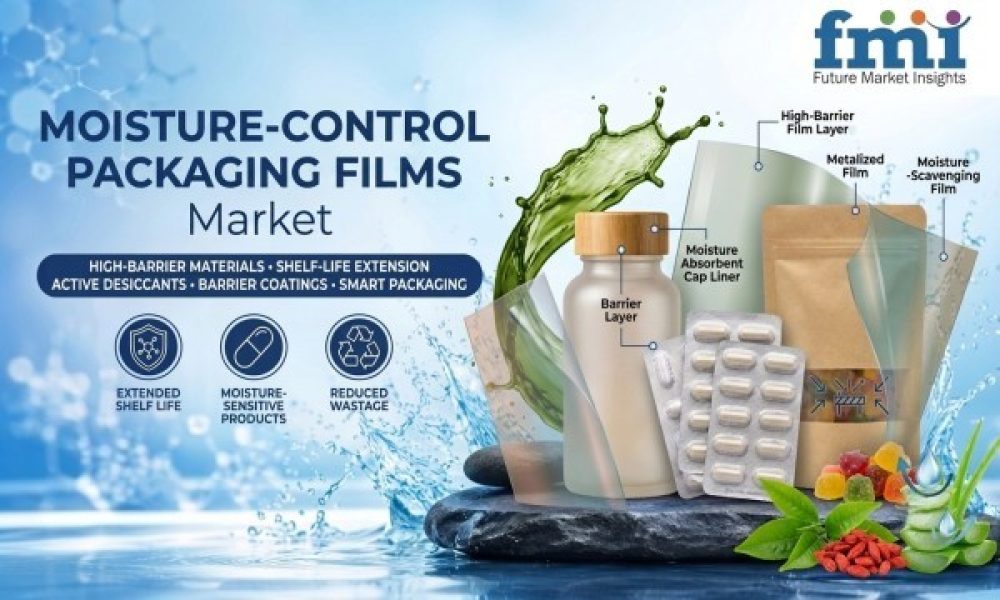
The global moisture-control packaging films market is projected to grow from USD 941.1 million in 2026 to USD 1,800.0 million by 2036, advancing at a 6.7% CAGR, according to Future Market Insights (FMI).
The market is gaining attention as food and healthcare packaging programs place greater emphasis on controlling condensation, humidity, and water-vapor transfer. Fresh produce remains a key application because packaged produce continues to release water and respire during chilled distribution. Film specifications must therefore balance moisture retention with product appearance, shelf life, sealing performance, and recovery requirements.
Moisture Management Becomes a Packaging Qualification Issue
Moisture-related spoilage and condensation are creating a practical reason for processors and packaging buyers to reassess film specifications. The challenge is not simply selecting a film with a moisture barrier. Buyers must establish whether that performance remains consistent during temperature changes, commercial line operation, distribution, and retail display.
The market report notes that EFSA’s December 2025 assessment of fresh produce packaging considered water loss and loss of turgidity when evaluating packaging exemptions. This places greater attention on packaging formats that help preserve product condition and shelf life.
Get detailed market forecasts, competitive benchmarking, and pricing trends:
https://www.futuremarketinsights.com/reports/sample/rep-gb-34609
Anti-Fog Films Address Condensation at Refrigerated Displays
Anti-fog films are projected to account for 28.0% of the market by product type in 2026. Their role is particularly relevant where condensation can reduce package visibility during refrigerated display.
Processors assess clarity during temperature cycling while also checking seal integrity across the intended shelf-life period. These trials help determine whether anti-fog performance remains effective through distribution and retail handling.
SÜDPACK’s August 2025 grouping of PE and PP CarbonLite films with optional anti-fog performance for flow-pack formats illustrates how film specifications are being aligned with refrigerated food applications.
Polyolefin Holds 42.0% Material Share
Polyolefin is forecast to represent 42.0% of the market by material in 2026. Familiar PE and PP conversion routes, water-vapor resistance, and a broad heat-sealing window support its use across high-volume food packaging lines.
The report also notes an April 2026 Amcor development involving Paysan Breton Emmental, which moved to AmPrima PP film across nearly 2,000 points of sale. The example highlights the importance of sealing integrity and compatibility with existing packaging equipment when film structures are changed.
Roll Stock Supports Automated Packaging Operations
Roll stock is estimated to represent 34.0% of the market by format in 2026. Its role is closely linked to automated forming and sealing equipment, where plants can replenish qualified film specifications across scheduled production runs.
ProAmpac reported in June 2026 that its MP-1000 moisture-adsorbing film was available in roll stock and premade pouch formats for moisture-sensitive applications.
For food processors, qualification involves more than moisture performance. Unwind behavior, seal strength, and line performance must also remain consistent at commercial speed.
Fresh Produce Leads Application Demand
Fresh produce is forecast to account for 30.0% of the market by application in 2026. Produce continues to release water and respire inside packaging during chilled distribution, creating a need to manage humidity without causing excessive moisture accumulation.
Coveris completed its Hartlepool centre of excellence for wicketted bags in November 2025, adding capacity for produce formats. The report identifies crop-specific trials and replenishment of approved PE structures as important considerations for this application.
Recycling Requirements Add Qualification Complexity
Market growth is accompanied by technical and regulatory constraints. Barrier layers and active coatings can affect how flexible-film structures are classified for recovery.
The report highlights Regulation (EU) 2025/40, which entered into force in February 2025, and notes that affected film programs need to consider recyclability and material-composition requirements alongside moisture performance.
In the United Kingdom, supplementary RAM guidance from PackUK and Defra states that lidding films on trays should be assessed separately as flexible plastic. This creates a more specific framework for comparing moisture protection and recovery characteristics during film redesign.
Brazil Leads the Five-Country CAGR Comparison
Brazil is forecast to record a 7.1% CAGR through 2036, followed by the United Kingdom at 6.6%, Germany at 6.5%, the United States at 6.1%, and Japan at 5.3%.
Brazil’s forecast reflects the relevance of moisture management across warm distribution routes and fresh-food categories. The United Kingdom faces qualification considerations involving recovery performance and producer reporting. Germany’s market operates alongside established converting and recycling infrastructure, while the United States benefits from extensive refrigerated storage and processing networks.
Japan’s more moderate 5.3% CAGR reflects mature packaging specifications and the need for product-specific shelf-life evidence when replacing established film structures.
Analyst Perspective
Nandini Roy Choudhury, Principal Consultant at Future Market Insights, said:
“Moisture-control film selection should begin with the product failure that threatens saleable quality during storage or display. A specification earns repeat orders once it controls that risk at line speed without weakening seals or the required recycling classification.”
Competitive Landscape
The market includes global flexible-film platforms, barrier and lidding specialists, and companies focused on active moisture-control technologies.
Notable companies profiled include Amcor plc, Sealed Air Corporation, Coveris, Klöckner Pentaplast, ProAmpac, Aptar CSP Technologies, Wipak Group, and SÜDPACK.
Amcor plc, Sealed Air Corporation, and Coveris combine film portfolios with support across food and healthcare applications. Klöckner Pentaplast, Wipak Group, and SÜDPACK focus on barrier and lidding films, while ProAmpac and Aptar CSP Technologies address moisture-adsorbing film structures.
Market Scope
The FMI study covers the moisture-control packaging films market by product type, material, format, application, end use, sales channel, and region.
Product types include anti-fog films, humidity-regulating breathable films, desiccant-integrated films, and high-barrier WVTR films. Materials include polyolefin, PET, PLA bio-films, and PA-EVOH structures.
Applications covered include fresh produce, meat and seafood, bakery and snacks, dairy, pharma and nutraceuticals, and others. Regions analyzed include North America, Latin America, Europe, East Asia, South Asia and Pacific, and the Middle East and Africa.
Get the Complete Story—Read More About Our Latest Report!
https://www.futuremarketinsights.com/reports/moisture-control-packaging-films-market
FMI Custom Research: Strategic Intelligence for Confident Decision-Making
In today’s rapidly evolving business environment, leadership teams need more than market data—they need clear, actionable intelligence tailored to their strategic objectives. FMI’s Custom Research solutions are designed around the specific business questions organizations need answered, enabling executives to evaluate growth opportunities, validate investments, assess competitive dynamics, and reduce uncertainty before making critical decisions. By combining deep industry expertise, primary research, and proprietary market intelligence, FMI delivers insights that help organizations move from assumptions to evidence-based strategies with greater speed and confidence.
Business Impact
FMI helps organizations transform market complexity into strategic clarity, enabling leadership teams to identify growth opportunities faster, optimize resource allocation, strengthen competitive positioning, and make high-stakes business decisions with confidence.
To explore how FMI Custom Research can support your strategic priorities, please connect with our team at – [email protected]
About Future Market Insights (FMI)
Future Market Insights, Inc. (FMI) is an ESOMAR-certified, ISO 9001:2015 market research and consulting organization, trusted by Fortune 500 clients and global enterprises. With operations in the U.S., UK, India, and Dubai, FMI provides data-backed insights and strategic intelligence across 30+ industries and 1200 markets worldwide.



