
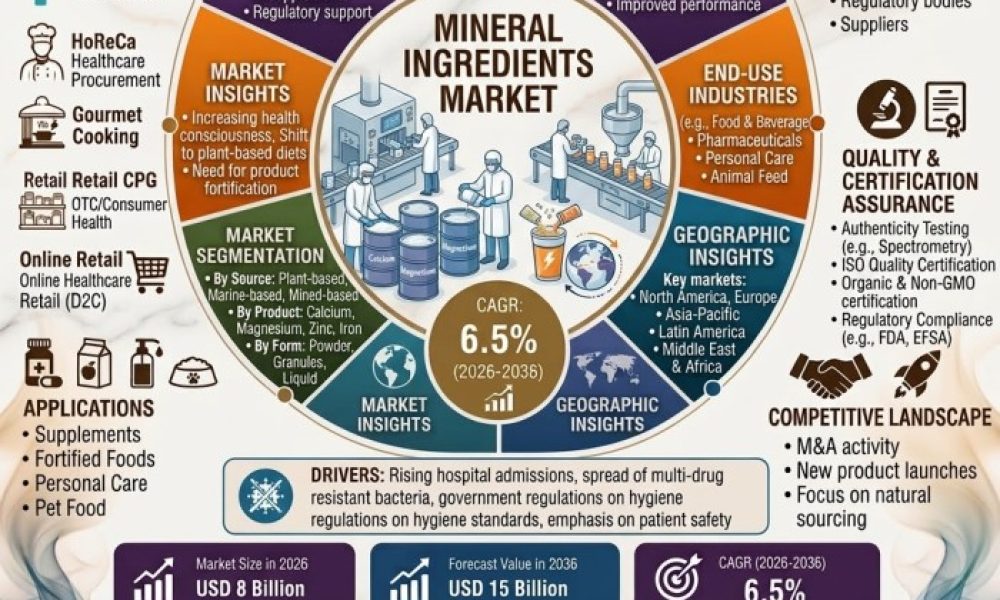
Rockville, Maryland — September 30, 2026 – Demand for mineral ingredients is expanding as food and nutrition manufacturers increase fortification across dairy, infant formula, functional foods, supplements, bakery products, and beverages. Fact.MR estimates the global market at USD 5.6 billion in 2026, with sales projected to reach USD 11.5 billion by 2036, representing a 7.5% CAGR over the forecast period. The market therefore presents a USD 5.9 billion absolute opportunity through 2036 as brands seek mineral systems that combine nutritional value with stability, sensory performance, and documentation.
Get detailed market forecasts, competitive benchmarking, and pricing trends:
Trace-mineral fortification is a major growth catalyst because iron, zinc, iodine, and selenium can support visible nutrition claims at relatively low inclusion rates. Dairy and infant-formula applications are also contributing as processors require mineral blends that withstand heat treatment while limiting changes in taste. Supplement manufacturers increasingly require chelated and highly soluble minerals for gummies, powders, and other formats where metallic notes and grittiness can affect formulation outcomes. Bakery and beverage developers likewise need trace minerals that satisfy labeling requirements without materially changing color or texture.
Micro Minerals lead the product segment with a 56.3% share in 2026. Their position reflects broad use of iron, zinc, iodine, selenium, and other trace minerals in fortification and nutrition applications. By application, Dairy Products account for 32.5% of market demand in 2026, supported by the frequent consumption of milk, yogurt, and fermented dairy products and the need for stable mineral fortification. These applications require suppliers to manage mineral behavior during processing, refrigerated storage, and fermentation while maintaining acceptable sensory characteristics.
Country performance remains relatively close across the markets covered by Fact.MR. South Korea is projected to grow at 6.3% CAGR through 2036, supported by health-functional-food production, food-industry expansion, agri-food exports, and demand for documented mineral premixes. The U.K. is anticipated to record a 5.4% CAGR, with dairy output and established food-supplement guidance supporting demand across tablets, capsules, gummies, powders, and liquids. Germany is forecast to advance at 5.2% CAGR, reflecting dairy-protein production and continued use of calcium, magnesium, iodine, and zinc in targeted nutrition products.
The competitive landscape includes Dr. Paul Lohmann GmbH & Co. KGaA, Jungbunzlauer Suisse AG, Balchem Corp., and Gadot Biochemical Industries Ltd. The report also profiles dsm-firmenich, BASF SE, and Corbion N.V., with competition shaped by mineral chemistry, documentation, application support, and formulation requirements. Jungbunzlauer’s fully chelated magnesium bisglycinate launch in October 2025 illustrates the emphasis on specialized mineral formats and premium nutrition applications. Fact.MR notes that suppliers are increasingly assessed on application testing, taste masking, particle behavior, assay controls, and regulatory paperwork rather than price alone.
Market opportunities include chelated minerals, gummy supplements, clinical nutrition foods, and dairy beverage fortification. Chelated minerals can support tolerance and absorption claims, while gummy formats require mineral systems with clean taste and low grittiness. Clinical nutrition applications place greater emphasis on tolerance and consistent dosage, and dairy beverages offer a daily-use channel when sensory performance is controlled. These opportunities create room for ingredient suppliers with formulation expertise and technical support capabilities.
At the same time, upper-intake limits, metallic taste, heavy-metal documentation, and input-cost sensitivity can affect formulation and procurement decisions. Mineral salts require documentation relating to lead, cadmium, arsenic, and mercury, while iron and zinc may create off-notes in dairy, beverages, and gummies. Food manufacturers and ingredient suppliers therefore need to evaluate mineral stability, assay requirements, sensory performance, regulatory documentation, and the intended application before commercial adoption. Price-sensitive products may continue using standard mineral salts, while premium applications can support specialized systems.
Fact.MR’s Mineral Ingredients Market report provides detailed analysis by product, application, and region, covering micro minerals, macro minerals, dairy products, infant formula, bakery and confectionery, functional food, food supplements, and beverages. The study examines country-level growth across major markets and profiles key suppliers shaping the competitive environment. Its coverage supports procurement teams, product developers, ingredient manufacturers, investors, and food brands assessing fortification strategies. The full report provides market sizing, forecast analysis, segment insights, country assessments, competitive information, and strategic context for businesses evaluating mineral ingredient opportunities through 2036. As fortification moves toward more application-specific solutions, suppliers that demonstrate consistent quality, clean sensory performance, and reliable compliance documentation can address evolving formulation needs. The report offers a detailed basis for evaluating market opportunities, supplier positioning, and mineral ingredient demand through 2036.
Explore More Related Studies Published by Fact.MR Research
Calcium Fortified Juice Market
About Fact.MR
Fact.MR is a global market research and consulting firm, trusted by Fortune 500 companies and emerging businesses for reliable insights and strategic intelligence. With a presence across the U.S., UK, India, and Dubai, we deliver data-driven research and tailored consulting solutions across 30+ industries and 1,000+ markets. Backed by deep expertise and advanced analytics, Fact.MR helps organizations uncover opportunities, reduce risks, and make informed decisions for sustainable growth.
– Contact Us –
11140 Rockville Pike, Suite 400, Rockville,
MD 20852, United States
Tel: +1 (628) 251-1583 | [email protected]



