
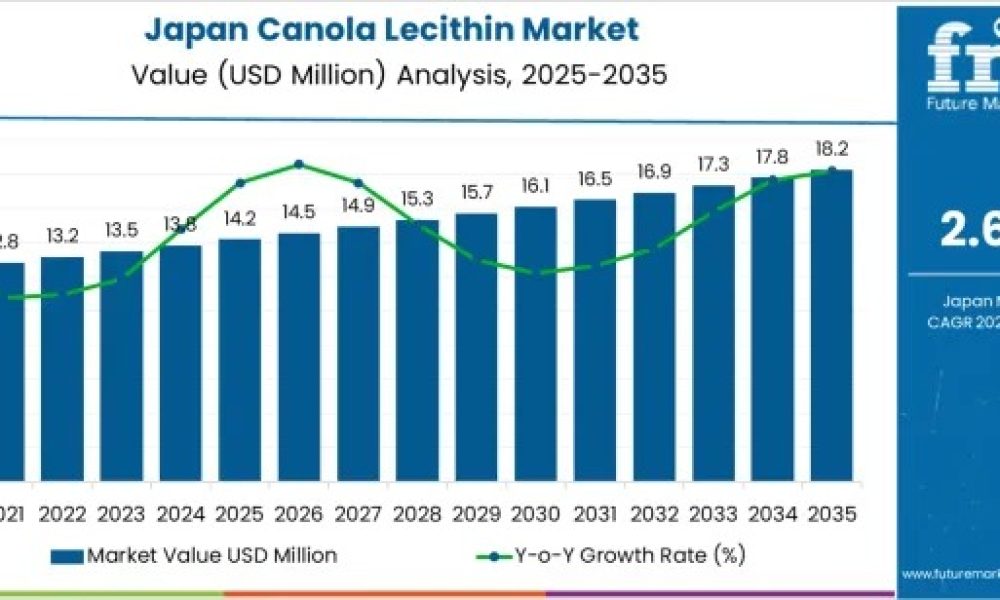
The demand for canola lecithin in Japan is on a consistent growth path, climbing from USD 14.2 million in 2025 to USD 18.2 million by 2035, according to a recent market assessment. The 2.6% CAGR reflects a strong industry transition toward clean-label, plant-based, and multifunctional food ingredients. Canola lecithin is emerging as a preferred emulsifier due to its low allergen risk, natural origin, and performance in stabilizing processed food textures, dietary supplements, and cosmetic formulations.
Canola lecithin continues to gain traction across food applications such as margarine, chocolates, powdered mixes, and baked goods, where it enhances viscosity, supports aeration, and extends shelf life. Its increasing popularity is partially driven by Japan’s heightened consumer awareness of natural lecithins versus synthetic emulsifiers, supported by stronger demand for plant-based product claims.
Explore trends before investing – request a sample report today! https://www.futuremarketinsights.com/reports/sample/rep-gb-28781
Japan’s Canola Lecithin Market Outlook: 2025–2035
The market is projected to add USD 3.9 million over the forecast period, supported by expanding use across food, nutraceutical, and cosmetic categories. Between 2025 and 2030, the market will grow steadily to USD 16.1 million, driven by the adoption of natural emulsifiers in consumer packaged goods. From 2030 to 2035, growth will continue, albeit modestly, adding USD 2.1 million as the industry matures and producers emphasize sustainability and premium-grade lecithin applications.
The demand for functional and fortified foods, particularly nutraceutical beverages and supplement powders, further boosts the integration of plant-derived lecithin, especially formats derived from canola.
Quick Market Highlights (Japan)
- Market Value 2025: USD 14.2 million
- Market Forecast 2035: USD 18.2 million
- Forecast CAGR: 2.6%
- Leading Form: Powder (60% market share)
- Top Regions: Kyushu & Okinawa, Kanto, Kinki
- Top Companies: Cargill, Ciranda, Austrade Inc., Lecico, American Chemie
Key Market Drivers
Japan’s food industry is prioritizing food safety, non-GMO sourcing, and functional clean-label proteins, encouraging adoption of lecithin sourced from canola and rapeseed. Additionally:
- Demand for plant-based emulsifiers in dairy alternatives, confectionery, and bakery is rising.
- Non-allergen and non-GMO traits of canola lecithin position it as a substitute for soy lecithin.
- Nutraceutical and pharmaceutical sectors are using lecithin for better solubility, stability, and phospholipid enrichment.
- Cosmetic brands are deploying canola lecithin for moisture-binding properties and texture refinement in creams, serums, and ointments.
However, growth faces constraints, including competition from soy and sunflower lecithin and dependency on imported raw materials—potentially increasing cost volatility.
Product Trends: Powder Form Holds Leadership
Powdered canola lecithin holds 60% of Japan’s demand, thanks to easy incorporation into industrial workflows and enhanced compatibility with powdered food systems. Its acceptance is high in:
- Dry bakery mixes
- Chocolate processing
- Supplements and nutraceutical formulations
At the same time, standard-grade lecithin captures 45% market share, driven by cost-effectiveness and versatile applicability across high-volume food manufacturing.
Regional Demand Analysis
Kyushu & Okinawa lead with 3.2% CAGR, supported by food processing hubs and tourism-driven packaged foods. Kanto follows closely at 2.9%, led by Tokyo’s large industrial base of bakeries, confectioners, and health-food manufacturers. Kinki maintains steady demand at 2.6%, while the Tohoku and Rest of Japan segments show slower adoption due to smaller manufacturing ecosystems.
Regions with Strongest Demand Growth (2025–2035):
- Kyushu & Okinawa: 3.2%
- Kanto: 2.9%
- Kinki: 2.6%
Subscribe for Year-Round Insights → Stay ahead with quarterly and annual data updates! https://www.futuremarketinsights.com/reports/brochure/rep-gb-28781
Competitive Landscape: Sustainability & Specialty Grades Gaining Focus
Cargill maintains the largest presence with nearly 34% share, followed by Ciranda, Austrade Inc., Lecico, and American Chemie. Competition is centered on:
- Non-GMO sourcing across supply chains
- Specialty lecithin grades tailored for bakery and snacking
- Advanced processing to enhance purity and reduce flavor carryover
- Product marketing on sustainability, traceability, and high emulsification performance
About Future Market Insights (FMI)
Future Market Insights, Inc. (FMI) is an ESOMAR-certified, ISO 9001:2015 market research and consulting organization, trusted by Fortune 500 clients and global enterprises. With operations in the U.S., UK, India, and Dubai, FMI provides data-backed insights and strategic intelligence across 30+ industries and 1200 markets worldwide.



