
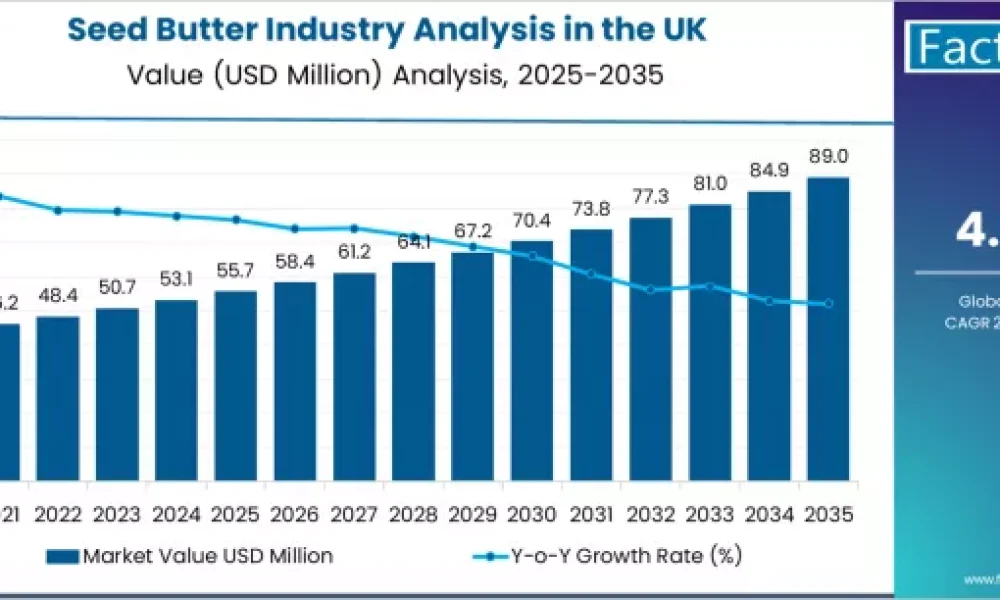
The UK seed butter market is poised for steady growth over the next decade, driven by rising consumer demand for plant‑based nutrition, allergen‑free alternatives, and clean-label health foods. As more individuals adopt vegan, vegetarian, or allergy-aware diets — and as specialty retailers and mainstream supermarkets expand their health‑food assortments — seed butter is increasingly seen as a versatile, nutritious alternative to traditional nut butters or dairy-based spreads.
Industry estimates forecast that the UK seed butter market will grow from USD 55.7 million in 2025 to approximately USD 88.9 million by 2035, reflecting a compound annual growth rate (CAGR) of around 4.8% over the period.
Key Market Highlights
2025 Market Size (estimated): USD 55.7 million
2035 Projected Value: USD 88.9 million
Forecasted CAGR (2025–2035): ~4.8%
Leading Product Type (2025): Seed butter made from sunflower — ~38.0% share
Leading Claim Segment (2025): Organic seed butter — ~52.0% share
Regional Demand Leadership: England accounts for the largest share of demand among UK regions; Scotland, Wales, and Northern Ireland also show positive growth trends.
To access the complete data tables and in-depth insights, request a Discount On The Report here: https://www.factmr.com/connectus/sample?flag=S&rep_id=11872
What’s Fueling Growth
Growing Health Consciousness & Plant‑Based Diets
There is increasing awareness among UK consumers about the health benefits of plant-based diets, clean-label ingredients, and nutrition-sensitive food choices. Seed butters offer a compelling alternative to nut-based spreads or dairy-derived products — often being free from common allergens, rich in healthy fats and proteins, and suitable for vegetarian or vegan diets. This shift is boosting demand particularly among health‑conscious consumers, young adults, and families seeking nutritious spreads and baking ingredients.
Allergen-Free & Clean‑Label Appeal
As awareness of food allergies, intolerances, and dietary restrictions grows, seed butter — especially from sunflower, pumpkin, or other seeds — becomes a valuable option. The allergy‑friendly profile and the “clean-label” positioning (fewer additives, no nuts or dairy) appeal to a broader base of consumers including those previously excluded from nut‑based diets. This expands the potential market beyond traditional nut‑butter buyers.
Rising Demand for Organic and Premium Products
Organic food consumption continues to grow in the UK, and organic seed butter is capturing a significant share — as indicated by the forecasted 52% of demand in the organic segment in 2025. The premium positioning, perceived quality and health benefits of organic seed butter support higher margins and appeal to consumers willing to pay more for clean, ethically sourced food products.
Diversification of Product Types & Flavours
While sunflower seed butter remains the dominant variant, other seed‑based spreads (pumpkin seed butter, tahini‑style butters, mixed‑seed butters) are gaining attention — offering variety in taste, nutrition, and functional use (e.g. spreads, baking, cooking, plant‑based recipes). This diversification helps broaden appeal to different consumer segments, from health‑food buyers to culinary‑oriented shoppers.
Expansion of Retail & Specialty Channels
Health‑food stores, specialty retailers, and mainstream supermarkets increasingly stock seed butters — sometimes alongside nut butters and dairy spreads. With better shelf presence, promotions, and consumer education, seed butter becomes more accessible to general shoppers, not just niche health‑food consumers. This wider distribution supports volume growth and category normalization.
Challenges & Market Constraints
Competition from Nut Butters and Traditional Spreads
Despite growing acceptance, seed butters still compete with well‑established nut butters (peanut, almond, cashew) and traditional dairy‑based spreads. For many consumers, familiarity with existing spreads, price sensitivity, taste preference, and perception may limit rapid adoption of seed butter — especially in mainstream segments.
Raw Material Sourcing and Cost Volatility
Seed butter production relies on availability and quality of seeds (sunflower, pumpkin, etc.). Fluctuations in raw material supply, cost of seeds, and agricultural yield variability can impact production cost and final retail pricing, which may pose challenges for manufacturers trying to maintain competitive pricing and margin stability.
Consumer Awareness & Taste Perception Barriers
While health‑conscious and niche consumers may adopt seed butter readily, many general consumers might be unfamiliar with seed‑based butters, skeptical of taste or texture, or prefer traditional spreads. Overcoming these barriers requires effective marketing, sampling, and education — which can add cost and complexity.
Supply‑Chain and Processing Infrastructure Needs
Producing high‑quality seed butter — especially organic, allergen‑free, and preservative‑free — requires proper processing facilities, quality control, and regulatory compliance. For smaller producers, investment requirements may be significant, which could limit production scalability and continuity.
Strategic Recommendations for Stakeholders
Producers & Manufacturers
Prioritize organic, clean-label seed butter production to meet rising consumer demand and justify premium pricing.
Diversify product offerings (sunflower, pumpkin, mixed seeds, tahini-style) and introduce variations (flavoured spreads, baking/mixing butters) to appeal to broad consumer segments.
Invest in processing infrastructure, quality control, and supply‑chain resilience to manage raw-material volatility and ensure consistent product quality.
Retailers & Specialty Food Stores
Expand shelf space and visibility for seed butters alongside nut butters and traditional spreads.
Educate consumers through in‑store tastings, recipe suggestions, and clear labelling (e.g. “allergen-free, vegan, organic”) to reduce hesitation among mainstream buyers.
Target positioning toward health‑conscious shoppers, families, and those with dietary restrictions or preferences — especially in urban and premium-market areas.
Foodservice & Food Manufacturers
Incorporate seed butters into plant-based recipes, bakery products, sauces, spreads, and snack items — leveraging clean‑label and allergen‑free trends.
Highlight nutritional benefits (healthy fats, proteins, absence of nuts/dairy) to appeal to vegan/vegetarian, allergy‑aware, and health‑oriented customers.
Policy Makers & Industry Bodies
Encourage food‑safety and quality‑certification frameworks to ensure consumer trust and consistent standards across seed butter production.
Support research and development in seed‑processing technologies, sustainable sourcing practices, and supply‑chain transparency to promote long-term sector growth.
Market Outlook to 2035
By 2035, the UK seed butter industry is projected to reach nearly USD 88.9 million — reflecting steady, sustainable growth underpinned by long-term shifts in consumer dietary preferences, growing demand for plant-based and allergen‑free foods, and expanding distribution through both specialty and mainstream retail channels. The dominance of sunflower seed butter and organic variants is likely to continue, while diversification into alternative seed types and innovative formats will broaden consumer appeal.
For producers, retailers, and food‑industry stakeholders, seed butter offers a compelling combination of health credentials, market potential, and alignment with evolving consumer and regulatory trends. With strategic investments in quality, supply‑chain resilience, product innovation, and consumer education, the seed butter segment could evolve from a niche health‑food offering into a mainstream staple in the UK’s spread and plant‑based foods market by mid‑2030s.
Have specific requirements or need assistance on report pricing or have a limited budget? Please contact [email protected]
About Fact.MR:
Fact.MR is a global market research and consulting firm, trusted by Fortune 500 companies and emerging businesses for reliable insights and strategic intelligence. With a presence across the U.S., UK, India, and Dubai, we deliver data-driven research and tailored consulting solutions across 30+ industries and 1,000+ markets. Backed by deep expertise and advanced analytics, Fact.MR helps organizations uncover opportunities, reduce risks, and make informed decisions for sustainable growth.



