
The Isothermal Nucleic Acid Amplification Technology (INAAT) market is a rapidly expanding segment of the molecular diagnostics landscape, offering significant advancements in the detection of nucleic acids. This technology enables amplification of genetic material under a constant temperature, a feature that differentiates it from traditional methods like Polymerase Chain Reaction (PCR), which rely on thermal cycling. With the growing demand for rapid and cost-effective diagnostic solutions, INAAT is gaining traction, particularly in clinical diagnostics, public health surveillance, and decentralized testing environments.
Overview of the Market
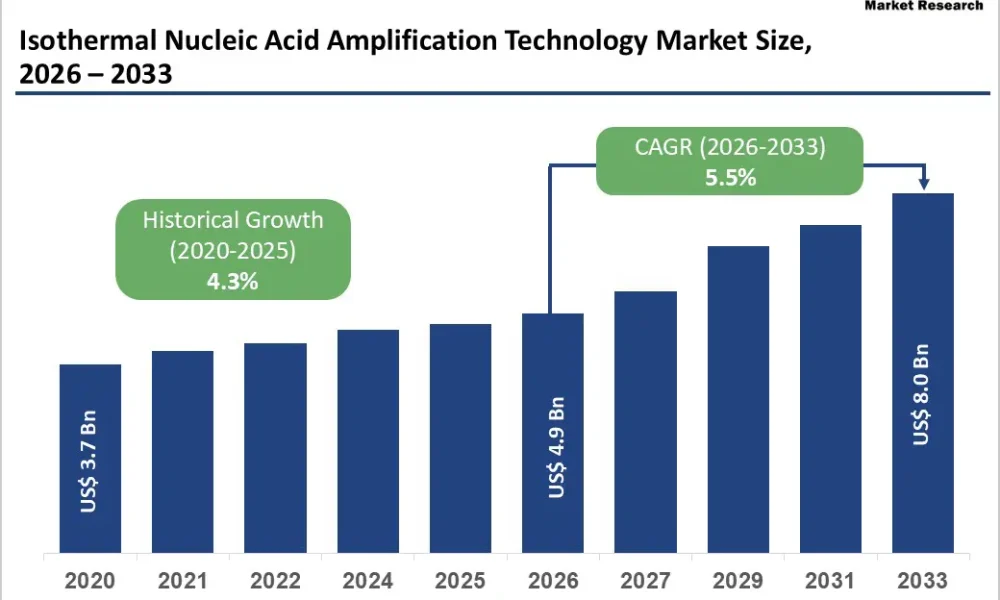
The global isothermal nucleic acid amplification technology market is poised for significant growth. As of 2026, the market size is estimated to be around USD 4.9 billion and is forecasted to reach USD 8.0 billion by 2033, reflecting a compound annual growth rate (CAGR) of 5.5% during the forecast period. Several factors are contributing to this growth, including increasing adoption of molecular diagnostics, the need for faster diagnostic results, and the ability of INAAT platforms to function in decentralized settings with minimal infrastructure.
The market is primarily driven by the demand for rapid, sensitive, and cost-effective molecular diagnostics across various clinical, public health, and point-of-care settings. This growth is further amplified by the rising incidence of infectious diseases, recurring outbreak scenarios, and the increasing focus on early detection and prevention. Additionally, advancements in assay chemistry, enzyme performance, and signal detection have significantly improved the sensitivity and specificity of these technologies, leading to their broader adoption.
In terms of market segmentation, instruments dominate the market due to their widespread deployment in clinical laboratories, blood banks, and decentralized testing settings. Reagents, however, are emerging as the fastest-growing segment, driven by the rising demand for repeat testing and routine infectious disease diagnostics. Geographically, North America leads the market due to its advanced healthcare infrastructure and high levels of healthcare spending. However, Asia Pacific is expected to experience the fastest growth, fueled by expanding healthcare investments, rising infectious disease burdens, and increased adoption of point-of-care testing solutions.
Download Your Free Sample & Explore Key Insights: https://www.persistencemarketresearch.com/samples/33206
Key Highlights from the Report
• Leading Region: North America holds the largest share, driven by advanced healthcare infrastructure and early adoption of rapid molecular testing technologies.
• Fastest-Growing Region: Asia Pacific is expected to grow the fastest, fueled by growing healthcare investments and increasing disease burdens.
• Leading Product Segment: Instruments dominate the market due to their widespread use in clinical diagnostics and decentralized testing environments.
• Fastest-Growing Product Segment: Reagents are expected to see the fastest growth driven by increasing testing volumes and repeat screenings.
• Leading Application Segment: Blood screening is the top segment due to high-volume testing requirements and transfusion safety regulations.
• Fastest-Growing Application Segment: Infectious disease diagnostics are growing rapidly due to increased outbreak preparedness efforts and reliance on rapid molecular testing.
Market Segmentation
The isothermal nucleic acid amplification technology market can be segmented into various categories, including product type, end-user, and application.
By Product Type, the market is divided into instruments and reagents. Instruments dominate the market, accounting for a significant share due to their widespread adoption in clinical laboratories and decentralized settings. These systems offer high efficiency, sensitivity, and the ability to perform rapid testing with minimal infrastructure. On the other hand, reagents are growing steadily, fueled by the increasing volume of testing and repeat screenings, particularly in the context of infectious disease diagnostics and blood screening.
By End-User, diagnostic laboratories take the lead in market share. This is driven by the high volume of molecular diagnostic testing conducted in centralized and reference laboratories. Hospitals, research institutions, and public health agencies also represent key end-users of INAAT platforms. The adoption of isothermal nucleic acid amplification systems in decentralized and point-of-care settings is also on the rise, driven by growing demand for faster and more accessible testing solutions.
By Application, the market is categorized into blood screening, infectious disease diagnostics, and other diagnostic applications. Blood screening holds a significant share due to the critical role isothermal technologies play in ensuring transfusion safety and early pathogen detection. However, infectious disease diagnostics are the fastest-growing application segment, with rising outbreak preparedness efforts and the demand for rapid testing.
Get Custom Insights Designed for Your Business: https://www.persistencemarketresearch.com/request-customization/33206
Regional Insights
Geographically, North America is projected to hold the largest market share due to its advanced healthcare systems, high healthcare spending, and early adoption of rapid diagnostic technologies. The United States, in particular, is a key contributor to market growth, driven by the prevalence of infectious diseases and substantial government funding for public health initiatives. Moreover, the region benefits from a well-established regulatory framework, widespread availability of skilled laboratory professionals, and significant investments in molecular diagnostics.
In contrast, Asia Pacific is emerging as the fastest-growing region in the market. Countries such as China, India, and Japan are witnessing rapid healthcare infrastructure development, rising diagnostic awareness, and increasing government investments in molecular testing. The region’s expanding population, coupled with a higher burden of infectious diseases, further supports the growth of isothermal nucleic acid amplification technologies. Furthermore, the increasing adoption of point-of-care diagnostics, especially in rural and semi-urban regions, is contributing to the region’s rapid growth.
Europe is expected to grow steadily due to robust public healthcare systems and strong academic research networks. Countries like Germany, the U.K., and France are leading the adoption of INAAT platforms, driven by proactive infectious disease surveillance programs and a focus on improving diagnostic capabilities. The region also benefits from EU-backed research initiatives and public healthcare reimbursement programs that encourage routine use of molecular diagnostic technologies.
Market Drivers
The primary driver of the isothermal nucleic acid amplification technology market is the rising demand for rapid, sensitive, and cost-effective molecular diagnostics. Isothermal technologies enable nucleic acid amplification at a constant temperature, eliminating the need for complex thermal cycling. This characteristic makes them highly suitable for point-of-care and decentralized testing, which are crucial in settings with limited infrastructure.
The increasing prevalence of infectious diseases, the recurrence of outbreaks, and the rising need for early detection are also pushing the demand for isothermal technologies. Moreover, the growing use of molecular diagnostics in blood screening, transplant safety, and antimicrobial resistance testing further strengthens market growth. Governments and healthcare organizations worldwide are increasingly investing in diagnostic preparedness programs, which further supports the sustained adoption of INAAT.
Market Restraints
Despite the growing demand, the market faces several challenges that could hinder its expansion. One of the major concerns is the performance variability across different isothermal amplification methods, particularly in samples with low viral loads or complex biological matrices. Some isothermal techniques face challenges related to nonspecific amplification, which can affect test accuracy.
Moreover, there is a lack of universal standardization across platforms, leading to challenges in comparability and consistency of results. This lack of standardization could slow the adoption of INAAT across laboratories. The integration of isothermal systems into existing laboratory workflows and information systems can also pose challenges, requiring additional validation and training.
Regulatory hurdles for new assays and the limited awareness of smaller healthcare facilities could also slow adoption, particularly in regions outside North America and Europe. Furthermore, issues related to reagent stability, storage requirements, and supply chain reliability can create barriers, especially in resource-limited settings.
Market Opportunities
The isothermal nucleic acid amplification technology market is poised to benefit from significant opportunities in emerging markets and home testing. As healthcare access expands in low-resource settings, INAAT’s simplicity and minimal equipment requirements make it an ideal solution for self-testing, mobile diagnostics, and decentralized screening. Additionally, the development of multiplex assays capable of detecting multiple pathogens simultaneously opens new avenues for growth, particularly for respiratory infections and sexually transmitted diseases.
There is also growing interest in integrating isothermal amplification platforms with digital health solutions, such as smartphone-based readers and cloud-connected reporting systems. This trend enhances the clinical value and adoption of INAAT in decentralized environments. Partnerships between diagnostic companies, public health agencies, and non-governmental organizations further expand deployment in disease surveillance and outbreak response programs.
Checkout Now & Download Complete Market Report: https://www.persistencemarketresearch.com/checkout/33206
Company Insights
Key players in the isothermal nucleic acid amplification technology market include:
• QIAGEN
• Quidel Corporation
• Thermo Fisher Scientific, Inc.
• BD
• Alere, Inc.
• bioMerieux SA
• Eiken Chemical Co. Ltd
• Hologic Inc. (Gen-Probe)
• Lucigen
• Meridian Bioscience, Inc.
• Ustar Biotechnologies Ltd.
• OptiGene Limited
Global Isothermal Nucleic Acid Amplification Technology Market Segmentation
By Product
- Instruments
- Kits & Reagents
- Services
- Others
By Technology
- Real Time-PCR (qPCR) Technology
- Microarray Technology
- Sequencing Technology
- Others
By Application
- Construction of RNA Expression Atlas
- Epigenetics
- Infectious Diseases and Pathogenesis
- Alternative RNA Splicing
- Development & Delivery of RNA Therapeutics
- Others
By End User
- Pharmaceutical & Biotechnology Companies
- Contract Research Organizations (CROs)
- Hospitals
- Academic and Research Institutions
By Region
- North America
- Europe
- East Asia
- South Asia and Oceania
- Latin America
- Middle East and Africa
Recent Developments:
In March 2025, a published study highlighted advancements in isothermal nucleic acid amplification methods, emphasizing improvements in sensitivity, speed, and applicability for rapid molecular diagnostics.
Companies are investing in new assays and automated systems to enhance the sensitivity and multiplexing capabilities of their isothermal amplification platforms.
Conclusion
The isothermal nucleic acid amplification technology market is on a strong growth trajectory, driven by increasing demand for rapid and decentralized molecular diagnostics. While challenges related to standardization and integration remain, the market presents significant opportunities, particularly in emerging markets and decentralized settings. Continued innovation in assay design, instrument automation, and integration with digital health solutions will shape the future of INAAT, positioning it as a key player in the global diagnostics landscape.




