
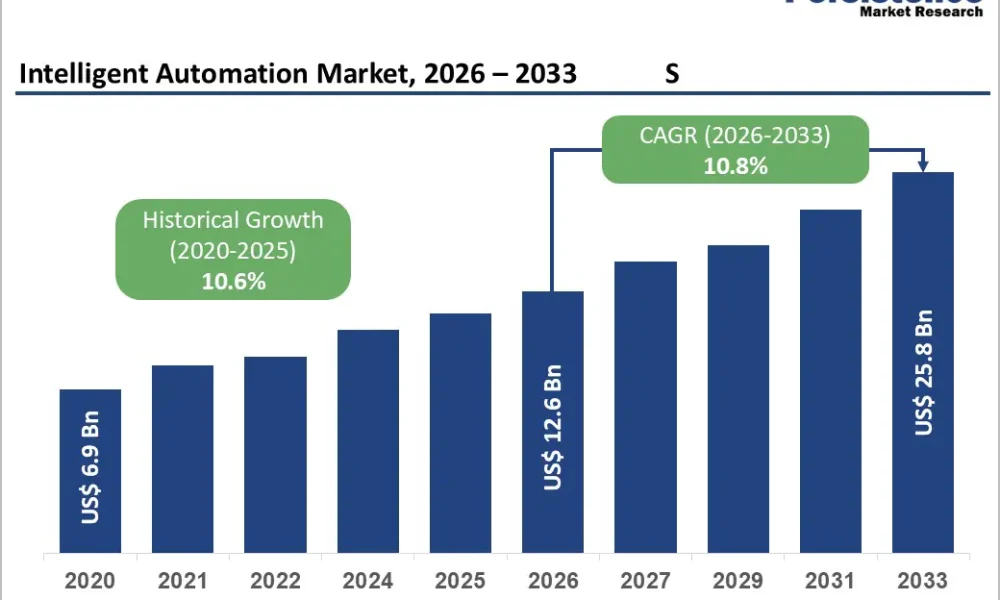
The global intelligent automation market is experiencing rapid growth as organizations across industries seek advanced technologies to enhance operational efficiency, reduce costs, and accelerate digital transformation. Intelligent automation integrates artificial intelligence (AI), machine learning (ML), robotic process automation (RPA), and analytics to automate complex business processes that traditionally required human intervention.
According to industry projections, the intelligent automation market size is expected to reach US$ 12.6 billion in 2026 and is forecast to expand to US$ 25.8 billion by 2033, growing at a compound annual growth rate (CAGR) of 10.8% during 2026–2033. The surge in demand for automation technologies is driven by organizations aiming to streamline workflows, improve productivity, and enhance customer experiences.
With businesses increasingly adopting digital technologies and cloud-based infrastructure, intelligent automation has become a critical enabler for modern enterprises seeking agility, scalability, and innovation in a competitive global marketplace.
Understanding Intelligent Automation and Its Role in Digital Transformation
Intelligent automation refers to the combination of multiple advanced technologies—such as AI, ML, natural language processing (NLP), and robotic process automation—to automate decision-making and operational workflows. Unlike traditional automation systems that follow predefined rules, intelligent automation systems are capable of learning from data, adapting to changing scenarios, and making context-aware decisions.
These capabilities enable businesses to automate a wide range of tasks including document processing, customer service interactions, fraud detection, predictive maintenance, and supply chain management. As enterprises deal with increasing volumes of data and operational complexity, intelligent automation helps streamline processes and reduce the reliance on manual interventions.
Furthermore, the shift toward digital-first business models has accelerated the adoption of intelligent automation technologies across sectors such as finance, healthcare, manufacturing, retail, and telecommunications.
Key Market Drivers Fueling Intelligent Automation Growth
Rapid Advancements in Artificial Intelligence and Machine Learning
One of the primary drivers behind the growth of the intelligent automation market is the continuous advancement of artificial intelligence and machine learning technologies. AI-powered systems are capable of processing massive datasets in real time, identifying patterns, and making data-driven decisions with high accuracy.
Machine learning algorithms also enable automation systems to improve continuously as they learn from new data inputs. This allows organizations to deploy automation solutions that evolve over time, delivering improved performance and operational efficiency.
Industries such as manufacturing and logistics are increasingly using AI-powered automation for predictive maintenance and process optimization. Similarly, financial institutions rely on AI-based automation to detect fraudulent transactions and improve compliance management.
As AI technologies become more sophisticated and accessible, their integration with automation platforms is expected to drive further market expansion.
Growing Demand for Operational Efficiency and Cost Optimization
Organizations worldwide are under constant pressure to improve operational efficiency while reducing operational costs. Intelligent automation offers a powerful solution by automating repetitive and time-consuming tasks, enabling employees to focus on higher-value strategic activities.
Automation technologies can handle tasks such as data entry, invoice processing, customer query management, and compliance reporting with greater speed and accuracy compared to manual processes. This results in significant cost savings, reduced human error, and faster decision-making.
Businesses are also leveraging intelligent automation to address labor shortages and improve productivity. By automating routine processes, companies can optimize workforce utilization and maintain operational continuity.
Increasing Adoption of Cloud-Based Automation Platforms
Cloud computing has become a key enabler for the adoption of intelligent automation solutions. Cloud-based platforms provide businesses with scalable infrastructure and flexible deployment options without requiring large upfront investments in hardware or IT resources.
Cloud-based intelligent automation solutions allow organizations to deploy automation tools quickly, integrate them with existing systems, and scale operations as needed. This flexibility is particularly beneficial for organizations undergoing digital transformation initiatives.
Additionally, cloud platforms support remote access and collaboration, which became increasingly important following the global shift toward hybrid and remote working environments after the COVID-19 pandemic.
Market Restraints: Data Security and Privacy Challenges
Despite the numerous benefits of intelligent automation, concerns related to data security and privacy remain a major challenge for organizations adopting these technologies.
Automation systems often process sensitive business and customer data, making them potential targets for cyberattacks. Data breaches can lead to financial losses, reputational damage, and legal penalties.
Organizations must also comply with strict data protection regulations such as the General Data Protection Regulation (GDPR) and the California Consumer Privacy Act (CCPA). These regulations impose stringent requirements on how businesses collect, store, and process personal data.
Ensuring secure data handling, encryption, and access control is therefore essential for organizations implementing intelligent automation solutions. Companies must invest in robust cybersecurity measures to mitigate risks and maintain trust with customers and stakeholders.
Emerging Opportunity: Integration of Generative AI with Intelligent Automation
One of the most promising developments in the intelligent automation market is the integration of generative AI technologies. Generative AI models can create new content, insights, and recommendations, adding an innovative dimension to automation systems.
When combined with intelligent automation, generative AI enables organizations to automate not only routine tasks but also creative and analytical processes. For example, generative AI can produce personalized marketing content, generate reports, and assist in customer service interactions.
In sectors such as healthcare and finance, generative AI can help generate predictive insights and support complex decision-making processes. This convergence of technologies enhances operational capabilities and allows businesses to deliver highly personalized services to customers.
As generative AI continues to evolve, its integration with automation platforms is expected to unlock new opportunities for innovation and competitive differentiation.
Elevate your business strategy with comprehensive market data. Request a sample report now: https://www.persistencemarketresearch.com/samples/24508
Deployment Insights: Cloud Solutions Dominate the Market
Cloud-based deployment models are expected to dominate the intelligent automation market, capturing approximately 60% of market revenue by 2026. The popularity of cloud deployment stems from its scalability, flexibility, and cost-effectiveness.
Cloud-based automation platforms enable organizations to implement automation solutions quickly and expand their capabilities as business requirements grow. These platforms also facilitate seamless integration with other enterprise systems and applications.
For instance, automation companies are increasingly offering cloud-native platforms that allow organizations to orchestrate digital workers, manage workflows, and monitor performance in real time.
While cloud adoption continues to rise, on-premises solutions are projected to witness the fastest growth during the forecast period. Industries with strict data security requirements, such as government, healthcare, and finance, often prefer on-premises deployments to maintain greater control over sensitive data and comply with regulatory requirements.
Organization Size Analysis: Large Enterprises Lead Adoption
Large enterprises are expected to dominate the intelligent automation market, accounting for nearly 70% of total market share in 2026. These organizations typically manage complex operations across multiple departments, making automation a critical tool for improving efficiency and productivity.
With greater financial resources and technological infrastructure, large enterprises can invest heavily in advanced automation platforms that streamline workflows and support enterprise-scale digital transformation initiatives.
However, small and medium-sized enterprises (SMEs) are expected to represent the fastest-growing segment in the market. The availability of cloud-based automation solutions has significantly reduced the barriers to entry for SMEs.
These solutions allow smaller businesses to adopt automation technologies without substantial capital investments, enabling them to enhance operational efficiency, reduce costs, and compete more effectively with larger organizations.
Industry Vertical Analysis
BFSI Sector Leads the Market
The banking, financial services, and insurance (BFSI) sector is projected to hold the largest share of the intelligent automation market, accounting for approximately 35% of revenue in 2026.
Financial institutions rely heavily on automation technologies to manage complex processes such as fraud detection, regulatory compliance, customer onboarding, and risk management. Automation helps financial organizations reduce operational risks while delivering faster and more secure digital services to customers.
Additionally, intelligent automation enables banks to improve customer experiences through automated chatbots, personalized financial recommendations, and streamlined digital banking services.
Healthcare Sector Emerging as the Fastest-Growing Segment
The healthcare sector is expected to witness the fastest growth in the intelligent automation market during the forecast period.
Healthcare organizations are increasingly adopting automation technologies to manage administrative tasks, improve patient monitoring, and support diagnostic processes. Automation tools can help hospitals handle tasks such as appointment scheduling, medical billing, claims processing, and electronic health record management.
The COVID-19 pandemic highlighted the importance of scalable healthcare infrastructure and accelerated the adoption of digital technologies across the sector. Intelligent automation is now playing a crucial role in improving healthcare efficiency and enabling better patient outcomes.
Regional Market Insights
North America Leads the Global Market
North America is expected to hold the largest share of the intelligent automation market, accounting for approximately 40% of global revenue in 2026.
The region benefits from advanced technological infrastructure, strong investments in digital innovation, and the presence of major technology companies. Industries in North America have been early adopters of automation technologies, particularly in sectors such as finance, healthcare, and manufacturing.
Companies in the region are increasingly using intelligent automation to address workforce shortages, optimize operations, and enhance customer engagement.
Europe Shows Strong Growth Potential
Europe represents a significant market for intelligent automation, driven by increasing digital transformation initiatives across industries such as manufacturing, automotive, and financial services.
Countries including Germany, the United Kingdom, and France are actively investing in Industry 4.0 technologies and smart manufacturing systems. Automation technologies are also being used to improve supply chain efficiency and support sustainability initiatives across the region.
Asia Pacific Emerging as the Fastest-Growing Region
Asia Pacific is projected to be the fastest-growing regional market for intelligent automation between 2026 and 2033.
Rapid industrialization, expanding digital economies, and strong government support for technology innovation are driving automation adoption across countries such as China, India, Japan, and Singapore.
Businesses in the region are increasingly adopting intelligent automation to improve productivity, optimize supply chains, and enhance customer service capabilities. The rising number of technology startups and increasing investments in AI research are further supporting market growth.
Competitive Landscape
The intelligent automation market is moderately fragmented, with several global technology companies competing to expand their market presence through innovation, partnerships, and acquisitions.
Major players in the market include:
- UiPath
- IBM Corporation
- Microsoft Corporation
- Blue Prism (SS&C)
- Pegasystems
- SAP SE
- Oracle Corporation
- WorkFusion
- NICE
- Cognizant
- Genpact
- HCL Technologies
- Accenture
- Infosys
These companies are continuously investing in research and development to enhance automation platforms and integrate advanced technologies such as AI, machine learning, and generative AI.
Strategic collaborations and product launches are also shaping the competitive landscape as vendors aim to deliver comprehensive automation solutions to enterprises worldwide.
Future Outlook of the Intelligent Automation Market
The future of the intelligent automation market appears highly promising as organizations continue to prioritize digital transformation and operational efficiency. Advances in AI, machine learning, and cloud computing will further expand the capabilities of automation systems, enabling businesses to automate increasingly complex processes.
The integration of generative AI, edge computing, and advanced analytics will create new opportunities for innovation and growth across industries. As automation technologies become more accessible and cost-effective, adoption is expected to accelerate among both large enterprises and small businesses.
By 2033, intelligent automation is expected to play a central role in shaping the future of work, enabling organizations to operate more efficiently, deliver better customer experiences, and remain competitive in an increasingly digital world.
Related Reports:




