
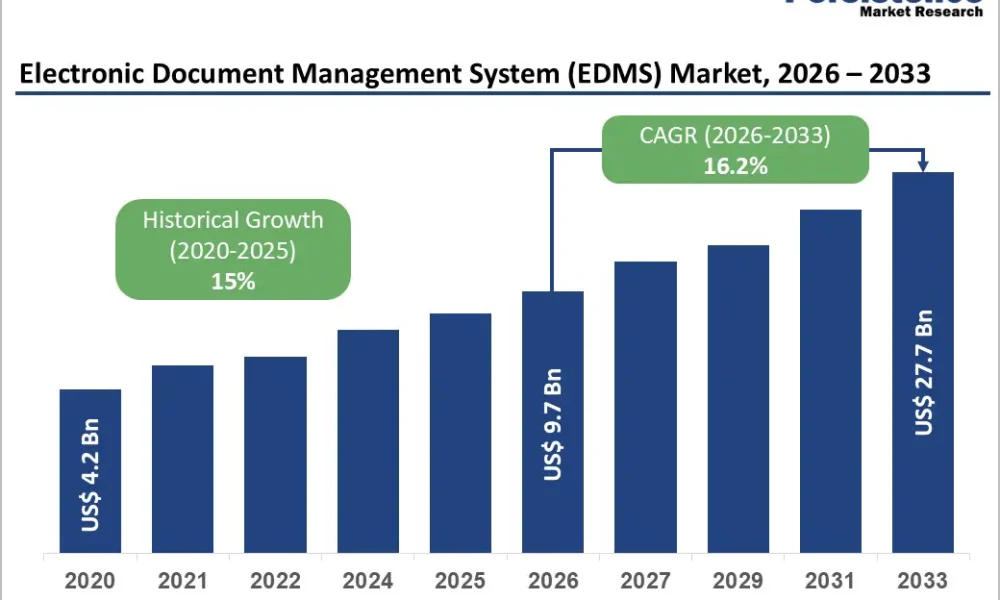
The global Electronic Document Management System (EDMS) market is entering a phase of rapid transformation as organizations shift toward digital-first operations and paperless workflows. The market is expected to grow from US$9.7 billion in 2026 to US$27.7 billion by 2033, expanding at a compound annual growth rate (CAGR) of 16.2% during the forecast period.
Enterprises worldwide are recognizing that managing large volumes of documents through manual or paper-based systems is inefficient, costly, and increasingly incompatible with modern regulatory requirements. As a result, organizations are investing in advanced EDMS platforms that centralize document storage, automate workflows, and ensure secure access across distributed teams.
The increasing adoption of cloud infrastructure, artificial intelligence (AI), and automation technologies is reshaping the document management landscape. Businesses across sectors such as banking, healthcare, government, and legal services are integrating EDMS platforms to improve operational efficiency, strengthen compliance frameworks, and enhance collaboration.
As digital transformation initiatives continue to accelerate globally, electronic document management systems are evolving from simple storage solutions into intelligent information management platforms capable of supporting complex enterprise workflows.
Rising Digital Transformation Driving EDMS Market Growth
Digital transformation is the most powerful catalyst behind the rapid expansion of the EDMS market. Organizations are transitioning away from traditional paper-based documentation toward fully digital ecosystems to improve efficiency and agility.
Businesses generate enormous volumes of documents every day, including contracts, invoices, employee records, financial reports, and compliance documentation. Without centralized document management, these records become difficult to track, share, and secure. EDMS platforms solve this problem by creating structured repositories where documents can be stored, categorized, and retrieved instantly.
Companies that deploy EDMS solutions gain several operational advantages:
- Faster document retrieval and workflow processing
- Reduced physical storage costs
- Improved regulatory compliance and audit readiness
- Enhanced collaboration across teams and departments
In industries such as banking, healthcare, and government, the shift toward electronic documentation is especially critical because of strict data governance requirements. Digital document management allows organizations to maintain detailed audit trails and enforce security policies that protect sensitive information.
Hybrid work models have also accelerated EDMS adoption. With employees working across different locations, organizations require systems that allow secure access to documents anytime and from anywhere.
Cloud-Based EDMS Platforms Transform Enterprise Document Management
Cloud-based deployment has become the dominant model in the electronic document management system market. In 2026, cloud EDMS solutions are expected to account for approximately 65% of total market share.
Cloud platforms offer several advantages compared to traditional on-premises systems:
- Lower infrastructure and maintenance costs
- Faster implementation and scalability
- Seamless remote access and collaboration
- Automatic updates and security enhancements
For small and medium enterprises (SMEs), cloud-based EDMS platforms are particularly attractive because they eliminate the need for expensive hardware investments.
Subscription-based pricing models also make these platforms more accessible to organizations with limited IT budgets. Businesses can scale their document management capacity as they grow, paying only for the resources they use.
Many software vendors are integrating EDMS functionality with broader enterprise ecosystems such as ERP, CRM, and workflow automation platforms, allowing organizations to manage documents directly within their operational systems.
As cloud adoption continues to accelerate globally, cloud-based EDMS solutions are expected to remain the fastest-growing deployment segment through 2033.
Elevate your business strategy with comprehensive market data. Request a sample report now: https://www.persistencemarketresearch.com/samples/23287
AI and Automation Enhancing Intelligent Document Processing
Artificial intelligence is rapidly transforming electronic document management systems from simple storage tools into intelligent automation platforms.
Modern EDMS platforms now incorporate AI-driven capabilities, including:
- Automated document classification
- Intelligent data extraction
- Smart metadata tagging
- Optical character recognition (OCR)
- Context-based search and analytics
These technologies enable organizations to process large volumes of unstructured documents with minimal human intervention.
For example, AI-powered document processing tools can automatically extract key information from invoices, contracts, insurance claims, or loan applications. This significantly reduces manual workload while improving processing speed and accuracy.
In the financial services sector, intelligent document processing enables faster loan approvals and fraud detection. In healthcare, AI-driven EDMS platforms help hospitals manage patient records and insurance documentation more efficiently.
By reducing administrative tasks and enabling data-driven decision-making, AI-powered EDMS systems are becoming essential components of modern enterprise operations.
High Implementation Costs and Legacy Migration Challenges
Despite strong growth potential, the EDMS market faces several barriers that can slow adoption.
One of the most significant challenges is the high upfront cost of implementation, particularly for large organizations with complex IT environments. A full-scale EDMS deployment can involve expenses related to:
- Software licensing
- Infrastructure upgrades
- Data migration
- System integration
- Employee training
For mid-sized organizations, deployment costs can range from US$40,000 to US$120,000, while large enterprise implementations can exceed US$250,000.
Legacy data migration is another major challenge. Many organizations maintain document archives that span decades, stored across physical records, shared drives, and outdated digital systems.
Migrating these records into a centralized EDMS platform requires significant data cleansing, indexing, and standardization. This process can extend implementation timelines and increase project costs.
Additionally, integrating EDMS platforms with existing enterprise systems such as ERP and CRM software requires careful planning and specialized technical expertise.
However, as cloud-based solutions become more affordable and AI-driven automation reduces operational complexity, these barriers are gradually diminishing.
BFSI Sector Leading Adoption of EDMS Solutions
Among all industry verticals, the banking, financial services, and insurance (BFSI) sector is expected to dominate the EDMS market, accounting for approximately 26% of market share in 2026.
Financial institutions manage enormous volumes of documentation, including:
- Loan applications
- Know-your-customer (KYC) records
- Insurance policies
- Compliance reports
- Financial statements
Regulatory requirements in the financial sector are extremely stringent, requiring detailed documentation and secure recordkeeping.
EDMS platforms help financial institutions streamline compliance processes by enabling automated document tracking, secure access controls, and real-time audit trails.
Automation technologies also reduce manual processing errors and accelerate document-intensive workflows such as loan approvals and claims processing.
As financial institutions continue to modernize their operations and adopt digital banking platforms, EDMS solutions will remain critical tools for ensuring efficiency and regulatory compliance.
Healthcare Emerging as the Fastest-Growing Industry Segment
The healthcare sector is expected to be the fastest-growing EDMS end-use segment, expanding at a CAGR of approximately 17% through 2033.
Healthcare organizations generate vast amounts of documentation related to patient care, insurance claims, regulatory compliance, and administrative operations.
Electronic document management systems play a crucial role in organizing and securing this information. Hospitals increasingly integrate EDMS platforms with electronic health record (EHR) systems to streamline document management across clinical and administrative processes.
Key benefits of EDMS adoption in healthcare include:
- Improved access to patient records
- Faster insurance claims processing
- Reduced administrative workload
- Enhanced compliance with healthcare regulations
Automation technologies also help healthcare providers manage medical billing documentation, discharge summaries, and consent forms more efficiently.
As global healthcare systems continue to digitize patient records and administrative workflows, EDMS adoption in the sector is expected to grow significantly.
North America Leading Global EDMS Market
North America is expected to maintain its leadership in the electronic document management system market, accounting for approximately 38% of global market share in 2026.
The region’s dominance can be attributed to several factors:
- Advanced digital infrastructure
- High enterprise IT spending
- Strong regulatory compliance frameworks
- Early adoption of cloud technologies
Organizations in the United States and Canada have been among the first to adopt enterprise document management solutions to improve operational efficiency and meet regulatory requirements.
Healthcare providers, financial institutions, and government agencies across North America rely heavily on EDMS platforms for secure document storage and regulatory compliance.
Government digitalization programs and increasing demand for remote collaboration tools are further strengthening market growth across the region.
Asia Pacific Emerging as the Fastest-Growing Regional Market
While North America currently leads the global market, Asia Pacific is expected to be the fastest-growing regional market, with a projected CAGR of nearly 19% through 2033.
Rapid economic development and digital transformation initiatives are driving EDMS adoption across countries such as China, India, and Japan.
Government-led digital governance programs are playing a major role in accelerating adoption. Many national governments are implementing electronic records systems to improve public service efficiency and transparency.
Small and medium enterprises across the region are also increasingly adopting cloud-based document management platforms to support digital business operations.
As businesses across Asia Pacific continue to modernize their IT infrastructure and adopt paperless workflows, demand for EDMS platforms is expected to grow significantly.
Competitive Landscape and Key Market Players
The global EDMS market is moderately consolidated, with several leading technology providers offering comprehensive document management solutions.
Major companies in the industry include:
- Microsoft Corporation
- Adobe Inc.
- OpenText Corporation
- Oracle Corporation
- IBM Corporation
- Zoho Corporation
- Salesforce
- DocuWare
- Xerox Corporation
- M-Files
These companies are investing heavily in AI integration, cybersecurity enhancements, and cloud-based architectures to strengthen their market positions.
Many vendors are also expanding their product portfolios through strategic acquisitions and partnerships to deliver integrated enterprise content management platforms.
Smaller and specialized vendors are targeting niche industry verticals by offering customized solutions tailored to regulatory requirements and operational needs.
As demand for intelligent document processing continues to grow, competition in the EDMS market is expected to intensify.
Future Outlook of the EDMS Market
The future of the electronic document management system market will be shaped by several transformative trends.
First, the integration of AI and machine learning will continue to enhance document processing capabilities, enabling fully automated document workflows.
Second, cloud-first architectures will dominate deployment strategies, offering scalable solutions for organizations of all sizes.
Third, regulatory compliance and cybersecurity will remain key priorities as organizations manage increasingly sensitive digital information.
Finally, the continued expansion of remote and hybrid work environments will increase the demand for secure, collaborative document management platforms.
As enterprises seek more efficient ways to manage growing volumes of data, EDMS platforms will become essential infrastructure for modern digital organizations.
Conclusion
The global electronic document management system market is poised for significant growth as businesses accelerate digital transformation and transition toward paperless workflows. With the market projected to reach US$27.7 billion by 2033, EDMS platforms are evolving into intelligent, AI-driven systems that enable organizations to manage information more efficiently and securely.
From financial institutions and healthcare providers to government agencies and SMEs, organizations across industries are embracing EDMS solutions to enhance productivity, strengthen compliance, and support digital collaboration.
As technology continues to advance and enterprise data volumes expand, electronic document management systems will play a central role in shaping the future of digital business operations.
Related Reports:




