
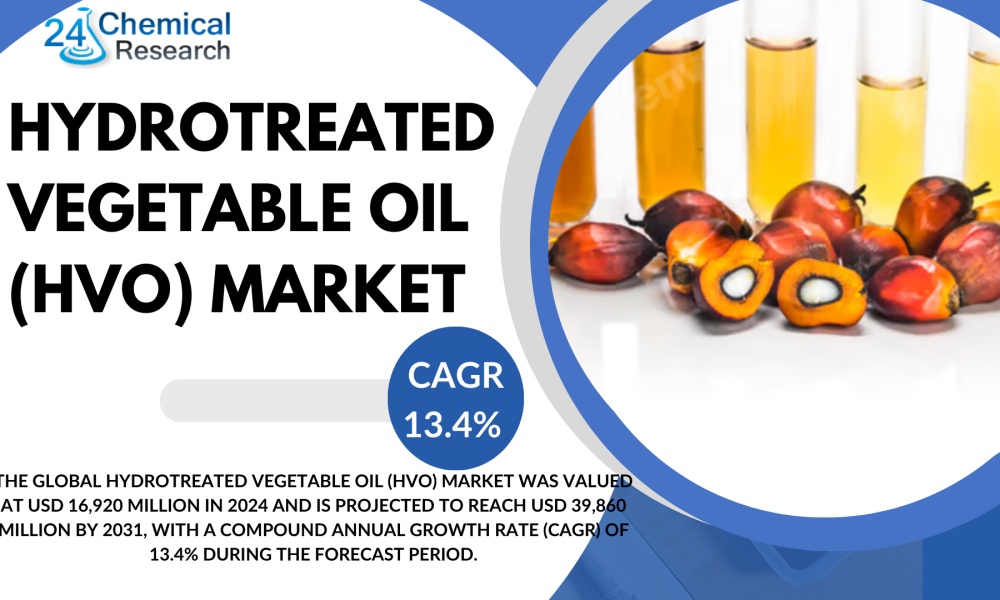
Global Hydrotreated Vegetable Oil (HVO) market continues to demonstrate robust expansion, with its valuation reaching USD 16.92 billion in 2024. According to recent industry analysis, the market is projected to grow at an impressive CAGR of 13.4%, reaching approximately USD 39.86 billion by 2031. This accelerated growth trajectory is primarily fueled by the global energy transition towards renewable resources and the increasing adoption of drop-in biofuels across transportation sectors.
Hydrotreated Vegetable Oil represents a paradigm shift in renewable fuels, offering near-identical performance to conventional diesel while reducing greenhouse gas emissions by up to 90% compared to fossil fuels. Its chemical similarity to petroleum diesel allows seamless integration with existing infrastructure, making it increasingly attractive for fleet operators and industrial users subject to decarbonization mandates.
Download FREE Sample Report: https://www.24chemicalresearch.com/download-sample/291177/hydrotreated-vegetable-oil-market
Recent News and Trends in the HVO Market
- Growth in Renewable Diesel Demand:
- The demand for renewable diesel (which includes HVO) is surging as more countries and regions adopt stricter emission regulations. Countries like the United States, Canada, and European Union nations have been focusing on decarbonizing the transport sector, which has fueled the adoption of alternative fuels like HVO.
- The U.S. recently saw a jump in production of renewable diesel, with companies like Chevron and Marathon Petroleum investing in HVO production plants, which could increase market supply significantly over the next decade.
- EU Sustainability Push:
- The European Union is also putting more pressure on reducing greenhouse gas emissions, especially in the transport and aviation sectors. As a result, HVO is expected to be a crucial part of the EU’s Green Deal, which aims to make Europe the first climate-neutral continent by 2050. Countries like Finland and Sweden have already adopted renewable fuels like HVO for public transport fleets.
- Increased Production Capacity:
- Several companies are expanding their HVO production capacity. For instance, Neste, one of the leading producers of renewable diesel, has been ramping up production at its refinery in the Netherlands, making a significant impact on the global supply of HVO. Other companies like TotalEnergies and BP are also increasing their production capabilities to meet the demand for renewable fuels.
- Feedstock Development:
- HVO is produced from various feedstocks, including vegetable oils (like palm oil, soybean oil, and rapeseed oil) and waste oils (like used cooking oil). However, there has been increasing scrutiny over the environmental impacts of certain feedstocks, such as palm oil, which has led to increased interest in waste oils and algae-based feedstocks for HVO production.
- Some companies are investing in algae cultivation technologies that could be a sustainable and abundant feedstock for HVO in the future.
- Partnerships and Acquisitions:
- Key players are entering into strategic partnerships and acquisitions to enhance their position in the HVO market. For example, RWE, a large European utility company, has been teaming up with biofuel firms to scale up production.
Key Benefits of Hydrotreated Vegetable Oil (HVO)
- Reduced Carbon Emissions:
- One of the most significant advantages of HVO is that it reduces greenhouse gas emissions when compared to conventional fossil diesel. Since it’s made from renewable feedstocks, its life cycle carbon footprint is much lower, especially when waste oils and fats are used.
- Compatibility with Existing Infrastructure:
- HVO is fully compatible with existing diesel engines, infrastructure, and distribution systems. This makes it easier for fleets and other diesel users to transition to a renewable alternative without significant upfront investments in new equipment or refueling stations.
- Improved Fuel Quality:
- HVO has better fuel quality than traditional biodiesel (FAME). It has higher energy density, superior cold-weather performance, and is more stable than biodiesel. These qualities make it a desirable option for both passenger vehicles and commercial fleets.
Market Overview & Regional Analysis
Europe currently leads the global HVO market with a 45% consumption share, driven by the Renewable Energy Directive II (RED II) mandates and carbon taxation policies. Scandinavian countries, particularly Finland and Sweden, demonstrate the highest per capita adoption, while Germany and France are scaling up imports to meet blending requirements.
North America follows with 30% market share, where California’s Low Carbon Fuel Standard (LCFS) has created a booming market. The Asia-Pacific region is emerging as the fastest-growing market, with Singapore becoming a major refining hub and China investing heavily in waste oil-to-fuel projects. Latin America shows potential through abundant feedstock availability, though infrastructure limitations currently constrain growth.
Key Market Drivers and Opportunities
The market’s expansion is underpinned by three core drivers: stringent emissions regulations across aviation and maritime sectors, corporate sustainability commitments, and technology advancements in feedstock preprocessing. The aviation sector alone is expected to account for 22% of demand growth through 2030 as airlines adopt SAF blends.
Significant opportunities exist in waste feedstock valorization – used cooking oil and animal fats now comprise nearly 40% of HVO production inputs. The development of catalytic hydroprocessing technologies enables higher yields from lower-grade feedstocks, while emerging applications in power generation and industrial heating present new demand verticals.
Challenges & Restraints
The industry faces headwinds from feedstock price volatility and competition from renewable diesel alternatives. Palm oil restrictions in Europe have increased input costs, while U.S. soybean oil prices fluctuate with agricultural commodity markets. Additionally, the scaling of e-fuels and biomethane solutions creates alternative pathways for hard-to-electrify transport segments.
Rail and maritime logistics bottlenecks constrain supply chain development, particularly in emerging markets. Trade flow disruptions continue as markets adjust to the EU’s deforestation regulation (EUDR) and evolving sustainability certification requirements.
Market Segmentation by Type
- Pure HVO (100% renewable content)
- HVO Blends (30-50% renewable content)
- Co-processed HVO (Renewable fraction averaging 5-20%)
Download FREE Sample Report: https://www.24chemicalresearch.com/download-sample/291177/hydrotreated-vegetable-oil-market
Market Segmentation by Application
- Road Transportation (Heavy-duty vehicles fleets)
- Aviation Fuel (SAF blending)
- Marine Bunkering
- Power Generation
- Industrial Processes
Market Segmentation and Key Players
- Neste
- Eni
- TotalEnergies
- Preem
- REG
- UPM Biofuels
- World Energy
- Cepsa
- Repsol
- Phillips 66
- Marathon Petroleum
- Valero
- HF Sinclair
- SK Energy
- Greenergy
Report Scope
This report provides a comprehensive analysis of the global Hydrotreated Vegetable Oil market, covering historical data from 2019 to 2023 and forecasted trends through 2031. The analysis includes detailed examination of:
- Market sizing and growth projections across product types and applications
- Supply chain dynamics including feedstock procurement trends
- Policy and regulatory impact analysis by key jurisdictions
The study incorporates competitive benchmarking of:
- Production capacities and expansion projects
- Technology strategies and patent landscapes
- Feedstock sourcing networks and sustainability claims
Independent market modelling incorporates:
- Demand-side analysis based on sectoral transition pathways
- Supply-side modeling of refinery conversions and new build economics
- Price scenario analysis under varying policy and feedstock conditions
Get Full Report Here: https://www.24chemicalresearch.com/reports/291177/hydrotreated-vegetable-oil-market
About 24chemicalresearch
Founded in 2015, 24chemicalresearch has rapidly established itself as a leader in chemical market intelligence, serving clients including over 30 Fortune 500 companies. We provide data-driven insights through rigorous research methodologies, addressing key industry factors such as government policy, emerging technologies, and competitive landscapes.
- Plant-level capacity tracking
- Real-time price monitoring
- Techno-economic feasibility studies
With a dedicated team of researchers possessing over a decade of experience, we focus on delivering actionable, timely, and high-quality reports to help clients achieve their strategic goals. Our mission is to be the most trusted resource for market insights in the chemical and materials industries.
International: +1(332) 2424 294 | Asia: +91 9169162030
Website: https://www.24chemicalresearch.com/




