
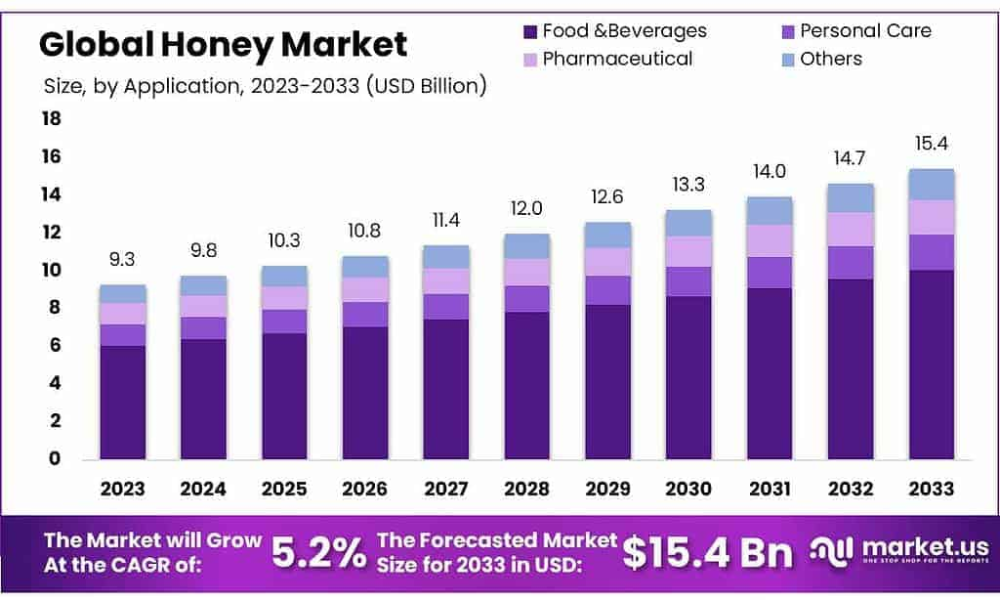
New York, NY – July 08, 2025 – The Global Honey Market is experiencing strong growth, driven by increasing consumer demand for natural and healthy food products. Valued at USD 9.3 billion in 2023, the market is projected to reach USD 15.4 billion by 2033, growing at a steady CAGR of 5.2% from 2024 to 2033.
This growth is fueled by rising awareness of honey’s health benefits, including its use as a natural sweetener, immunity booster, and remedy for various ailments. The market’s popularity is also expanding due to the growing preference for organic and clean-label products, with consumers shifting away from artificial sweeteners. Key opportunities lie in the development of innovative honey-based products, such as infused flavors, functional foods, and beauty products, catering to diverse consumer needs.
Additionally, expanding retail channels, including e-commerce and specialty stores, are making honey more accessible worldwide. Emerging markets in Asia-Pacific and Latin America are witnessing rapid demand growth, supported by increasing disposable incomes and changing dietary habits. With rising applications in food & beverages, pharmaceuticals, and cosmetics, the honey market is set for significant expansion, presenting lucrative opportunities for producers and investors alike.
Important Revelation
- Market Growth: By 2033, it is anticipated that the global honey market will reach approximately USD 15.4 billion at an average compound annual growth rate (CAGR) rate of 5.2% from its value of USD 9.3 billion as reported in 2023.
- Processing Analysis: Conventional honey held an estimated Honey market share of 786 percent as of 2023 due to its lower price and greater availability, while organic varieties are expected to experience compound annual compounded annual growth at 5.2% between 2023-2032 due to an increasing emphasis on healthier diets.
- Variety of Honey Types: There is an array of honey varieties, from Alfalfa and Buckwheat honey to Acacia honey, Wildflower honey, and Clover honey, designed to satisfy diverse consumer preferences. Buckwheat holds the largest market share due to its intense and flavorful characteristics.
- By Application: Honey can be found in food and beverage applications at 65.3% market share; its moisturizing and medicinal qualities also make it popularly utilized by cosmetic and pharmaceutical products.
- Distribution Channels: Hypermarkets and supermarkets captured 38.6% market share as of 2023, while online distribution channels are expected to experience rapid growth at 6.2% annually between 2023-2032 as shoppers increasingly turn toward digital shopping methods.
- Market Drivers: Honey is driven by consumer demand for healthier sweeteners, particularly due to its long shelf life and health advantages compared to regular sugar. As such, its market growth can be expected to remain robust.
- Market Challenges: Honey fraud has increased substantially, undermining quality and slowing market expansion. Meanwhile, alternative products like Stevia and Maple Syrup are quickly gaining ground, posing competition to honey.
➤ Download Exclusive Sample Of This Premium Report (Including Full TOC, Table & Figures): https://market.us/report/honey-market/request-sample/
Report Segmentation
Processing Segment
- In 2023, the processing segment dominated the global honey market, accounting for over 78.6% of total revenue. This dominance is expected to persist throughout the forecast period, primarily due to the lower cost and widespread availability of processed honey compared to organic variants. Conventional honey continues to gain traction as manufacturers introduce innovative flavors and exotic blends, further expanding market appeal.
- Additionally, the increasing substitution of plant-based natural sweeteners is likely to accelerate growth in the honey-based sweetener segment. However, the proliferation of adulterated honey in both local and international markets is negatively affecting producers of high-quality and pure honey, posing a challenge to profitability.
Product Type Insights:
- In terms of product types, buckwheat honey led the market in 2023 with a commanding 32.4% share, favored for its dark color and rich, molasses-like flavor. Alfalfa honey gained popularity due to its light color and mild taste, appealing to those preferring subtle flavor profiles. Acacia honey stood out for its floral aroma and gentle sweetness, while wildflower honey attracted consumers seeking a diverse and robust flavor experience. Clover honey remained widely consumed for its classic and sweet taste, securing its place as a familiar favorite. The “Other” category included niche honey types catering to specialized consumer tastes. Overall, the product landscape reflected diverse consumer preferences, with buckwheat honey emerging as a strong leader.
Application Outlook:
- The food and beverage industry represented the largest application segment in 2023, capturing more than 65.3% of the global market. The segment’s dominance stems from honey’s widespread use as a natural sweetener and flavor enhancer in various edible products. The personal care segment also held a noteworthy share, with honey being recognized for its moisturizing and nourishing properties in skincare and haircare products. In pharmaceuticals, honey is utilized for its antimicrobial and healing benefits, particularly in cough syrups, wound care, and other medicinal formulations. Collectively, these application areas underscore honey’s versatility and wide acceptance across multiple industries.
Distribution Channel Trends:
- Hypermarkets and supermarkets accounted for the largest revenue share in 2023, contributing over 38.6% of total sales. Retail chains such as Walmart and Costco have enhanced consumer access and product visibility, further supporting segment growth. Many consumers prefer purchasing honey in-store, where they can inspect product quality directly. E-commerce platforms offer convenience, greater product variety, user reviews, return options, and doorstep delivery—factors that are increasingly influencing consumer preferences and boosting online sales.
Market Key Segmentation
By Processing
- Conventional
- Organic
By Product Type
- Alfalfa
- Acacia
- Wildflower
- Buckwheat
- Clover honey
- Others
By Application
- Food &Beverages
- Personal Care
- Pharmaceutical
- Others
By Distribution Channel
- Convenience Stores
- Online
- Hypermarkets & Supermarkets
- Others
Regional Analysis
Europe emerged as the leading regional market in 2023, accounting for more than 36.7% of global revenue. The region’s growth is driven by rising disposable incomes, urbanization, and evolving consumer lifestyles. Within Europe, demand in the food and beverage sector alone reached approximately USD 3.4 billion in 2023, signaling strong consumption patterns.
Factors supporting this growth include increasing demand for natural and nutritious foods, a growing millennial population, and the presence of established market players such as Jedwards International, Inc., Koru Natural, and Pacific Resources International. The region’s expanding honey production and rising consumption levels are poised to further accelerate market expansion.
Factors Affecting the Growth of the Honey Market
- Floral Source: The type of flowers bees collect nectar from impacts honey’s flavor, color, and aroma. Different plants, like clover or acacia, produce unique honey characteristics. The availability and diversity of flowers in a region directly affect the quality and quantity of honey produced.
- Climate Conditions: Temperature and rainfall influence nectar production in flowers. Extreme heat or drought reduces floral resources, lowering honey yield. High humidity can increase honey’s moisture content, risking fermentation. Stable, warm climates with adequate rain support better honey production.
- Beekeeping Practices: Ethical beekeeping, like avoiding over-harvesting and using natural pest control, ensures healthy bee colonies. Poor management, such as neglecting hive maintenance or using harmful chemicals, reduces honey quality and quantity. Skilled beekeepers enhance production through proper care.
- Pesticide Exposure: Pesticides, especially neonicotinoids, harm bees by affecting navigation and immunity. Contaminated nectar leads to lower honey yields and potential residues in honey. Reducing pesticide use and promoting organic farming practices help maintain high-quality honey production.
- Hive Technology: Modern beehives, like box hives, yield more honey (up to 22 kg per hive) compared to traditional hives (9 kg). Lack of access to advanced equipment limits production efficiency. Upgrading to transitional or modern hives improves both quantity and quality.
Competitive Landscape
- Beyond the Hive
- Barkman Honey LLC
- Dabur India Ltd.
- Capilano Honey Ltd.
- New Zealand Honey Co.
- Streamland Biological Technology Ltd.
- Oha Honey LP
- Billy Bee Honey Products
- Comvita Ltd.
- Gold Honey Inc.
- Honey Limited
- Dutch Gold Honey Inc.
- Comvita Food Ltd.
- Comvita China Ltd.
- Other Key Players
Get in Touch with Us:
Market.us (Powered By Prudour Pvt. Ltd.)
Address: 420 Lexington Avenue, Suite 300, New York City, NY 10170, United States
Send Email: [email protected]
Refer To More Related Reports:



