
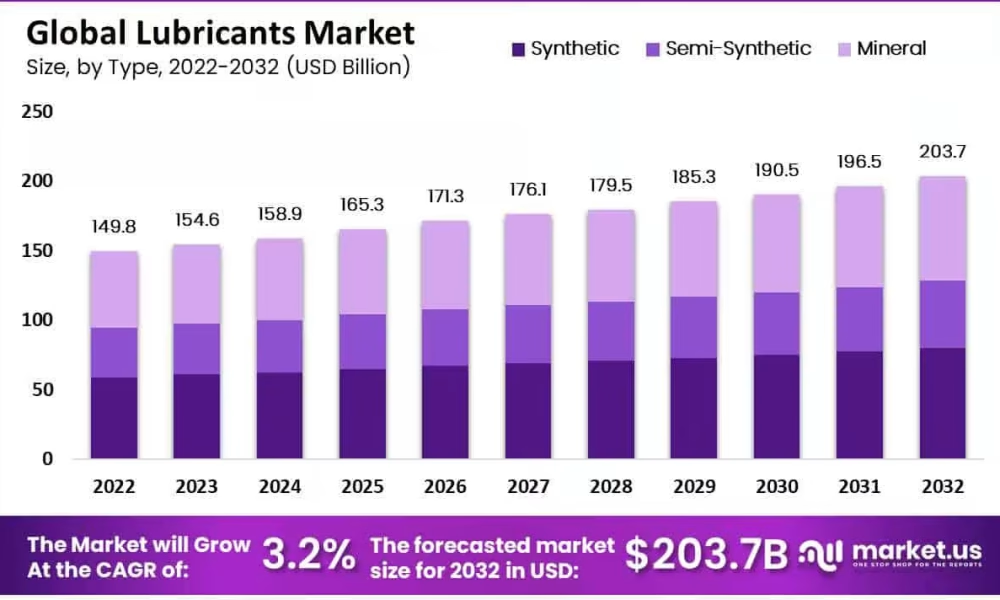
According to market.us, in 2022, the global lubricants market reached a valuation of nearly USD 149.8 billion and is anticipated to grow to approximately USD 203.7 billion by 2032, reflecting a steady compound annual growth rate (CAGR) of 3.2% from 2023 to 2032.
Lubricants continue to play a fundamental role in enhancing operational efficiency, protecting mechanical components, and extending equipment lifespan across a wide range of industries, including automotive, power generation, industrial processing, construction, and marine applications. These substances minimize friction, dissipate heat, and reduce mechanical wear, ensuring smoother performance of engines and industrial machinery.
The rapid pace of industrial development and vehicle production, particularly in developing nations, is significantly contributing to market growth. Moreover, a notable transition is underway, driven by the increasing use of synthetic and environmentally friendly lubricants, spurred by stricter emission standards and sustainability initiatives.
The evolution of modern engine technologies and industrial systems has created a demand for advanced lubricants with superior performance characteristics, such as thermal stability and longer drain intervals. The Asia-Pacific region remains a major hub for lubricant consumption, driven by large-scale industrialization, while North America and Europe are witnessing a gradual preference for bio-based and high-performance formulations.
Key Takeaways
- Market Growth: In 2022, the global lubricants market reached USD 149.8 billion with projected revenue reaching approximately USD 203.7 billion by 2032 at an astounding compound annual growth rate of 3.2% during this timeframe (i.e. from 2023-2032).
- Analysis by Type of Lubricants Market: When broken down by type, the market for lubricants encompasses synthetics, semi-synthetics, and minerals with synthetics holding the highest market share at 39.3%.
- By Product Analysis: Automotive-grade lubricants are designed for specific engine components like engines, gearboxes, and transmissions; industrial-grade ones may also be applied in hydraulic systems, gears, bearings, and compressors.
- Analysis by End-Use Industry: Markets for Lubricants have been divided into three broad end-use industries that use them; transportation, industry, and marine are the three biggest end-use markets that utilize Lubricants products.
- Regional Dominance: Asia Pacific is home to one of the fastest-growing oil and lubricants markets globally, featuring China and India as major lubricant producers and consumers, respectively. Lubricant demand is projected to continue increasing over time, thanks to an increasing need for industrial equipment as well as automobile vehicles.
Access a Complimentary Sample of This Premium Report: https://market.us/report/lubricants-market/request-sample/
Factors Affecting the Growth of the Lubricants Market
Automotive and Industrial Expansion: The continuous growth of the automotive and manufacturing sectors significantly drives lubricant consumption. Increased vehicle production, rising demand for transportation, and expanding industrial activities lead to higher requirements for engine oils, gear oils, and industrial fluids.
Technological Advancements in Machinery: Modern machinery and advanced engine systems require high-performance lubricants capable of withstanding extreme conditions. The development of energy-efficient and low-emission engines has increased the demand for synthetic and specialized lubricants with improved viscosity and thermal stability.
Environmental Regulations and Sustainability Trends: Stricter environmental standards and global efforts to reduce carbon emissions are pushing the industry toward cleaner, bio-based, and low-toxicity lubricants. Regulatory pressure is encouraging manufacturers to innovate and invest in eco-friendly alternatives.
Raw Material Availability and Price Volatility: The availability and cost of base oils and additives directly impact lubricant production. Fluctuations in crude oil prices and supply chain disruptions can affect manufacturing costs and influence pricing strategies across the market.
Shifting Consumer Preferences and Maintenance Practices: Consumers and industries are increasingly prioritizing longer equipment life and reduced maintenance frequency. This has led to a shift toward premium lubricants that offer extended drain intervals, better protection, and energy efficiency, influencing purchasing behavior and product development trends.
Key Market Segmentation
Based on Type Analysis
Based on type, the lubricants market is segmented into synthetic, semi-synthetic, and mineral categories. Among these, synthetic lubricants hold the dominant position, accounting for a market share of 39.3%. This segment has exhibited the highest compound annual growth rate (CAGR) during the forecast period due to its superior performance under extreme conditions.
Synthetic lubricants, made from chemical compounds, are known for their ability to withstand high temperatures, heavy loads, and intense pressure. Semi-synthetic lubricants, which combine synthetic and mineral oils, offer a balance between performance and cost-efficiency, delivering improved protection at a relatively lower price.
Mineral lubricants, derived from crude oil, remain the most commonly used type due to their affordability and wide availability, although they offer lower performance compared to synthetic and semi-synthetic options.
Based on Product Analysis
The lubricant market is segmented into various product categories, including automotive oils, industrial oils, metalworking fluids, hydraulic oils, process oils, marine oils, greases, and others. Among these, the automotive segment is the most dominant and lucrative, driven by the vast size of the global transportation industry, where every vehicle requires lubricants for optimal functioning.
Automotive lubricants are specifically formulated for use in engines, transmissions, and gearboxes. Industrial lubricants serve applications such as hydraulic systems, gears, bearings, and compressors across various manufacturing sectors.
Marine lubricants, engineered to resist corrosion and wear, are used in marine engines and other onboard mechanical systems. The automotive segment leads in consumption due to its essential role in vehicle maintenance and performance.
Based on End-Use Industry Analysis
Based on end-use industry, the lubricants market is categorized into transportation, industrial, and marine segments. Among these, the transportation sector is the largest end-user, accounting for the highest share of lubricant consumption.
This segment includes commercial vehicles, passenger automobiles, and aviation applications, all of which require regular lubrication for engines, transmissions, and mechanical parts. The industrial segment covers a broad range of sectors such as agriculture, mining, manufacturing, and construction, where lubricants are essential for equipment maintenance and operational efficiency.
The marine segment comprises commercial ships, recreational boats, and offshore drilling rigs, where specialized lubricants are used to protect against corrosion, high pressure, and water exposure.
Key Market Segments
Based on Type
- Mineral
- Semi-Synthetic
- Synthetic
Based on Product
- Automotive Oils
- Industrial Oils
- Metalworking Fluids
- Hydraulic Oils
- Process Oils
- Marine Oils
- Greases
- Other Products
Based on End-Use Industry
- Transportation
- Industries
- Marine
Latest trends
Latest trends in the lubricants market highlight a strong shift toward sustainability and technological innovation. Growing environmental concerns have accelerated the demand for eco-friendly and bio-based lubricants, which are derived from renewable resources, biodegradable, and have a lower environmental impact compared to traditional mineral-based products. This shift is supported by increasing regulatory pressure and consumer awareness.
Energy efficiency is also a key focus area. Lubricant manufacturers are developing advanced formulations that reduce friction and wear, thereby enhancing equipment efficiency. These high-performance lubricants help lower energy consumption and emissions, making them a more sustainable option for industrial and automotive applications.
Furthermore, technological advancements are reshaping product development. Companies are increasingly investing in R&D to produce next-generation lubricants, including synthetic and nanotechnology-enhanced variants. These formulations offer superior thermal stability, extended service life, and improved performance in extreme operating conditions, aligning with the growing demand for innovative and environmentally conscious lubrication solutions.
Market Key Players
- ExxonMobil Corp.
- Royal Dutch Shell Co.
- BP PLC.
- Total Energies
- Chevron Corp.
- Fuchs
- Castrol India Ltd.
- Amsoil Inc.
- JX Nippon Oil & Gas Exploration Corp.
- Philips 66 Company
- Valvoline LLC
- PetroChina Company Ltd.
- China Petrochemical Corp.
- Idemitsu Kosan Co. Ltd.
- Lukoil
- Petrobras
- Petronas Lubricant International
- Quaker Chemical Corp.
- PetroFer Chemie
- Buhmwoo Chemical Co. Ltd.
- Zeller Gmelin Gmbh & Co. KG
- Blaser Swisslube Inc.
- Other Key Players
Get in Touch with Us:
Market.us (Powered By Prudour Pvt. Ltd.)
Address: 420 Lexington Avenue, Suite 300 New York City, NY 10170, United States
Send Email: [email protected]
Refer to More Related Reports:



