
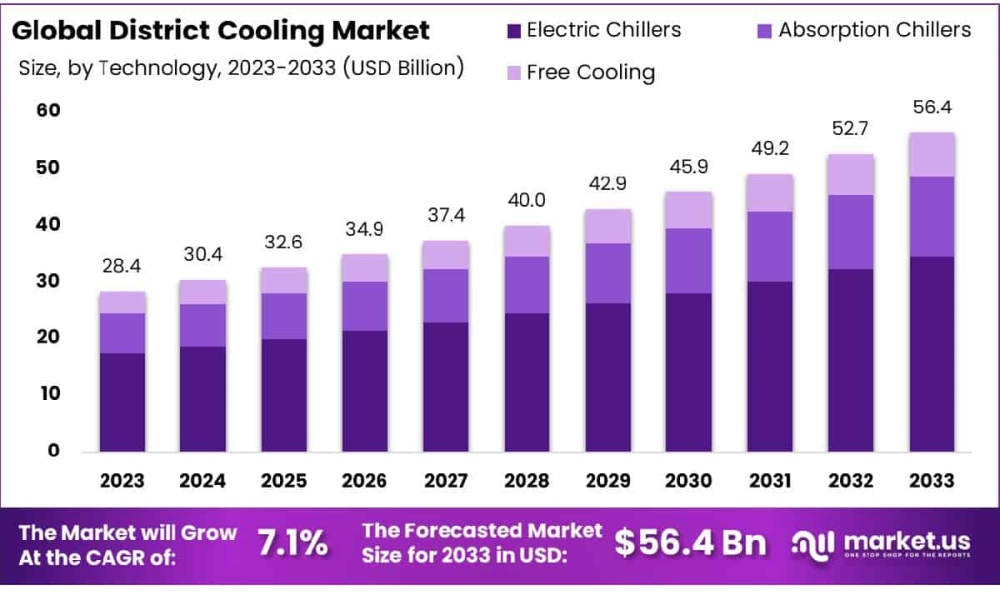
New York, NY – July 03, 2025 – The Global District Cooling Market is projected to expand significantly, with its size expected to increase from USD 28.4 billion in 2023 to approximately USD 56.4 billion by 2033, reflecting a compound annual growth rate (CAGR) of 7.1 % from 2024 to 2033. Market demand is being driven by accelerating urbanization and increasing population density, particularly in hot and densely populated regions, which are creating a growing need for efficient and large-scale cooling solutions.
Growth factors include mounting concerns over energy efficiency, rising temperatures due to climate change, and supportive government policies promoting sustainable infrastructure. The popularity of district cooling systems is rising, as these centralized systems offer up to 35 % energy savings compared to traditional individual cooling units and provide environmentally friendly alternatives for commercial, residential, and industrial applications.
Market opportunities are expanding through the integration of renewable energy sources, smart control systems, waste heat recovery, and innovative technologies such as absorption chillers and thermal energy storage. In addition, rapid construction of green buildings and urban master-planned developments is creating new avenues for expansion. Market expansion is expected across regions with favorable climatic conditions, such as the Middle East, Asia-Pacific, and North America, where environmental regulations, economic growth, and infrastructure upgrades are fueling adoption. Investments in district cooling infrastructure represent both a cost-effective and sustainable solution for meeting future cooling demand.
Important Revelation
- The Global District Cooling Market size is expected to be worth around USD 56.4 billion by 2033, from USD 28.4 billion by 2023, growing at a CAGR of 7.1% during the forecast period from 2024 to 2033.
- The District Cooling Market in the Middle East & Africa is valued at USD 11.0 billion, accounting for 38.9% of the market.
- Electric Chillers dominate with a 61.2% share, reflecting their widespread adoption.
- Small Cooling Systems under 5,000 RT hold a 42.5% market segment.
- Commercial Applications lead, utilizing 74.2% of district cooling technologies.
➤ Download Exclusive Sample Of This Premium Report (Including Full TOC, Table & Figures): https://market.us/report/district-cooling-market/request-sample/
Report Segmentation
By Technology
- Electric chillers led the district cooling technology segment in 2023, commanding a 61.2% market share. Their dominance stems from high efficiency, scalability, and compatibility with renewable energy sources, making them ideal for urban cooling needs amid rising global temperatures and urbanization. Absorption chillers, utilizing waste heat or alternative heat sources, held a notable market share. Popular in regions with high electricity costs or abundant waste heat, these chillers reduce operational costs and carbon emissions, aligning with sustainability goals.
- Free cooling, though a smaller segment, is gaining traction in cooler climates by leveraging ambient air to lower energy use, offering significant cost savings during colder months. The district cooling market is growing rapidly, driven by the demand for energy-efficient, eco-friendly cooling solutions. Electric chillers, absorption chillers, and free cooling each contribute uniquely to sustainable urban cooling.
By Cooling Capacity
- In 2023, small district cooling systems (<5,000 RT) captured a 42.5% market share, serving residential and small commercial facilities. Their cost-effectiveness and ease of installation in space-constrained urban areas drive their popularity. Medium systems (5,000–20,000 RT) cater to larger commercial buildings, hospitals, and educational institutions, offering flexibility and efficient energy management for moderate cooling needs.
- Large systems (>20,000 RT), with a smaller share, are vital for industrial complexes and large commercial hubs, providing high-efficiency cooling for extensive community-wide applications. As urbanization and sustainability priorities grow, demand for all cooling capacity segments is expected to rise, meeting diverse needs with energy-efficient solutions.
By End-Use
- Commercial applications dominated the district cooling market in 2023, holding a 74.2% share. Office buildings, shopping malls, and business parks favor district cooling for its cost-effective, reliable, and sustainable performance in high-demand settings. Residential applications, though smaller, are growing as awareness of energy efficiency and environmental benefits increases, particularly in residential complexes.
- Industrial applications, the smallest segment, are gaining interest in sectors like pharmaceuticals and food processing, where precise temperature control and cost savings are critical. The commercial sector leads market growth, with residential and industrial applications contributing to the expanding adoption of district cooling for its economic and environmental benefits.
Market Key Segmentation
By Technology
- Electric Chillers
- Absorption Chillers
- Free Cooling
By Cooling Capacity
- Small (<5,000 RT)
- Medium (5,000 – 20,000 RT)
- Large (>20,000 RT)
By End-Use
- Commercial
- Residential
- Industrial
Regional Analysis
The Middle East & Africa held a 38.9% share of the district cooling market in 2023, valued at USD 11.0 billion, driven by high cooling demand in hot climates. North America’s market growth is fueled by sustainable cooling adoption in urban centers, supported by strict environmental regulations and advanced infrastructure. Europe’s market is propelled by a focus on sustainability, with countries like Sweden, Germany, and France integrating renewable energy into district cooling systems to meet ambitious climate goals.
Asia Pacific is witnessing rapid growth due to urbanization and economic development, with countries like China, Japan, and India investing heavily in district cooling to support expanding urban and commercial sectors. The global district cooling market continues to expand, driven by regional demands for energy-efficient, sustainable cooling solutions tailored to diverse climatic and economic conditions.
Competitive Landscape
- Emirates Central Cooling Systems Corporation
- Engie
- Veolia
- ADC Energy Systems
- Emirates District Cooling LLC
- Keppel DHCS. Pte. Ltd
- Stellar Energy
- Ramboll Group A/S
- Shinryo Corporation
- Dalkia Company
- Danfoss
- Emicool
- Enwave Energy Corporation
- Marafeq Qatar
- National Central Cooling Company PJSC
Get in Touch with Us:
Market.us (Powered By Prudour Pvt. Ltd.)
Address: 420 Lexington Avenue, Suite 300, New York City, NY 10170, United States
Send Email: [email protected]
Refer More Related Reports:
Mexico Pecan Nuts Market
Natural Vanilla Market
Coumarin Market



