
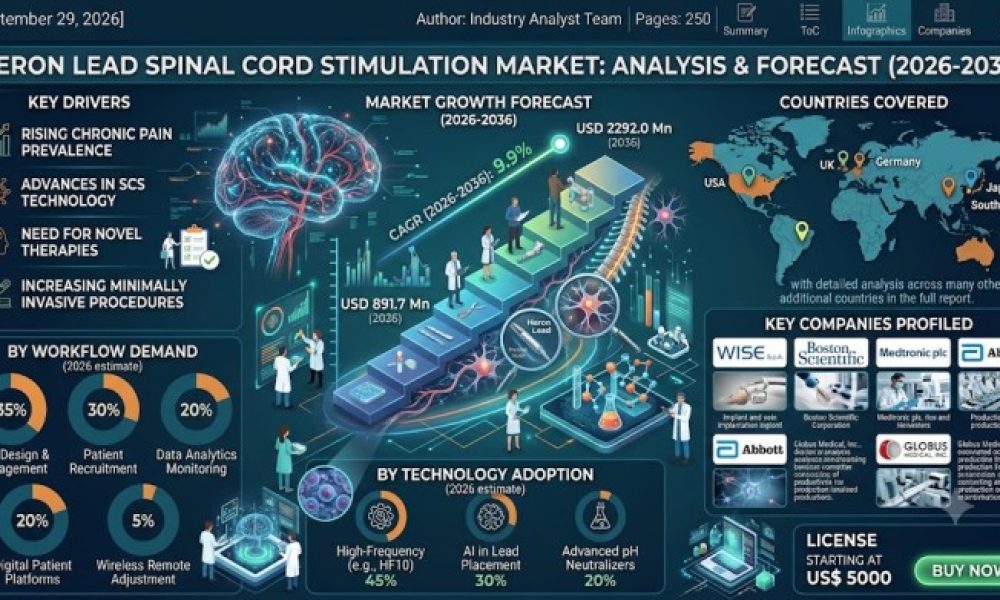
NEWARK, Del., September 29, 2026 — According to Future Market Insights, the global Heron Lead Spinal Cord Stimulation Market is valued at USD 891.7 million in 2026 and is projected to reach USD 2,292.0 million by 2036, expanding at a 9.9% CAGR during the forecast period from 2026 to 2036. Demand is being supported by pain specialists seeking focused dorsal-column coverage through expandable and minimally invasive leads. In January 2026, Boston Scientific reported three-year RELIEF registry data tracking more than 500 patients, providing longer-term outcome evidence for physicians evaluating spinal cord stimulation implants and follow-up pathways.
👉 Get Detailed Market Forecasts, Competitive Benchmarking, and Pricing Trends:
https://www.futuremarketinsights.com/reports/sample/rep-gb-34161
Global Segment Leaders
- Lead Type – Expandable Paddle Leads: 52.1% share in 2026 — Paddle-style field coverage delivered through a less invasive route supports demand among specialists seeking controlled dorsal-column targeting.
- Application – Chronic Pain Management: 32.9% share in 2026 — Persistent neuropathic and axial pain conditions sustain demand for durable relief and long-term therapy management.
- End User – Hospitals: 41.5% share in 2026 — Hospitals provide imaging access and specialist teams that coordinate implantation, postoperative programming, and revision planning.
- Technology – Directional Stimulation: 61.5% share in 2026 — Directional field steering enables focused neural coverage and contact selection across complex pain distributions.
Country-Level Performance
- South Korea – 11.8% CAGR (2026–2036): South Korea’s Ministry of Data and Statistics reported in September 2024 that residents aged 65 and older represented 19.2% of the population, supporting demand for specialist chronic-pain services.
- Japan – 11.0% CAGR (2026–2036): Japan’s Statistics Bureau reported in April 2025 that 36.243 million residents were aged 65 or older in 2024, creating a large population requiring age-related chronic-pain management.
- United States – 10.1% CAGR (2026–2036): Mykyta and Weeks reported in April 2026 that 90.3% of adults had a usual healthcare source during 2024, supporting continuity across screening and postoperative management.
- United Kingdom – 9.8% CAGR (2026–2036): NHS England reported in July 2025 a 7.36 million treatment-pathway waiting list, increasing attention to pathway efficiency among specialist pain services.
- Germany – 8.8% CAGR (2026–2036): Germany’s structured hospital evaluation and rigorous clinical-evidence requirements support carefully screened implantation programs.
The five profiled countries all record positive growth, with a 3.0-percentage-point spread between South Korea’s 11.8% CAGR and Germany’s 8.8%.
Regional Context
Fast-growing markets include South Korea, Japan, and the United States. South Korea’s growth is linked to concentrated tertiary hospitals, specialist education, and an aging population. Japan benefits from its established hospital infrastructure and the scale of its older population, while the United States combines extensive device availability with experienced neuromodulation practitioners and follow-up networks.
Moderate-growth markets include the United Kingdom and Germany. The UK is supported by specialist commissioning and organized public-care referral pathways, although capacity constraints are influencing technology reviews. Germany’s market is shaped by structured hospital evaluation and rigorous clinical-evidence requirements for implant programs.
The full report covers North America, Latin America, Western Europe, Eastern Europe, East Asia, South Asia and Pacific, and the Middle East and Africa, with country-level analysis including the United States, United Kingdom, Germany, Japan, and South Korea.
Market Drivers, Restraints and Opportunities
Directional expandable leads are a key market driver because they provide focused dorsal-column coverage through a percutaneous implantation pathway. Expandable contact deployment allows clinicians to shape stimulation fields while limiting the surgical burden associated with implantation.
Lead migration and explant exposure remain restraints. Mullins and colleagues reported in May 2024 that significant radiographic migration occurred in at least one lead across 62.0% of evaluated trials, increasing attention to deployment control and long-term epidural positioning. Gatzinsky and colleagues subsequently reported in December 2025 a 38.0% cumulative explantation risk at 10 years.
Responsive stimulation and MRI-compatible systems represent opportunities. Falcão and colleagues reported in January 2026 a 90.0% pooled pain-response rate across closed-loop studies, while MRI-compatible configurations address the imaging requirements of patients receiving long-term spinal cord stimulation.
Clinical evidence is also influencing treatment selection. Mekhail and colleagues reported in May 2024 that 77.6% of closed-loop participants achieved at least 50.0% pain reduction at 36 months, while Yue and colleagues reported an 85.3% responder rate among nonsurgical chronic-low-back-pain patients receiving spinal cord stimulation in June 2024.
👉 Access the Complete Report in PDF Format:
https://www.futuremarketinsights.com/reports/brochure/rep-gb-34161
Competitive Landscape
The market is led by WISE S.p.A., Boston Scientific Corporation, Medtronic plc, Abbott, and Globus Medical, Inc. WISE focuses on expandable directional lead development, while Boston Scientific and Medtronic compete through established spinal cord stimulation portfolios. Abbott brings BurstDR therapy and MRI-conditional configurations, while Globus Medical participates through its integrated musculoskeletal and neuromodulation portfolio.
Key Developments
- March 2025: Medtronic announced Canadian availability of its Inceptiv closed-loop rechargeable spinal cord stimulation system, expanding access to responsive chronic-pain treatment through automatic sensing and near-real-time therapy adjustment.
- April 2025: Globus Medical completed its acquisition of Nevro, making Nevro a wholly owned subsidiary and adding high-frequency spinal cord stimulation technologies to Globus Medical’s chronic-pain portfolio.
- December 2025: The S. Food and Drug Administration approved revised MRI conditions for Boston Scientific’s WaveWriter Alpha spinal cord stimulation mixed systems using compatible Medtronic Specify SureScan leads, expanding MRI-eligible lead compatibility.
Analyst Perspective
“Lead stability, not electrode design alone, is the quiet variable separating durable therapy from repeat procedures: radiographic migration in at least one lead across a majority of evaluated trials means expandable paddle designs earn their share only if deployment control translates into stable epidural positioning over time, not just favorable initial placement.”
— Anurag Sharma, Principal Consultant for Healthcare, Future Market Insights
About Future Market Insights
Future Market Insights (FMI) is a leading provider of market research and consulting services, offering syndicated and customized research across industries including healthcare, medical devices, and pharmaceuticals.
Access Full Report: https://www.futuremarketinsights.com/reports/heron-lead-spinal-cord-stimulation-market
About Future Market Insights (FMI)
Future Market Insights (FMI) is a global market intelligence and consulting firm providing comprehensive market research, competitive intelligence, and strategic business insights across industries. The firm delivers detailed forecasts, technology analysis, and data-driven recommendations that support informed decision-making for manufacturers, investors, distributors, and policymakers worldwide.
For Press & Corporate Inquiries
Rahul Singh
AVP – Marketing and Growth Strategy
Future Market Insights, Inc.
+91 8600020075



