
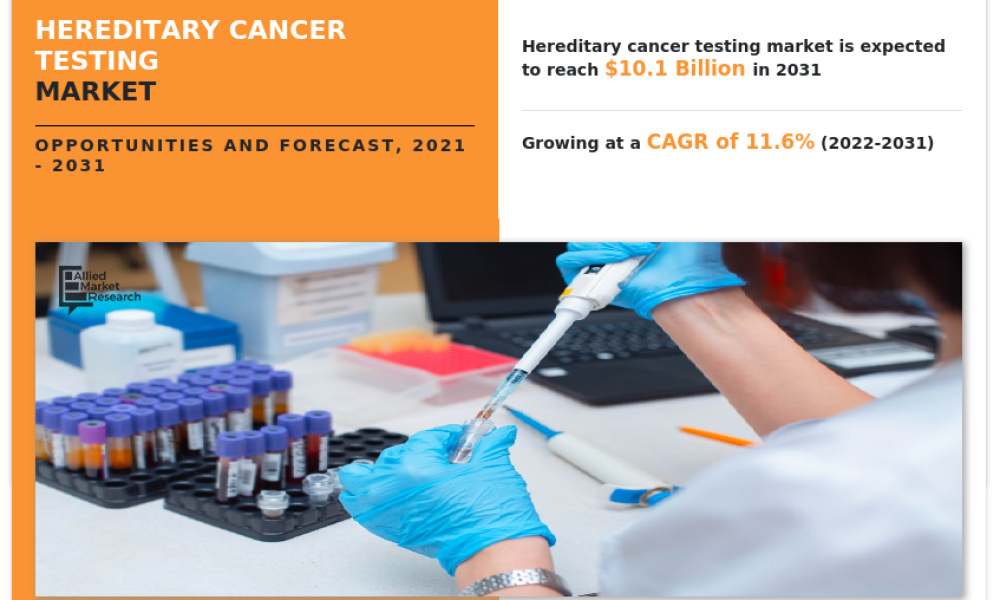
The global hereditary cancer testing market was valued at $3.5 billion in 2021 and is projected to reach $10.1 billion by 2031, growing at a robust CAGR of 11.6% from 2022 to 2031. This remarkable growth underscores the rising importance of genetic screening in identifying individuals at higher risk for cancer due to inherited genetic mutations. As awareness increases and technology advances, hereditary cancer testing is emerging as a cornerstone of modern preventive and personalized medicine.
Understanding Hereditary Cancer
Cancer develops when abnormal genetic mutations disrupt normal cell growth and division, causing uncontrolled cell proliferation. Although most cancers are caused by acquired mutations due to environmental factors, aging, or lifestyle, around 5–10% are hereditary. These cancers arise from germline mutations—genetic changes that are inherited from one or both parents and are present in virtually every cell of the body from birth.
Some of the most common hereditary cancers include:
Breast cancer (often linked to BRCA1 and BRCA2 gene mutations)
Ovarian cancer
Colorectal cancer
Prostate cancer
Gastric cancer
Identifying individuals with these inherited mutations can help in early diagnosis, preventive measures, and selecting appropriate treatment strategies. This is where hereditary cancer testing plays a critical role.
Key Market Drivers
Several factors are propelling the growth of the hereditary cancer testing market:
Aging Population: The global rise in geriatric population increases the risk of age-related diseases, including cancer.
Rising Cancer Incidence: Cancer remains one of the leading causes of death globally, prompting higher demand for early detection methods.
Increased Government Spending: Many governments are investing in improved healthcare infrastructure and cancer screening programs.
Technological Advancements: Next-generation sequencing (NGS) and AI-based analysis have significantly improved the speed and accuracy of genetic testing.
Favorable Reimbursement Policies: In several developed markets, insurance companies now cover part or all of the cost of hereditary cancer testing.
Market Challenges
Despite strong growth potential, the market faces some barriers:
High Cost of Testing: Advanced genetic tests can be expensive, especially in low- and middle-income countries.
Lack of Skilled Professionals: Interpreting genetic test results requires specialized knowledge, which is still lacking in many regions.
Ethical and Psychological Barriers: Fear of discrimination or emotional burden may deter individuals from opting for genetic testing.
Segmentation Overview
By Cancer Type
The market is segmented into breast, gastric, ovarian, prostate, colorectal, and other cancers. Among these, breast cancer holds the largest share, driven by increasing cases and public awareness. The availability of well-established genetic panels for BRCA mutations also contributes to its dominance.
By Test Type
Hereditary cancer testing is divided into predictive testing and diagnostic testing:
Predictive Testing: Expected to dominate due to its preventive value. It allows healthy individuals with a family history of cancer to understand their risk and take early action.
Diagnostic Testing: Used to confirm genetic mutations in individuals already diagnosed with cancer. Its use is growing, particularly in treatment planning.
By End User
Key end users include hospitals, diagnostic centers, and clinics. The hospital segment leads the market, driven by an increase in hospital infrastructure, advanced testing capabilities, and higher patient volumes. Hospitals are also preferred for genetic counseling and follow-up care.
Regional Market Insights
North America
North America currently dominates the hereditary cancer testing market due to:
High cancer prevalence
Advanced healthcare infrastructure
Strong presence of leading diagnostic companies
Supportive reimbursement landscape
Asia-Pacific
The Asia-Pacific region is projected to grow at the fastest pace, with a CAGR of 13.8%. Factors driving this growth include:
High population density in countries like India and China
Increasing awareness about genetic diseases
Rising healthcare expenditure
Expanding middle class with access to better healthcare
Competitive Landscape
The market is characterized by strategic collaborations, product innovations, and global expansion. Leading companies include:
Abbott Laboratories
Agilent Technologies, Inc.
Bio-Rad Laboratories, Inc.
Danaher Corporation
Eurofins Scientific SE
F. Hoffmann-La Roche AG
Illumina, Inc.
Myriad Genetics, Inc.
Qiagen N.V.
Thermo Fisher Scientific, Inc.
These companies are continuously investing in R&D, launching new hereditary cancer panels, and enhancing their diagnostic platforms to gain a competitive edge.
Future Outlook
The future of the hereditary cancer testing market is poised for substantial growth, shaped by technological innovations and a global shift toward precision medicine. Key trends expected to drive the next phase of market expansion include:
Integration with AI: AI can help in interpreting complex genetic data, improving diagnosis accuracy.
At-Home Testing Kits: User-friendly testing kits are making hereditary testing more accessible.
Expansion into Emerging Markets: Companies are increasingly focusing on Asia, Latin America, and Africa for new opportunities.
Conclusion
The hereditary cancer testing market is at the forefront of a paradigm shift in how we approach cancer prevention and treatment. With rising cancer awareness, government support, and cutting-edge technologies, this market is not only expanding rapidly but also playing a crucial role in saving lives through early detection and risk management. As barriers such as cost and accessibility continue to be addressed, hereditary cancer testing is likely to become a routine part of healthcare worldwide.




