
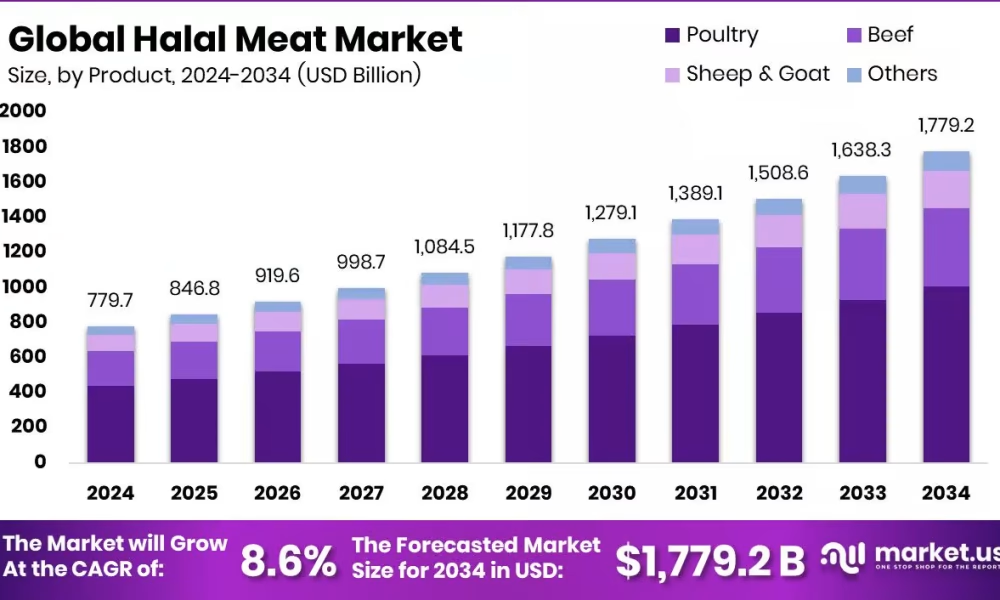
According to market.us, the Halal Meat Market is projected to reach approximately USD 1,779.2 billion by 2034, rising from USD 779.7 billion in 2024, with a robust compound annual growth rate (CAGR) of 8.6% during 2025–2034. This market comprises meat products that comply with Islamic dietary laws, attracting not only Muslim consumers but also a growing number of non-Muslims who perceive Halal products as safer, cleaner, and ethically sourced.
The rise in global Muslim population, coupled with increasing international migration and tourism, is expanding the reach and demand for Halal-certified meat in non-traditional regions such as Europe and North America.
Another major driver is the growing awareness and preference among younger consumers for branded and quality-assured Halal food. This segment is particularly concerned about food safety and ethical sourcing, leading to rising demand for properly certified products. Meanwhile, global beef production is led by countries with advanced processing and export capabilities.
One leading producer recorded 12.89 million tons of beef in 2022. China, which produced 7.18 million tons in the same year and has over 98 million cattle, remains the world’s top beef consumer. This large domestic demand, supported by increasing production capacity, plays a crucial role in shaping the global meat supply chain.
Key Takeaways
- Global Halal Meat Market is expected to be worth around USD 1,779.2 billion by 2034, up from USD 779.7 billion in 2024, and grow at a CAGR of 8.6% from 2025 to 2034.
- In the Halal Meat Market, poultry is notably predominant, holding a 56.7% share.
- Fresh halal meat is preferred, representing 62.3% of the market’s product type.
- B2B and wholesalers distribute 44.8% of halal meat, showcasing significant channel involvement.
- The food service sector is a major consumer, accounting for 58.3% of the market.
- Asia-Pacific captured 41.2% of the Halal Meat Market, valued at USD 321.2 billion.
Access a Complimentary Sample of This Premium Report: https://market.us/report/halal-meat-market/request-sample/
Factors Affecting the Growth of the Halal Meat Market
Rising Global Muslim Population: The consistent growth in the global Muslim population significantly fuels the demand for Halal meat. As more people adhere to Islamic dietary laws, the consumption of Halal-certified meat products increases, creating sustained demand across traditional and emerging markets.
Increasing Awareness of Halal Certification: There is growing awareness among both Muslims and non-Muslims regarding Halal-certified food. This includes a focus on hygiene, ethical sourcing, and humane animal treatment, which appeals to a broader consumer base beyond religious obligation, thereby expanding market reach.
Expansion in Non-Traditional Markets: Demand for Halal meat is no longer confined to Middle Eastern or Southeast Asian regions. Increasing immigration and cultural integration have led to greater consumption in regions like Europe and North America, where retailers and food chains are expanding Halal offerings to serve diverse communities.
Government Support and Regulatory Frameworks: Many governments in Muslim-majority countries and beyond have established regulatory standards for Halal certification. These frameworks ensure quality, safety, and authenticity, which boosts consumer confidence and facilitates smoother international trade in Halal meat products.
Technological Advancements in Halal Processing: Modern slaughtering and packaging technologies that comply with Halal standards are improving operational efficiency. This ensures scalability while maintaining religious compliance, enabling producers to meet growing global demand without compromising on ethical or religious practices.
Key Market Segmentation
By Product Analysis
In 2024, poultry emerged as the leading segment in the Halal Meat Market by product type, capturing a dominant 56.7% market share. This strong position is largely due to poultry’s widespread acceptance across various cultures observing halal practices, combined with its affordability and high protein content. Compared to red meat, poultry is easier to produce and has a lower environmental impact, aligning well with rising consumer preferences for sustainable and ethical food options.
The segment’s growth is further supported by streamlined halal certification processes that ensure global compliance and trust in poultry products. These developments have enabled wider distribution and innovative product offerings, reinforcing poultry’s role as the core driver in the Halal Meat Market’s expansion.
By Type Analysis
In 2024, the fresh meat segment dominated the Halal Meat Market by type, holding a significant 62.3% market share. This leadership is driven by strong consumer preference for freshly processed meats, which are widely perceived as healthier and more flavorful than frozen alternatives. The demand is especially pronounced in regions with large Muslim populations, where freshness and quality are central to halal dietary practices.
Advancements in cold chain logistics and the expansion of halal-certified slaughterhouses have ensured consistent quality and availability of fresh meat. Additionally, improved regulatory oversight has strengthened consumer confidence. Retailers and halal butchers have further boosted demand through live demonstrations and direct consumer engagement, reinforcing the appeal of fresh halal meat and maintaining the segment’s leading market position.
By Distribution Channel Analysis
In 2024, the B2B/Wholesaler segment led the Halal Meat Market by distribution channel, accounting for a 44.8% share. This dominance highlights the key role wholesalers play in bridging meat processors with various retail outlets, including supermarkets, restaurants, and small retailers. Their capacity to handle large volumes efficiently supports widespread market reach.
Wholesalers also ensure halal compliance by coordinating closely with certifiers and maintaining proper logistics and storage systems to preserve product integrity. As global demand for halal meat continues to rise, wholesalers remain essential in managing complex supply chains and facilitating cross-border distribution, reinforcing their strong position in the market.
By End-user Analysis
In 2024, the food service segment held a leading position in the Halal Meat Market by end-user, capturing a 58.3% market share. This dominance is driven by the widespread use of halal meat in restaurants, catering services, and other dining establishments that cater to a growing global Muslim population seeking meals aligned with Islamic dietary laws.
The segment’s growth is further supported by the rising number of halal-certified food outlets in both Muslim-majority and non-Muslim countries. These establishments not only fulfill religious needs but also appeal to consumers seeking ethically sourced and high-quality food. The increasing focus on ingredient transparency and ethical sourcing has further strengthened the food service sector’s role in expanding the reach of halal meat globally.
Key Market Segments
By Product
- Poultry
- Beef
- Sheep and Goat
- Others
By Type
- Fresh
- Processed
- Sausages
- Cold Cuts
- Ready-to-eat Meat Meals
- Others
By Distribution Channel
- B2B/Wholesaler
- Supermarkets/Hypermarkets
- Convenience Stores
- Online Retail
By End-user
- Food Service
- Household
Regional Analysis
In 2024, Asia-Pacific led the global Halal Meat Market with a dominant 41.2% share, valued at USD 321.2 billion. This leadership is driven by a large Muslim population, rapid urbanization, and strong demand in countries such as Indonesia, Malaysia, and India. North America is also a significant market, fueled by rising halal awareness among non-Muslims and a growing Muslim immigrant population in the U.S. and Canada.
Europe continues to see notable growth, particularly in France, Germany, and the U.K., where demand for halal-certified meat is increasing. The Middle East & Africa region remains a traditional core market due to religious practices, although its growth is steady. In Latin America, market expansion is gradual, with Brazil emerging as a key halal meat exporter to Muslim-majority nations.
Top Key Players in the Market
- BRF Global
- Thomas International
- Tyson Foods, Inc.
- Hormel Foods Corp
- Nema Halal
- Crescent Foods
- Harris Ranch Beef Co.
- Midamar Corporation
- Danish Crown
- Vion
- Bigard
- Al Kabeer Group ME
- Amana Foods
- Al Islami Foods
- Tariq Halal
- Tahira Foods Ltd
- Saffron Road
- American Foods Group, LLC
- Tallgrass Beef
- Ena Meat Packing
- Al-Aqsa
- SIS Company
- Prairie Halal Foods
- DOUX
- Other Key Players
Get in Touch with Us:
Market.us (Powered By Prudour Pvt. Ltd.)
Address: 420 Lexington Avenue, Suite 300 New York City, NY 10170, United States
Send Email: [email protected]
Refer More Related Reports:



