
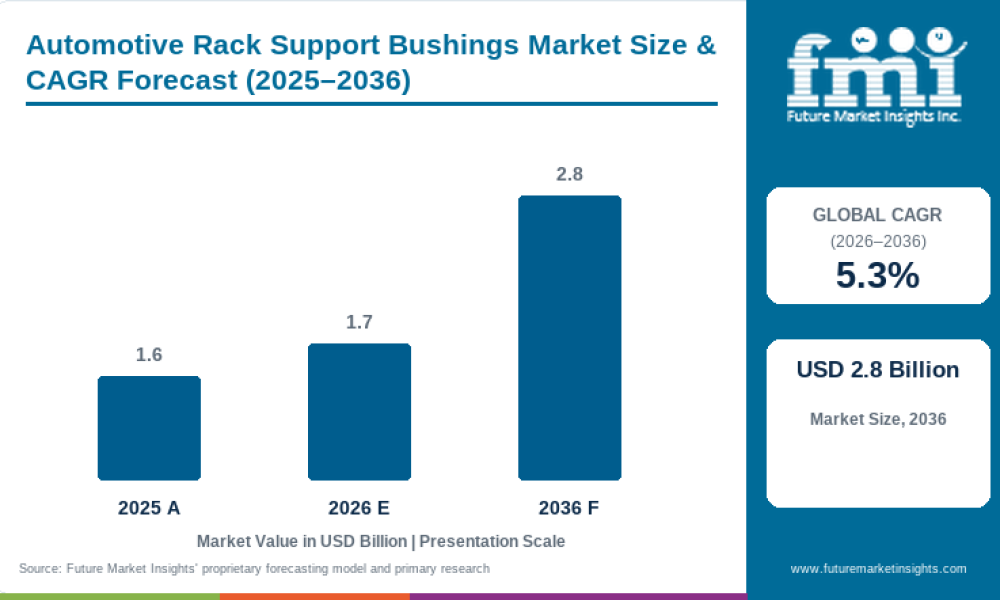
The global automotive rack support bushings market is projected to grow from USD 1.7 billion in 2026 to USD 2.8 billion by 2036, registering a CAGR of 5.3% over the forecast period. The market was valued at USD 1.6 billion in 2025. Demand is supported by steering-system development, vehicle-level noise and durability requirements, and the need for bushings that balance compliance, rack positioning, steering precision, and long-term performance.
Rack support bushings help locate and support the steering rack while controlling vibration and unwanted movement at the chassis interface. Their stiffness, geometry, and material characteristics influence steering response, noise isolation, and durability. As automakers refine electric power steering and steer-by-wire systems, suppliers face greater expectations to demonstrate consistent performance under application-specific loading conditions.
Vehicle electrification is adding to these requirements. In February 2023, Vibracoustic reported that current-generation battery electric vehicles can be 18% to 24% heavier than comparable internal-combustion vehicles. The company also noted that quieter powertrains expose road and chassis noise that combustion engines previously masked. Higher vehicle mass can increase static preload and dynamic loading at steering-system interfaces, while reduced powertrain noise makes bushing-related vibration and sound more noticeable.
These conditions are encouraging OEM chassis teams to specify validated bushing compounds and geometries rather than relying solely on generic mounting elastomers. Suppliers must demonstrate noise isolation, rack positioning, stiffness consistency, and durability together to meet vehicle-level performance requirements.
What Are the Key Factors Shaping the Automotive Rack Support Bushings Market?
Demand is shaped by steering-system architecture, vehicle weight, noise and vibration targets, and the requirements of individual vehicle platforms. Rack support bushings must maintain controlled compliance without allowing excessive steering-rack movement.
- Application-specific stiffness: Bushing stiffness influences rack positioning and steering response, making compound and geometry selection important for vehicle-level calibration.
- Noise and vibration control: Quieter electric powertrains can make road and chassis noise more apparent, increasing the importance of vibration isolation.
- Durability under load: Heavier vehicle platforms can place additional demands on steering-system mounting interfaces, requiring validated performance across operating conditions.
- Electric steering integration: Electric power steering and steer-by-wire programs still depend on mechanical support and controlled rack movement, even when steering feel is managed electronically.
- Fitment and qualification: Vehicle-specific geometry and performance requirements can make supplier validation and production consistency important purchasing considerations.
Get detailed market forecasts, competitive benchmarking, and pricing trends:
https://www.futuremarketinsights.com/reports/sample/rep-gb-35577
Which Countries Are Showing the Strongest Growth in the Automotive Rack Support Bushings Market?
The Czech Republic is projected to record the fastest growth among the profiled countries, with a 6.0% CAGR from 2026 to 2036. Its automotive manufacturing base supports demand for components used in export-oriented vehicle programs. AutoSAP reported in January 2026 that 92.5% of the 1,445,776 passenger vehicles produced in the country during 2025 were exported. This production structure creates opportunities for suppliers able to meet platform-specific specifications, production volumes, and quality requirements.
Mexico is expected to expand at a 5.6% CAGR. The country’s export-oriented automotive sector supports demand for steering and chassis components across established vehicle programs. INEGI recorded 309,453 light vehicles produced and 289,598 exported in July 2025. Suppliers must provide consistent fitment, predictable stiffness, and dependable production quality to support vehicle assembly and cross-border supply chains.
Brazil is projected to grow at a 5.3% CAGR. Demand is influenced by automotive production and the need for steering components that meet vehicle-specific durability and performance requirements. Suppliers must balance material performance and cost while maintaining consistent dimensions and functional characteristics.
The United States is expected to record a 5.0% CAGR. The market benefits from both original equipment requirements and replacement demand. S&P Global Mobility reported in May 2025 that the average light-vehicle age reached 12.8 years. An aging vehicle fleet creates opportunities for replacement components, although purchasing decisions depend on correct fitment, reliable performance, and availability across vehicle applications.
France is projected to expand at a 4.6% CAGR. Demand reflects the requirements of vehicle manufacturers and suppliers seeking steering-system components that support noise control, durability, and predictable steering response. Application-specific validation remains important as vehicle platforms evolve.
Germany is expected to grow at a 4.3% CAGR. Electrified-vehicle production and vehicle-level validation requirements influence bushing specifications. The VDA reported that Germany produced 1.67 million electric passenger cars in 2025. For suppliers, this environment increases the importance of demonstrating stiffness consistency, vibration control, and durability across electrified vehicle platforms.
Japan is projected to record the lowest growth rate among the profiled countries, at a 3.9% CAGR. Demand depends on vehicle production, steering-system design, and replacement requirements. Suppliers must maintain tight manufacturing tolerances and demonstrate that their compounds and geometries meet the performance expectations of individual vehicle programs.
How Is the Competitive Landscape Evolving?
Competition in the automotive rack support bushings market is influenced by materials engineering, geometry development, application validation, and production consistency. Buyers increasingly evaluate suppliers on their ability to demonstrate steering precision, vibration isolation, and durability together rather than assessing a bushing solely by material or unit price.
The connection between steering support and vehicle-level noise and durability assessment is particularly important. Rack-support designs are evaluated alongside automotive suspension systems, since chassis vibration and road inputs can influence the performance of multiple interconnected components.
As electric power steering and steer-by-wire systems evolve, suppliers must continue to meet mechanical support requirements even where electronic controls increasingly influence steering feel. This creates a need for close coordination among bushing manufacturers, steering-system suppliers, and OEM chassis engineering teams.
Production qualification is another competitive factor. Changes in compound, geometry, or stiffness may require validation against vehicle-specific requirements. Suppliers that provide repeatable manufacturing quality and dependable fitment can help customers manage qualification risk and maintain consistent performance across production lots.
Drive Your Business Growth Strategy: Checkout the Report for Key Insights!
https://www.futuremarketinsights.com/checkout/35577
What Is Driving Demand for Automotive Rack Support Bushings?
Electric vehicle weight and chassis loading
Battery electric vehicles can weigh more than comparable internal-combustion vehicles, increasing the importance of validating component loads and chassis interfaces. Rack support bushings must maintain their intended stiffness and positioning characteristics under the applicable loading conditions. Suppliers that demonstrate durability under these requirements can support the development of electrified vehicle platforms.
Greater attention to noise and vibration
Quieter powertrains can expose road and chassis noise that was previously masked by engine operation. Bushing performance therefore contributes to the broader vehicle refinement target. Manufacturers must balance vibration isolation with the stiffness needed to maintain steering-rack positioning and response.
Steering-system evolution
Electric power steering and steer-by-wire architectures introduce different calibration and integration requirements. Although electronic systems can influence steering feel, mechanical rack support remains important for controlling movement and maintaining the required structural relationship between steering components and the chassis. Application-specific validation helps ensure that the bushing works within the intended steering architecture.
Replacement demand from an aging fleet
The average age of light vehicles in the United States reached 12.8 years in May 2025, according to S&P Global Mobility. Older vehicles create a replacement opportunity for steering and chassis components as wear and maintenance needs emerge. Aftermarket suppliers must support accurate fitment and reliable replacement availability across vehicle applications.
What Are the Key Market Restraints?
Vehicle-specific requirements can increase development and qualification costs. A bushing that meets general material specifications may still require adjustments to stiffness, shape, or compound to meet an individual platform’s steering and noise targets. Such changes can extend validation timelines and make it difficult to substitute components without additional engineering work.
Suppliers must also balance competing performance objectives. Greater compliance can help isolate vibration, while excessive movement may compromise rack positioning and steering response. Achieving the appropriate stiffness window across different loads and operating conditions requires careful design, material selection, and testing.
What Opportunities Exist for Automotive Rack Support Bushing Manufacturers?
Opportunities are emerging in application-specific bushing designs for electric power steering, steer-by-wire systems, and vehicles with higher mass or more demanding noise targets. Manufacturers that combine material expertise with vehicle-level validation can help OEMs meet steering precision and refinement requirements.
The replacement market also offers opportunities for suppliers that provide broad fitment coverage, consistent quality, and reliable parts availability. In export-oriented production hubs such as the Czech Republic and Mexico, dependable manufacturing and delivery can support high-volume vehicle programs. In markets with aging fleets, clear application coverage can help repair channels identify suitable replacement components.
How Is the Automotive Rack Support Bushings Market Segmented?
The market outlook is influenced by the vehicle platform, steering-system architecture, material formulation, and purchasing channel. Suppliers must align product specifications with the required balance of compliance, steering precision, noise isolation, and durability.
Key demand considerations include:
- By application: Rack support designs developed for different vehicle and steering-system architectures.
- By material: Elastomer compounds and other material formulations selected according to stiffness, durability, and vibration-control requirements.
- By vehicle type: Passenger vehicles and other vehicle categories with different mass, packaging, and operating requirements.
- By sales channel: Original equipment supply and replacement channels with different qualification and fitment needs.
- By region: Automotive manufacturing hubs and replacement markets with differing production volumes and sourcing practices.
What Is the Outlook for the Automotive Rack Support Bushings Market?
The automotive rack support bushings market is projected to reach USD 2.8 billion by 2036, advancing at a 5.3% CAGR from 2026 to 2036. Demand is supported by steering-system development, vehicle-level noise and durability requirements, and the need for validated bushing designs across conventional and electrified platforms.
The Czech Republic is expected to lead the profiled countries with a 6.0% CAGR, followed by Mexico at 5.6%, while Japan is projected to grow at 3.9%. Across markets, suppliers that can demonstrate application-specific stiffness, stable rack positioning, noise isolation, and durable performance will be better positioned to meet evolving OEM and aftermarket requirements.
About Future Market Insights
Future Market Insights (FMI) provides market research and consulting services, delivering market forecasts, competitive intelligence, and industry analysis to support business planning and strategic decisions across global markets.



