
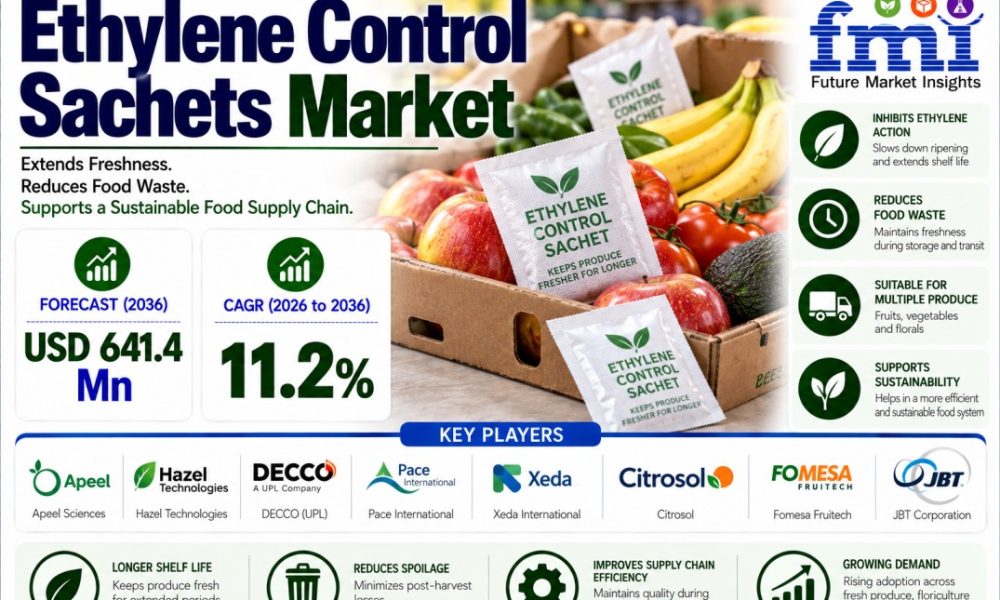
The global ethylene control sachets market is projected to grow from USD 221.8 million in 2026 to USD 641.4 million by 2036, registering a compound annual growth rate (CAGR) of 11.2%, according to Future Market Insights (FMI). Demand is supported by fresh-produce handlers seeking to manage ripening, protect saleable quality and reduce losses during storage and distribution.
Ethylene management can help produce businesses coordinate inventory with planned release dates, particularly when fruit must remain in storage or travel long distances before reaching consumers. However, results depend on the commodity, cultivar, treatment method and operating conditions. Suppliers must demonstrate that a treatment can deliver repeatable results under the packhouse or storage conditions in which it will be used.
👉 Get Detailed Market Forecasts, Competitive Benchmarking, and Pricing Trends: https://www.futuremarketinsights.com/reports/sample/rep-gb-35161
Edible Coatings Lead Product-type Demand
Edible coatings are projected to account for 42.0% of product-type demand in 2026. Applied during existing packhouse handling steps, these coatings can support surface protection and freshness management without necessarily requiring a separate treatment-room process.
By commodity, pome and stone fruit are expected to account for 43.4% of demand in 2026. Apples and other storage-sensitive fruits can remain in commercial storage for extended periods, making ripening control important to inventory planning, quality preservation and the timing of market release.
The packhouse is projected to represent 38.3% of demand by application point. At this stage, operators can assess crop condition, destination requirements and planned storage duration before the produce enters a longer and less controlled distribution process.
Biological-microbial approaches are forecast to account for 50.9% of demand by technology base in 2026. Their commercial adoption depends on validated efficacy for the target commodity and application, as well as compliance with applicable requirements. Results from one fruit type should not automatically be assumed to apply to another.
Reducing Produce Losses Strengthens the Business Case
The Food and Agriculture Organization of the United Nations reported in September 2025 that fruits and vegetables had the highest global food-loss rate, at 25.4%. This highlights the scale of the challenge facing fresh-produce supply chains, although the figure does not measure losses attributable specifically to ethylene.
Nandini Roy Choudhury, Principal Consultant at Future Market Insights, explains: “Ethylene control earns repeat business only if treatment preserves a planned release window under the packhouse’s real crop and room conditions. The stronger commercial offer couples crop-specific efficacy with dosing support that lets operators reproduce the result during storage and shipment.”
For packhouses, the commercial objective is to preserve quality without disrupting routine operations. Treatment economics depend on whether the resulting reduction in spoilage or downgrading justifies the cost of the product, application and technical support.
This makes treatment consistency a key purchasing consideration. Room conditions, dose delivery, cultivar response and application timing can affect outcomes. Suppliers that provide clear instructions and practical technical support can help operators establish protocols before expanding treatment across larger volumes.
Packhouse Suppliers Lead Sales Channels
Packhouse suppliers are projected to account for 42.5% of sales-channel demand in 2026. These suppliers are positioned close to day-to-day handling operations and can help customers connect treatment selection with line throughput, crop condition and storage schedules.
Direct sales and post-harvest service providers also serve the market. The choice of channel often depends on how much application guidance a customer requires and whether the treatment needs to be integrated into existing equipment or handling processes.
In September 2025, Citrosol reported the reconstruction and expansion of its manufacturing plant, increasing capacity and centralizing quality controls for post-harvest products. In April 2025, Citrosol and Innoprint held a technical conference in Chile for packhouse professionals, focusing on post-harvest treatment decisions and application practices.
These activities highlight the importance of production consistency and field-level support in helping customers implement treatment programs.
Country Growth Outlook
FMI projects South Korea to record the highest CAGR among the profiled countries at 10.8% from 2026 to 2036. Germany follows at 10.5%, while the United States is forecast to grow at 10.2%. The United Kingdom is projected at 9.9%, and Japan at 8.9%.
South Korea’s forecast reflects opportunities to expand crop-specific programs and packhouse trials. Germany’s established fruit-storage operations create a setting where new treatments must fit existing quality controls. In the United States, large apple-handling volumes support demand for protocols designed around cultivar response and long storage periods.
The United Kingdom’s reliance on imported fruit makes arrival quality and remaining shelf life important considerations. Japan’s premium-fruit programs place particular emphasis on appearance, firmness and color, requiring local validation before treatment protocols are extended to new crops.
These growth rates describe forecast market expansion rather than absolute market size. For suppliers, commercial success will also depend on technical coverage, crop-specific evidence and the ability to support customers during seasonal peaks.
👉 Access Detailed Market Insights: https://www.futuremarketinsights.com/reports/brochure/rep-gb-35161
Competitive Landscape and Industry Developments
Companies profiled in the ethylene control sachets market include Apeel Sciences, Hazel Technologies, DECCO (UPL), Pace International, Xeda International, Citrosol, Fomesa Fruitech and JBT Corporation.
The competitive landscape spans produce coatings, active freshness management, post-harvest treatment chemistry and application-support systems. These businesses approach freshness management through different technologies and points in the supply chain, making crop-specific performance and service capabilities important differentiators.
In March 2025, Hazel Technologies developed a BreatheWay modified-atmosphere pallet bag for broccoli shipments designed to eliminate the need for ice after precooling and palletization. In May 2025, AgroFresh and Biotalys entered a collaboration to develop biological fungicides for post-harvest produce protection. JBT Corporation completed its combination with Marel in January 2025, expanding its food-processing equipment and service platform.
These developments illustrate wider investment in produce preservation and post-harvest systems. Their relevance to an individual ethylene-control program depends on the crop, treatment mechanism and operating conditions.
Outlook
The ethylene control sachets market is positioned for growth as produce handlers seek to protect quality through longer storage and distribution windows. Yet the opportunity depends on more than the availability of a preservation product.
Suppliers that demonstrate crop-specific efficacy, provide practical application guidance and help packhouses reproduce results can strengthen the case for repeat purchasing. For buyers, validating treatment performance under real operating conditions remains essential to reducing quality losses while maintaining planned release schedules.
To explore how FMI Custom Research can support your strategic priorities, connect with our team at – [email protected]
About Future Market Insights (FMI)
Future Market Insights, Inc. is an ESOMAR-certified, ISO 9001:2015 market research and consulting organization trusted by Fortune 500 companies. With a global presence across the U.S., UK, India, and Dubai, FMI delivers data-driven insights across 30+ industries and 1200 markets worldwide.



