
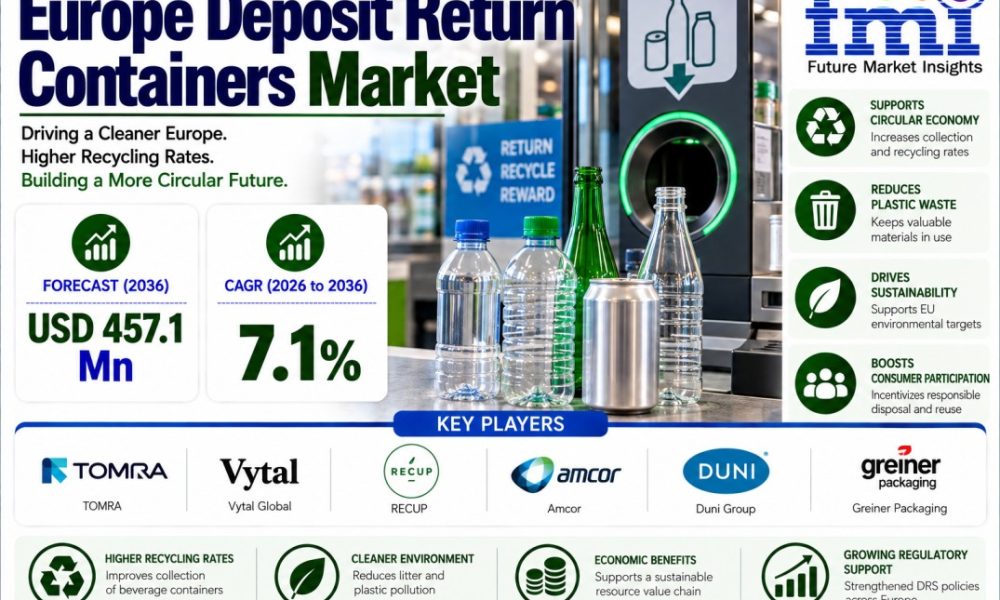
The Europe deposit return containers market is projected to grow from USD 230.2 million in 2026 to USD 457.1 million by 2036, registering a compound annual growth rate (CAGR) of 7.1%, according to Future Market Insights (FMI). Demand is being shaped by foodservice operators adapting packaging specifications to reuse requirements, return routines and the practical costs of collecting, cleaning and redistributing containers.
For operators, the commercial challenge extends beyond selecting a container. A return-ready format must fit foodservice workflows, remain suitable for repeated handling where designed for reuse, and move efficiently through collection and cleaning systems. Low return rates, container losses and washing costs can undermine the economics of a programme even when the initial purchase price is competitive.
>> Access detailed market insights: https://www.futuremarketinsights.com/reports/brochure/rep-gb-35172
Standard Formats Lead Market Demand
Standard formats are projected to account for 37.0% of format-type demand in 2026. Common dimensions can simplify pooling, sorting, stacking and handling at return points. They can also reduce the number of container and lid variations that operators need to manage across multiple locations.
By material, paperboard is forecast to account for 32.0% of demand in 2026. Paperboard formats remain relevant to foodservice purchasing through familiar converting and printing processes, particularly in take-back and recovery-oriented applications. Their suitability depends on the intended use and whether the format is designed for recovery after use or for repeated circulation.
Standard meal formats are expected to represent 39.0% of format-size demand in 2026. Their dimensions can accommodate common takeaway portions while supporting efficient stacking, delivery-bag use and handling in commercial washing systems where the design is intended for reuse.
Delivery platforms are projected to account for 28.0% of end-use demand in 2026. Digital ordering provides a way to communicate return instructions and deposit terms during checkout, helping connect packaging use with the return process.
Return Rates Determine Total-cycle Economics
The economics of a deposit-backed container depend on how often it completes a usable rotation. A container that is lost after one use, returned in poor condition or delayed in collection can increase replacement costs and reduce the value of the reuse programme.
Nandini Roy Choudhury, Principal Consultant at Future Market Insights, explains: “Return-ready containers should be judged by completed rotations because losses and washing can erase a low unit price. Commercial value comes from formats that fit return hardware and cleaning capacity while preserving foodservice speed.”
This makes return rates, cleaning capacity and handling efficiency important factors in supplier qualification. Operators need to consider how customers return containers, how outlets store used packaging, how containers reach washing facilities and how clean stock is redistributed.
Shared washing facilities can help reduce the investment required from individual restaurant groups. ADEME’s 2025 survey identified 45 shared packaging washing centres in France, illustrating the role that shared infrastructure can play in supporting reuse programmes.
European Packaging Rules Influence Procurement
The European Union’s Packaging and Packaging Waste Regulation, Regulation (EU) 2025/40, began applying on 12 August 2026. The regulation establishes common packaging rules, including requirements that affect reusable and takeaway foodservice packaging.
For covered takeaway operators, the regulation provides for accepting customer-provided containers from February 2027 and offering reusable packaging from February 2028, subject to the applicable provisions and exemptions. These milestones increase the importance of selecting containers that satisfy relevant food-contact requirements and fit a practical return process.
The transition is not uniform across every packaging application. Deposit-backed beverage-container systems and reusable meal-container programmes have different collection, washing and redistribution needs. Foodservice operators therefore need to evaluate the specific requirements of their packaging format rather than assume that beverage-return infrastructure automatically accommodates meal boxes.
Country Growth Outlook
FMI projects the United Kingdom to record the highest CAGR among the profiled countries at 8.2% from 2026 to 2036. Italy follows at 7.9%, while France is forecast to grow at 7.6%. Germany is projected at 7.3% and Spain at 7.0%.
The United Kingdom’s forecast reflects investment in return infrastructure and growing familiarity with refundable deposits. Italy’s institutional catering market can provide predictable volumes, while France’s shared washing network offers a potential route to lower operating costs for pooled programmes.
Germany’s established takeaway reuse activity places emphasis on return convenience and consistent container specifications. Spain’s fragmented hospitality base can make collection density more difficult to achieve outside major urban centres.
These growth rates indicate expected market expansion rather than absolute market size. For suppliers, commercial success will depend on local return infrastructure, washing access, customer density and the ability to supply compatible formats at scale.
>> Get Detailed Market Forecasts, Competitive Benchmarking, and Pricing Trends: https://www.futuremarketinsights.com/reports/sample/rep-gb-35172
Competitive Landscape and Industry Developments
Companies profiled in the Europe deposit return containers market include TOMRA, Amcor, Duni Group, Novolex, Sabert Corporation Europe, Graphic Packaging International, Greiner Packaging, Vytal Global and RECUP.
The competitive landscape includes return-system operators, reusable foodservice platforms and packaging manufacturers. TOMRA, Vytal Global and RECUP are associated with return or circulation infrastructure, while Duni Group, Greiner Packaging and Amcor offer reusable formats for foodservice programmes. Novolex, Sabert Corporation Europe and Graphic Packaging International serve foodservice accounts across conventional and recovery-focused packaging formats.
Recent developments demonstrate continued investment in return systems. In March 2025, Eco-Products, a Novolex brand, partnered with OZZI to expand access to reusable foodservice containers and tracking systems. In June 2025, Greiner Packaging deployed reusable drinking cups at the DEKRA Lausitzring motorsport venue in Germany. In February 2026, RECUP expanded its reusable cup system to all 120 Tchibo coffee bars in Austria.
These deployments show how container design, tracking and collection infrastructure can be combined in practical reuse programmes. Their success depends on return participation, cleaning logistics and the suitability of formats for the participating venues.
Outlook
The Europe deposit return containers market is expected to expand as foodservice operators translate packaging requirements into procurement decisions and operating procedures. The central challenge is to make return systems practical for customers, outlets and logistics partners.
Suppliers that provide compatible formats, clear handling specifications and support for circulation workflows can help customers manage the shift. For operators, the strongest business case will depend on completed rotations, return rates and washing efficiency—not simply the purchase price of each container.
To explore how FMI Custom Research can support your strategic priorities, connect with our team at – [email protected]
About Future Market Insights (FMI)
Future Market Insights, Inc. is an ESOMAR-certified, ISO 9001:2015 market research and consulting organization trusted by Fortune 500 companies. With a global presence across the U.S., UK, India, and Dubai, FMI delivers data-driven insights across 30+ industries and 1200 markets worldwide.



