
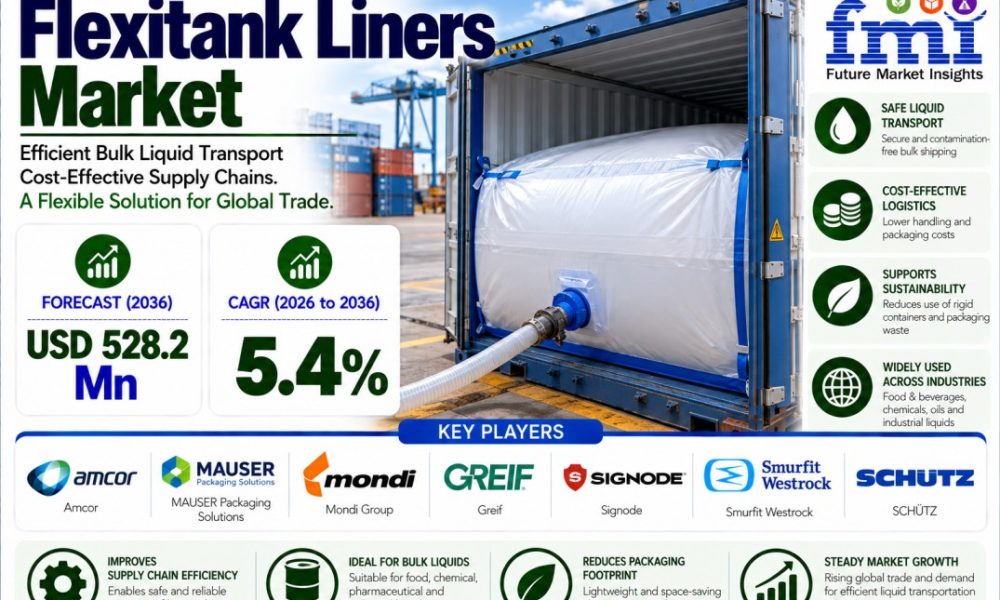
The global flexitank liners market is projected to grow from USD 312.2 million in 2026 to USD 528.2 million by 2036, registering a compound annual growth rate (CAGR) of 5.4%, according to Future Market Insights (FMI). Demand is linked to the movement of bulk liquids across international supply chains, where packaging performance can affect cargo integrity, discharge efficiency and the economics of each shipment.
Flexitank liners and related liner-integrated bulk-liquid packaging provide a product-contact solution for selected transport applications. Their suitability depends on the liquid being shipped, the filling process, the required barrier performance and the conditions expected during transit and discharge. A lower purchase price alone may not justify a supplier change when a failure could result in product loss, contamination or operational disruption.
Access detailed market insights: https://www.futuremarketinsights.com/reports/brochure/rep-gb-35192
Single-use Flexitanks Lead Product-type Demand
Single-use flexitanks are projected to account for 45.0% of product-type demand in 2026. These systems suit export movements where a fresh product-contact layer can avoid the need to return a dedicated tank for reuse. The economics depend on the route, cargo characteristics, loading arrangements and the handling procedures followed by the shipper.
By material, rigid plastics are forecast to account for 30.0% of demand in 2026. These systems can combine a durable outer structure with a replaceable inner product-contact component, supporting familiar handling and stacking practices at industrial facilities.
The 200–1,000-litre capacity segment is expected to represent 37.0% of the market in 2026. Intermediate formats provide more volume per handling unit than smaller containers while allowing receiving facilities to manage storage and discharge without committing an entire freight container to one liquid.
Chemicals are projected to account for 29.0% of end-use demand in 2026. Chemical shippers must assess compatibility, permeability and stress-cracking risks before approving a liner. Food ingredients, agricultural liquids, construction and automotive applications, and energy-related uses introduce their own performance requirements.
Qualification Is Central to Cargo Protection
Flexitank liners operate within a transport system that includes filling equipment, fittings, container preparation, transit handling and discharge procedures. A liner that performs well under one set of conditions may not be suitable for another liquid or process.
Nandini Roy Choudhury, Principal Consultant at Future Market Insights, explains: “Flexitank liners earn account retention after the pack survives the shipper’s real filling and discharge conditions. Manufacturers should compare barrier performance with installation control and recovery support because a failure can erase the freight saving from several successful loads.”
The Container Owners Association’s flexitank quality framework emphasizes design-specific qualification and independent testing. This makes documented performance and application-specific assessment important parts of supplier approval.
For procurement teams, the qualification process should cover the intended cargo, filling conditions, installation requirements, barrier needs and discharge arrangements. Suppliers that provide clear technical documentation and practical application support can help customers assess a new design without treating price as the only decision criterion.
Trade Routes and Liquid Exports Support Demand
Long-distance shipping can increase the commercial consequences of leakage, contamination or delayed discharge. UN Trade and Development reported in September 2025 that vessel rerouting increased seaborne trade ton-miles by 5.9% during 2024. Longer transport routes can raise exposure to freight costs and make packaging reliability more consequential.
Bulk wine is another established application. The International Organisation of Vine and Wine reported in May 2026 that bulk wine accounted for 34.0% of global wine export volume in 2025. This provides a recurring transport base for suitable one-way liquid packaging, although adoption still depends on cargo-specific requirements.
Food oils and chemical liquids require different barrier and compatibility assessments. Suppliers therefore need to match the liner design to the liquid and shipping process rather than assume that a single structure can serve every bulk-liquid application.
Direct Industrial Accounts Lead Sales Channels
Direct industrial accounts are projected to represent 52.0% of sales-channel demand in 2026. Direct relationships allow packaging suppliers to work with plant engineers, procurement teams and shipping specialists on compatibility trials, traceability and specification approval.
Distributors remain relevant where customers need local inventory and routine supply. Rental and pooling arrangements serve programs that specify reusable outer transport assets or broader packaging services.
For manufacturers, direct technical engagement can be particularly valuable when the liner forms part of an approved transport process. Clear records and coordinated support can help reduce avoidable delays during qualification and subsequent replenishment.
Spain Leads the Country Growth Forecast
FMI projects Spain to record the highest CAGR among the profiled countries at 7.3% from 2026 to 2036. Turkey follows at 7.0%, while the United States is forecast to grow at 6.7%. South Korea is projected at 6.4%, Australia at 6.1% and Italy at 5.8%.
Spain’s food-liquid export activity and port access support opportunities for bulk-liquid packaging. Turkey’s manufacturing and export base creates demand for dependable local supply and technical assistance. In the United States, industrial customers may prioritize site-level approval and documented compatibility. Australia’s long export routes make puncture resistance and oxygen control important considerations for sensitive liquids.
These growth rates indicate expected expansion, not the relative size of each national market. Suppliers must also consider cargo mix, account access, technical-service coverage and the time required to qualify a liner.
👉 Get Detailed Market Forecasts, Competitive Benchmarking, and Pricing Trends: https://www.futuremarketinsights.com/reports/sample/rep-gb-35192
Competitive Landscape and Industry Developments
Companies profiled in the flexitank liners market include Amcor, MAUSER Packaging Solutions, Mondi Group, Greif, Signode, Smurfit Westrock, SCHÜTZ, Sonoco, Nefab and International Paper.
The competitive landscape spans flexible-material manufacturers, integrated intermediate bulk container (IBC) suppliers and industrial packaging businesses with adjacent transit-protection capabilities. Product performance, qualification records, filling support and regional service coverage can influence customer retention.
Recent developments include Amcor’s completion of its combination with Berry Global in April 2025. In January 2025, SCHÜTZ signed a licence agreement with Saudi Arabia’s National Plastic Factory Company for local production of 1,000-litre ECOBULK IBCs, with first deliveries scheduled for 2026. Smurfit Westrock also highlighted a WorldStar-winning bag-in-box solution for cleaning products in January 2025.
These developments demonstrate activity across adjacent liquid-packaging systems and regional supply infrastructure. Their relevance to a particular flexitank liner program depends on the cargo, packaging configuration and customer’s handling requirements.
Outlook
The flexitank liners market is expected to expand as bulk-liquid exporters continue to evaluate packaging systems that support efficient transport without compromising cargo integrity. However, market growth will depend on more than shipping volumes alone.
Manufacturers that combine appropriate barrier performance with controlled installation, reliable discharge and documented qualification will be better positioned to compete for repeat business. For shippers, the priority is to evaluate the full transport process and the cost of potential failure—not just the price of the liner.
To explore how FMI Custom Research can support your strategic priorities, connect with our team at – [email protected]
About Future Market Insights (FMI)
Future Market Insights, Inc. is an ESOMAR-certified, ISO 9001:2015 market research and consulting organization trusted by Fortune 500 companies. With a global presence across the U.S., UK, India, and Dubai, FMI delivers data-driven insights across 30+ industries and 1200 markets worldwide.



