
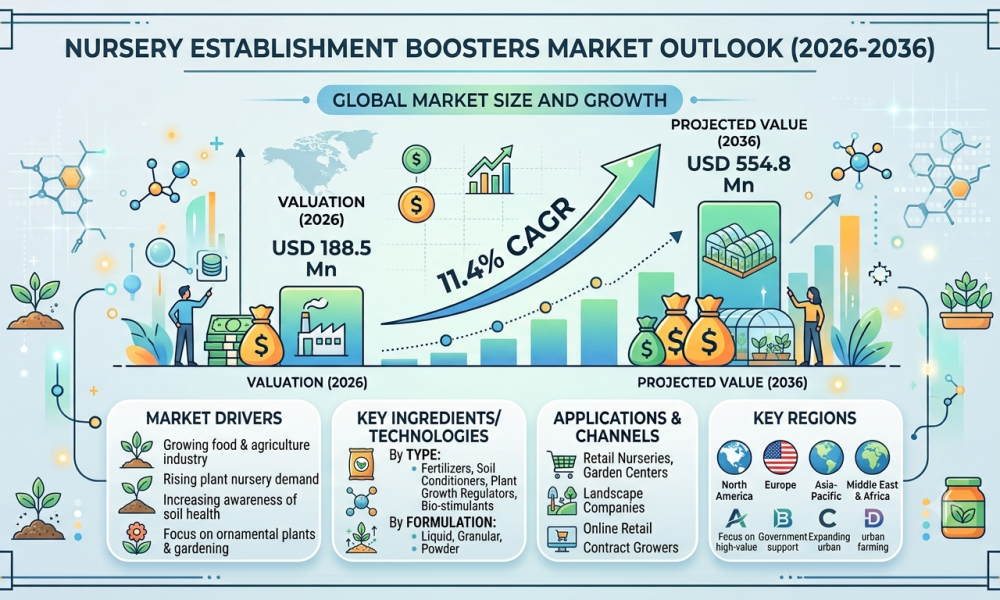
The global nursery establishment boosters market is projected to grow from USD 188.5 million in 2026 to USD 554.8 million by 2036, registering a CAGR of 11.4% during the forecast period. Demand is supported by the need for stronger early root development, more uniform crop establishment, improved planting efficiency, and reduced losses associated with uneven emergence and transplant stress. Growers are increasingly considering establishment-support products that can be integrated into existing seed treatment, soil application, and irrigation programs.
Amino acid and peptide-based products are gaining importance because they can be applied at low doses through seed treatment, root drenching, soil placement, and fertigation. Soil application remains a leading delivery method, while cereals and grains represent a major crop category due to the potential for repeatable treatments across extensive planted areas. Commercial farms are also evaluating products through controlled field trials, comparing crop stand, root development, and early biomass before expanding their use. Compatibility with existing farm operations and demonstrated crop-specific performance are expected to influence purchasing decisions.
Get detailed market forecasts, competitive benchmarking, and pricing trends:
https://www.futuremarketinsights.com/reports/sample/rep-gb-35775
Global Segment Leaders
- Product Type – Amino Acid and Peptide-Based Products: 38.8% in 2026. These products lead the category as low-dose formulations can be incorporated into seed treatment, root drenching, soil placement, and fertigation programs.
- Crop Type – Cereals and Grains: 46.2% in 2026. Extensive planted areas and the suitability of seed and in-furrow treatments support demand across broad-acre crop production.
- Application Method – Soil Application: 40.7% in 2026. Direct placement near seeds and developing roots makes soil application an important option during early crop growth.
- Farm Type – Large Commercial Farms: 44.3% in 2026. Standardized planting equipment and the ability to conduct field trials across multiple blocks support adoption among larger agricultural operations.
- Sales Channel – Agri-Input Distributors: 41.6% in 2026. Local product availability, agronomic guidance, and planting-season inventory support distributors’ leading position.
Country-Level Performance
South Korea is projected to record the fastest growth among the profiled countries, with an 11.0% CAGR through 2036. The country’s expansion of smart greenhouses and controlled irrigation systems creates opportunities for products compatible with measured fertigation and root-zone application.
Germany is expected to grow at a 10.7% CAGR, supported by its extensive vegetable production and demand for crop-specific establishment programs. The United States is forecast to expand at a 10.4% CAGR, benefiting from a substantial commercial horticulture base and established wholesale distribution channels.
The United Kingdom is projected to register a 9.9% CAGR, as vegetable production, changing weather conditions, and water availability concerns sustain interest in early root-support products. Japan is expected to grow at a 9.4% CAGR, supported by efforts to address agricultural labor constraints through automation, smart agriculture, and more efficient input application.
Regional Context
South Korea and Germany represent two important growth markets, with projected CAGRs of 11.0% and 10.7%, respectively. South Korea’s expanding smart-agriculture infrastructure supports measured product application in protected cultivation, while Germany’s outdoor vegetable production creates opportunities for soil-applied and root-zone treatments. The United States, at a projected CAGR of 10.4%, benefits from commercial horticulture operations and established agricultural distribution networks.
The United Kingdom and Japan are also expected to see continued adoption, with projected CAGRs of 9.9% and 9.4%, respectively. In the UK, uneven planting conditions and water constraints increase the importance of early crop establishment. In Japan, labor-saving agricultural practices and smart-farming technologies may support products that fit existing irrigation and transplanting operations.
The full report covers North America, Latin America, Western Europe, Eastern Europe, East Asia, South Asia and Pacific, and the Middle East and Africa, with individual country analysis for key markets.
Access full Report in PDF Format@ https://www.futuremarketinsights.com/reports/brochure/rep-gb-35775
Competitive Landscape
The competitive landscape includes Plant Health Care, Compo Expert, Valagro, UPL, Rovensa Next, Hello Nature, Acadian Plant Health, and Biolchim. Companies compete through product formulation, biological ingredient development, root-support applications, distribution reach, and compatibility with existing crop management practices. Product portfolios span peptide-based technologies, seaweed-derived biostimulants, microbial-enhanced blends, and soil or fertigation solutions.
Competition is also shaped by growers’ expectations for reliable crop-specific performance and practical application methods. Manufacturers are focusing on integrating establishment-support products into seed treatment, in-furrow placement, and irrigation programs to reduce the need for separate field operations. Local agronomic support, application guidance, and evidence from field trials remain important factors in building repeat demand.
Recent developments include Syngenta’s expansion of biological production capacity at its Orangeburg facility in June 2025, with annual capacity reported at 16,000 tons of plant biostimulants. In August 2025, Acadian Plant Health added its fifth CE-marked biostimulant under the EU Fertilising Products Regulation. Rovensa Next introduced GALACTEK in February 2026, targeting root strength, nutrient uptake, and early-season growth. These developments reflect continued activity in biological products and solutions designed to support early crop development.
About Future Market Insights (FMI)
Future Market Insights, Inc. (ESOMAR certified, recipient of the Stevie Award, and a member of the Greater New York Chamber of Commerce) offers profound insights into the driving factors that are boosting demand in the market. FMI stands as the leading global provider of market intelligence, advisory services, consulting, and events for the Packaging, Food and Beverage, Consumer Technology, Healthcare, Industrial, and Chemicals markets. With a vast team of over 400 analysts worldwide, FMI provides global, regional, and local expertise on diverse domains and industry trends across more than 110 countries.



