
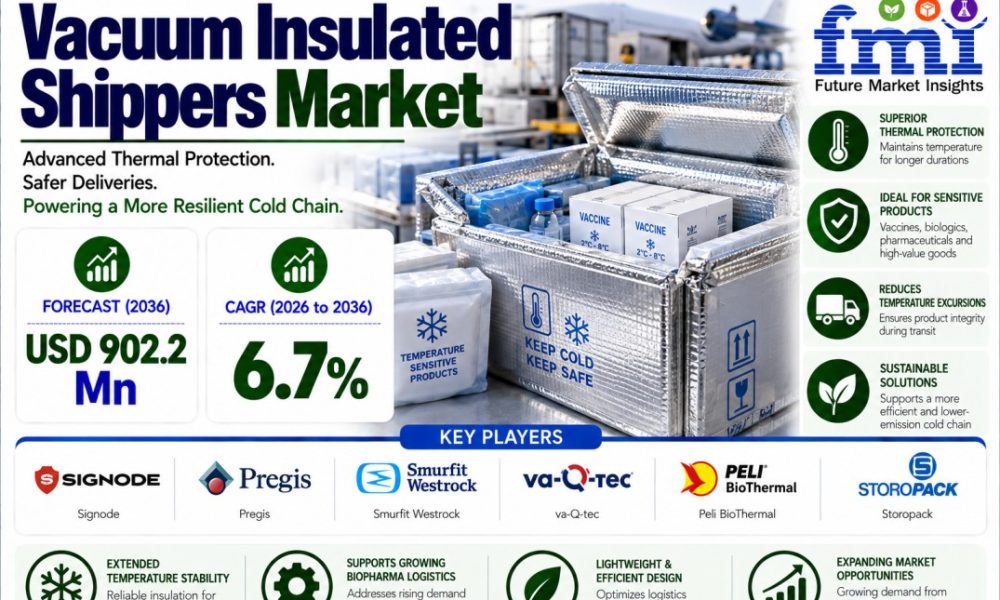
The global vacuum insulated shippers market is projected to grow from USD 471.7 million in 2026 to USD 902.2 million by 2036, registering a compound annual growth rate (CAGR) of 6.7%, according to Future Market Insights (FMI).
October 12, 2026 — Demand for vacuum insulated shippers is expected to increase as e-commerce, healthcare distribution and other temperature-sensitive shipping applications require packaging that protects goods throughout transit. The commercial challenge is to maintain the required temperature conditions without adding unnecessary weight, packing time or recovery costs.
Unlike ordinary protective packaging, insulated shipping systems must be matched to the payload and shipping route. Routine parcels may require standard-duty protection for a defined transit window, while sensitive healthcare shipments can require documented thermal performance and additional qualification. This distinction influences product design, purchasing decisions and supplier selection.
👉 Access detailed market insights: https://www.futuremarketinsights.com/reports/brochure/rep-gb-35197
Standard Formats Lead Market Demand
Standard formats are projected to account for 40.0% of format-type demand in 2026. Common dimensions simplify inventory management, packing instructions and freight planning, allowing fulfillment teams to use repeatable pack-out procedures across sites.
By material, paper-based systems are forecast to hold a 32.0% share in 2026. These systems appeal to buyers seeking thermal protection alongside practical fiber-recovery and disposal options. More demanding applications may still require vacuum panels, phase-change materials or other engineered insulation components, depending on the required protection window.
Standard-duty systems are expected to represent 40.0% of performance-class demand in 2026. For routine shipping lanes, buyers often prioritize dependable protection and straightforward handling over maximum thermal duration. Heavy-duty and temperature-assured formats remain important when cargo sensitivity or route conditions justify more demanding specifications.
E-commerce and parcel applications are projected to account for 35.0% of end-use demand. Direct accounts are forecast to represent 43.0% of sales-channel demand, reflecting the role of design support, qualification and implementation planning in larger shipping programs.
Thermal Performance Must Match the Route
The choice of an insulated shipper depends on more than insulation depth. Payload size, ambient exposure, transit duration, refrigerant conditioning, assembly time and freight dimensions all affect the economics of a shipment.
Nandini Roy Choudhury, Principal Consultant at Future Market Insights, states: “The commercial test for an insulated shipper is not maximum thermal duration. It is whether the chosen pack-out protects the payload for the real lane while keeping freight, assembly and recovery steps under control. Suppliers that make performance easy to specify and repeat will convert more trials into recurring programs.”
For buyers, this means assessing the actual shipping lane before choosing a system. A package designed for a short, predictable journey may not suit a route with longer transit times or greater temperature variability. Where temperature-sensitive medicinal products are involved, applicable good-distribution practices can require qualified equipment and documented controls.
Qualification can add time and cost to implementation. Refrigerant conditioning, cold storage and reusable-asset handling may also create operational demands. Suppliers that simplify pack-out procedures while providing suitable performance evidence can help reduce friction during approval and routine use.
E-commerce Growth Supports Recurring Demand
Every fulfilled order creates another packaging requirement. As online retail expands, more shipments need physical protection, and some also require thermal control for food, healthcare and other sensitive goods.
The US Census Bureau reported first-quarter 2026 retail e-commerce sales of USD 326.7 billion, up 9.8% from the same quarter a year earlier. This growth provides context for the recurring packaging demand associated with parcel fulfillment.
However, the market opportunity is not limited to maximizing insulation. Dimensional efficiency, reduced void space and easy assembly can lower handling and shipping costs. For high-value or temperature-sensitive goods, the cost of a shipment failure may justify more advanced protection, provided the system is appropriately qualified for the route.
Recyclability and Reuse Influence Design Choices
European packaging policy is increasing attention to recyclability and reuse. Regulation (EU) 2025/40 raises the importance of these considerations across packaging supply chains from August 2026.
This creates opportunities for fiber-heavy liners, reusable transport formats and designs that use only the insulation required for the application. Yet material choice must remain linked to performance. A recyclable structure is not a substitute for documented thermal protection where the payload requires it.
The most commercially useful designs combine appropriate insulation with manageable assembly, efficient freight dimensions and a practical recovery or reuse process. The aim is to reduce total logistics cost rather than shift expense from packaging materials to handling or disposal.
Country Growth Forecast
FMI projects the following country-level CAGRs for 2026 to 2036, ranked from highest to lowest:
| Country | CAGR |
| United Arab Emirates | 8.4% |
| Saudi Arabia | 8.1% |
| South Korea | 7.8% |
| United States | 7.5% |
| United Kingdom | 7.2% |
| Germany | 6.9% |
| France | 6.6% |
| Japan | 6.1% |
The United Arab Emirates leads the profiled markets by projected growth rate, followed by Saudi Arabia and South Korea. These forecasts indicate market growth pace rather than absolute market size.
In the UAE and Saudi Arabia, increasing digital purchasing and the need for dependable local supply create opportunities for standardized and temperature-assured formats. South Korea’s frequent online orders place value on fast assembly and replenishment. In the United States and United Kingdom, fulfillment scale makes dimensional efficiency important, while European packaging rules increase attention to material recovery. Japan’s demand spans food, electronics and healthcare, each with different protection requirements.
👉 Get Detailed Market Forecasts, Competitive Benchmarking, and Pricing Trends: https://www.futuremarketinsights.com/reports/sample/rep-gb-35197
Competitive Landscape
Companies profiled in the vacuum insulated shippers market include Signode, Pregis, Smurfit Westrock, va-Q-tec, Peli BioThermal, Storopack, Cold Chain Technologies, Sealed Air, Sonoco ThermoSafe and Ranpak.
The competitive landscape spans temperature-controlled logistics specialists, protective-packaging manufacturers and fiber-based parcel solutions. Companies compete through thermal engineering, standardization, custom pack-out design, reusable systems, material efficiency and implementation support.
Recent product activity illustrates this range. Cold Chain Technologies introduced the CCT Tower Elite in 2025 with compatibility for Euro and US pallets. In May 2025, the company also launched the TRUEtemp Naturals shipper, a curbside-recyclable parcel solution using recycled materials. These developments highlight efforts to combine thermal protection with more practical handling and recovery options.
Outlook
The vacuum insulated shippers market is projected to expand as parcel volumes and temperature-sensitive distribution create recurring demand for thermal protection. Growth will depend on matching performance to the shipment rather than specifying the highest level of insulation for every application.
Suppliers that make performance easier to qualify, simplify pack-out operations and support practical recycling or reuse pathways can help customers manage both shipment risk and total logistics cost.
To explore how FMI Custom Research can support your strategic priorities, connect with our team at – [email protected]
About Future Market Insights (FMI)
Future Market Insights, Inc. is an ESOMAR-certified, ISO 9001:2015 market research and consulting organization trusted by Fortune 500 companies. With a global presence across the U.S., UK, India, and Dubai, FMI delivers data-driven insights across 30+ industries and 1200 markets worldwide.



