
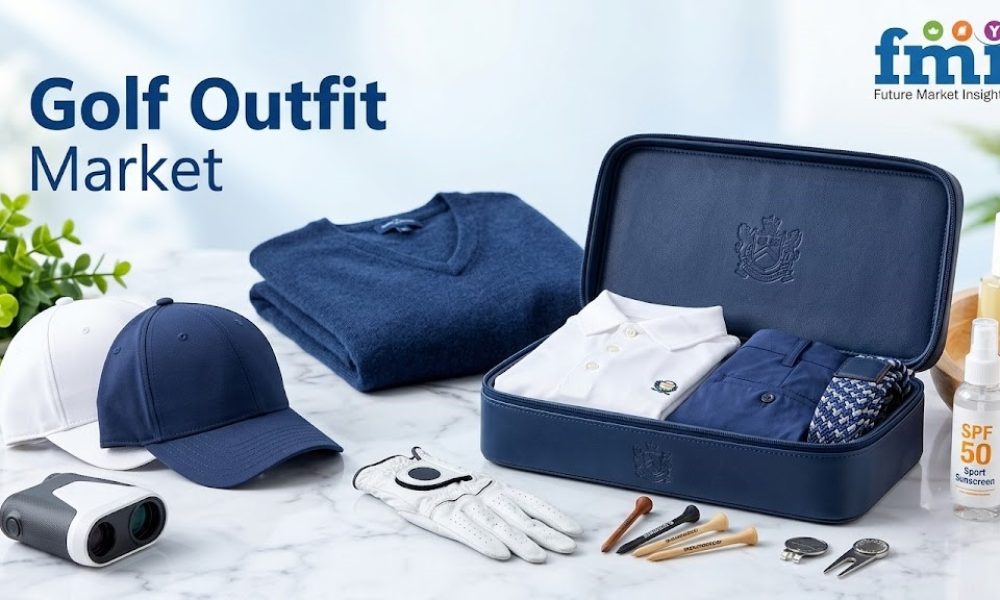
The global golf outfit market is projected to reach USD 2.9 billion by 2036, up from USD 1.4 billion in 2026, according to a new report by Future Market Insights (FMI). The market, valued at USD 1.3 billion in 2025, is forecast to expand at a 7.8% CAGR from 2026 to 2036, creating an absolute opportunity of USD 1.5 billion over the forecast period.
The research identifies top wear as the leading product segment, accounting for 34.0% of the market in 2026. Polo shirts, performance pullovers, quarter-zip tops, wind shirts and other golf-specific outerwear remain central to apparel purchasing as golfers increasingly seek clothing that combines course functionality with contemporary styling.
Get detailed market forecasts, competitive benchmarking, and pricing trends: https://www.futuremarketinsights.com/reports/sample/rep-gb-14747
Golf Participation and Changing Consumer Demographics Support Market Expansion
Growth in golf participation is a key factor supporting demand for golf-specific apparel. The expansion of participation among younger golfers, women and junior players is broadening the consumer base beyond the traditional male golfer demographic.
At the same time, casual golf formats and entertainment-oriented venues are influencing apparel preferences. Consumers are increasingly looking for golf clothing that can transition from the course to casual settings, strengthening the crossover between golf apparel and the broader athleisure market.
Performance functionality is also becoming an established requirement. Moisture-wicking fabrics, UV protection and four-way stretch are increasingly incorporated into golf apparel as consumers expect technical performance alongside fit, comfort and contemporary design.
Top Wear Leads as Golf Apparel Moves Toward Athletic-Inspired Styling
Top wear holds a 34.0% share of the product segment in 2026, with golf polo shirts representing the highest-volume individual product category. Performance outerwear and pullovers provide additional demand across seasonal and weather-variable playing conditions.
Golf apparel design is also moving beyond traditional conservative styling. Modern athletic influences, stronger color combinations and contemporary prints are increasingly being incorporated into collections aimed at younger consumers.
Men remain the larger consumer segment, accounting for 68.0% of the market in 2026. However, women golfers represent a rapidly expanding demographic, encouraging brands to develop more dedicated women’s ranges with gender-specific fits, designs and performance features. Junior participation is creating another product opportunity for age-specific golf apparel.
Athleisure Crossover Creates New Consumption Opportunities
The report highlights the growing role of athleisure in golf apparel demand. Products designed for both on-course performance and everyday casual use can increase consumption occasions while broadening the potential customer base.
This crossover is also influencing product development and positioning. Golf apparel companies are increasingly balancing technical requirements with lifestyle-oriented aesthetics, allowing products to appeal to consumers who value versatility in addition to golf-specific functionality.
Seasonality remains an industry challenge, particularly in temperate markets. Weather-dependent golf participation can create significant fluctuations in purchasing patterns, requiring retailers and brands to manage spring and summer inventory carefully and account for markdown risks associated with unsold seasonal products.
United States Leads Country Growth
The United States is projected to register a 4.2% CAGR through 2036, supported by its large golf participation base, established specialty retail infrastructure and consumer spending on premium golf apparel.
South Korea follows with a 4.1% CAGR, reflecting strong golf popularity, fashion-oriented consumer preferences and the presence of domestic and international golf apparel brands. The European Union is projected to grow at 4.0% CAGR, supported by golf tourism, European Tour influence and premium golf resort merchandising.
The United Kingdom and Japan are forecast to expand at 3.8% and 3.9% CAGR, respectively. UK demand benefits from an established golf culture and variable weather that supports demand for outerwear and layering products, while Japan’s fashion-conscious golf culture supports premium apparel consumption.
Competitive Landscape
The competitive landscape includes global athletic brands with golf divisions alongside dedicated golf apparel companies. Nike Golf holds a leading competitive position, supported by its broad apparel portfolio, athletic performance technology and contemporary designs across men’s and women’s categories.
Other prominent companies include Adidas Golf, Under Armour, Puma Golf, Callaway Golf Company, FootJoy, TravisMathew and Peter Millar. Competition centers on performance fabric technology, design aesthetics, brand recognition, distribution reach and golf-related visibility.
In 2025, Nike Golf expanded its women’s golf apparel line with performance fabrics targeting the growing female golfer demographic across North American and Asian markets. Also in 2025, TravisMathew, part of Callaway Golf, launched a premium lifestyle golf collection aimed at younger golfers seeking versatile course-to-casual apparel.
Rahul Pandita, Principal Consultant at FMI, said, “Golf apparel brands that can deliver performance fabric technology, modern design aesthetics, and versatile on-to-off-course wearability are positioned to capture the expanding consumer base as golf participation diversifies and athleisure trends influence course dress codes through 2036.”
Access the Complete Report in PDF Format: https://www.futuremarketinsights.com/reports/brochure/rep-gb-14747
Report Scope
The Golf Outfit Market study covers commercially traded golf outfit products across product type, consumer orientation, buyer type, sales channel, material and pricing tier. The study covers 2026 to 2036, with 2025 as the base year, across North America, Latin America, Western Europe, Eastern Europe, East Asia, South Asia and Pacific, and the Middle East and Africa.
The research covers more than 30 countries, including the United States, South Korea, the United Kingdom, Japan and Germany. Golf footwear, golf gloves, golf bags and equipment, and general athletic wear not specifically designed and marketed for golf play are excluded from the market scope.
Business Impact
FMI helps organizations transform market complexity into strategic clarity, enabling leadership teams to identify growth opportunities faster, optimize resource allocation, strengthen competitive positioning, and make high-stakes business decisions with confidence.
To explore how FMI Custom Research can support your strategic priorities, please connect with our team at – [email protected]
About Future Market Insights (FMI)
Future Market Insights, Inc. (FMI) is an ESOMAR-certified, ISO 9001:2015 market research and consulting organization, trusted by Fortune 500 clients and global enterprises. With operations in the U.S., UK, India, and Dubai, FMI provides data-backed insights and strategic intelligence across 30+ industries and 1200 markets worldwide.



