

Gas Lift System Market Overview
According to a new report published by Allied Market Research, the gas lift system market size was valued at $1.8 billion in 2022, and is estimated to reach $3.8 billion by 2032, growing at a CAGR of 7.6% from 2023 to 2032.
A gas lift system is a method used in the oil and gas industry to artificially lift fluids, typically crude oil, from a wellbore to the surface. This technique involves injecting gas into the well to reduce the density of the fluid column, making it easier for the reservoir fluids to flow to the surface.
Download PDF Brochure: https://www.alliedmarketresearch.com/request-sample/220913
North America held the highest gas lift system market share in terms of revenue in 2022, accounting for nearly two-fifths of the global gas lift system market size, and is likely to dominate the market forecast.
The Asia-Pacific region is expected to witness the fastest CAGR of 8.36% from 2023 to 2032. The Asia-Pacific region presents significant growth potential in the gas lift system industry.
Emerging markets, such as India, China, and Southeast Asian countries, have witnessed rapid industrial growth which provide gas lift system market opportunities for the development.
The key players operating and profiled in the gas lift system market report include Baker Hughes Company, ChampionX, Weatherford International plc, Schlumberger Limited, Saudi Arabian Oil Co. (Saudi Aramco), National Oilwell Varco, Inc., Tendeka, Emerson Electric Co., Spoc Automation, Inc., and Tally Energy Services.
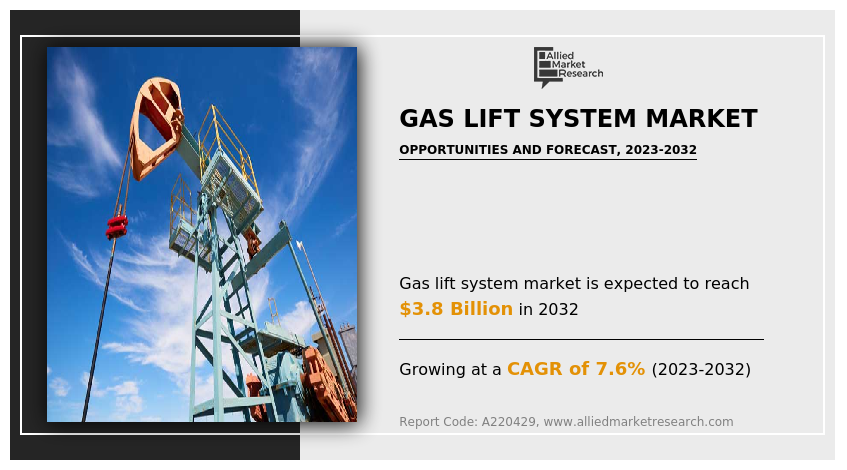
The gas lift system market is a vital component of the oil and gas industry, primarily designed to enhance reservoir pressure and facilitate the extraction of crude oil from subterranean reservoirs.
Gas lift systems come into play when the inherent reservoir energy is insufficient to naturally propel the oil to the surface, serving as a critical means to recover additional crude oil from the reservoir.
How It Works
- Gas Injection: Compressed gas (usually natural gas) is injected into the production tubing through gas lift valves.
- Pressure Reduction: The injected gas mixes with the produced fluid, reducing its overall density.
- Fluid Flow Enhancement: The lower density fluid column creates a pressure differential, allowing the fluid to flow more efficiently to the surface.
On the basis of lift type, the market is bifurcated into gas lift, and others. On the basis of component, the market is segmented into mandrels, valves, and packers. On the basis of application, it is bifurcated into onshore and offshore.
On the basis of gas lift type, it is bifurcated into continuous flow and intermittent flow. On the basis of well type the market is bifurcated into horizontal and vertical. On the basis of region, the market is studied across North America, Europe, Asia-Pacific, and LAMEA.
In the realm of oil and gas operations, the paramount objective of every operator is to strike a balance between reducing both capital expenditure (CAPEX) and operating expenditure (OPEX) while maximizing oil production and minimizing costs.
Buy This Report (299 Pages PDF with Insights, Charts, Tables, and Figures): https://bit.ly/4564Gwt
The gas lift system achieves this by efficiently promoting the upward flow of liquids to the surface within a production oil well, employing mechanical devices like pumps and leveraging high-pressure gas to reduce the weight of the liquid-gas mixture.
Advantages
- Increased Production: Enhances oil recovery in wells that are under low pressure or have high fluid viscosity.
- Flexibility: Can be used in various well conditions and is adjustable based on production needs.
- Cost-Effective: Often more economical than other artificial lift methods, such as electric submersible pumps (ESPs).
Applications
- Oil Wells: Commonly used in oil fields to boost production rates, especially in mature fields.
- Gas Wells: Can also be applied in gas wells to facilitate the flow of gas.
- Heavy Oil Recovery: Useful in wells producing heavy or viscous oil, where natural flow is insufficient.
The market progression faces occasional challenges stemming from the inherent volatility in petroleum prices, environmental considerations, and financial uncertainties, all of which require astute industry adaptation and strategic responses.
Future Trends
- Automation and Monitoring: Advances in technology are leading to more automated and intelligent gas lift systems for better performance monitoring.
- Integration with Digital Solutions: Use of data analytics and IoT technologies to optimize gas lift operations and improve efficiency.




