
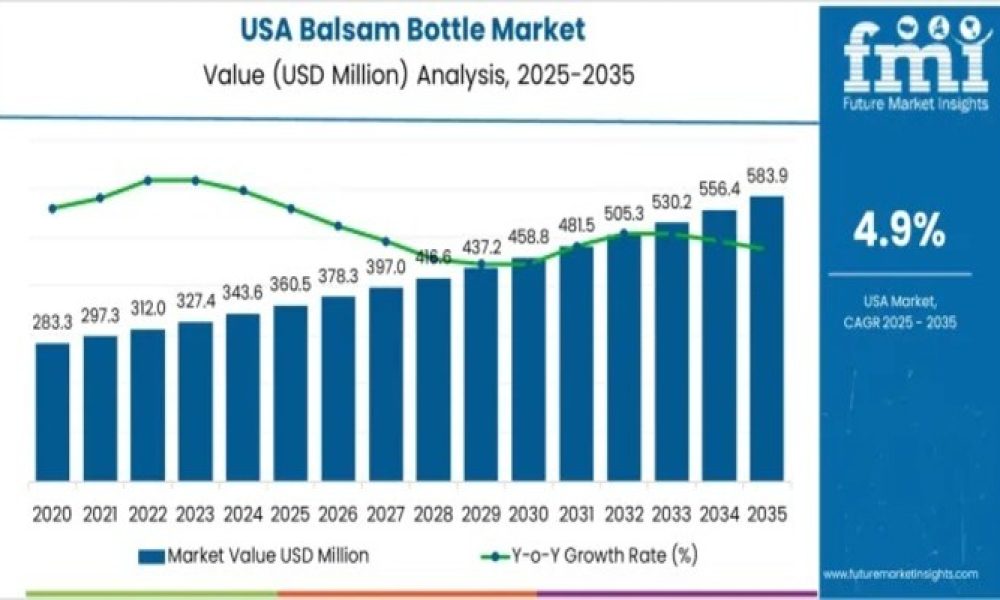
The demand for balsam bottles in the United States is entering a decade of steady, value-led expansion as pharmaceutical, wellness, nutraceutical, and specialty food manufacturers continue to rely on premium glass packaging to protect sensitive liquid formulations. In 2025, the U.S. balsam bottle market is valued at USD 360.5 million and is forecast to reach USD 583.9 million by 2035, registering a compound annual growth rate (CAGR) of 4.9% over the forecast period.
This growth reflects a structural shift toward higher-value packaging rather than purely volume-driven demand. Balsam bottles are increasingly selected for their chemical inertness, recyclability, visual appeal, and ability to preserve potency in products ranging from medicated syrups and essential oils to herbal extracts and therapeutic balms.
Discover Market Opportunities – Get Your Sample of Our Industry Overview Today!
Market Growth Trajectory: Two Distinct Phases of Expansion
Between 2025 and 2030, the U.S. balsam bottle market is expected to add approximately USD 98.3 million in incremental value, with demand rising from USD 360.5 million to about USD 458.8 million. This initial phase of growth is characterized by stability and predictability, driven by established use across pharmaceuticals, dietary supplements, specialty foods, and controlled personal care applications.
Core contributors during this phase include:
- Routine retail packaging replacement cycles
- Consistent demand for liquid health supplements
- Stable output from pharmaceutical and nutraceutical manufacturers
- Measured expansion in personal care and wellness formulations
From 2030 to 2035, the market enters a higher-value acceleration phase, contributing an additional USD 125.1 million as demand reaches USD 583.9 million. This later period accounts for the larger share of total incremental growth under the growth contribution index, supported by rising unit prices and design-driven differentiation.
Key value drivers in the second half of the forecast include:
- Increased use in premium liquid supplements and therapeutic oils
- Adoption of enhanced seal systems and dispensing closures
- Material upgrades supporting sustainability and shelf stability
- Expansion of specialty wellness and boutique personal care brands
Quick Stats: Demand for Balsam Bottles in USA
- Market Value (2025): USD 360.5 million
- Forecast Value (2035): USD 583.9 million
- Forecast CAGR (2025–2035): 4.9%
- Leading Capacity Segment: 100 ml (28% share)
- Dominant Material: Lime glass (45.0% share)
- Key Growth Regions: West, South, Northeast, Midwest
Demand Acceleration: A Smooth and Sustained Curve
From 2020 to 2025, balsam bottle demand in the U.S. followed a moderate but consistent acceleration pattern. Market value rose from USD 283.3 million to USD 360.5 million, with annual additions gradually increasing from USD 14.0 million to nearly USD 16.9 million. This reflects controlled growth supported by brand scaling and format upgrades rather than abrupt shifts in usage.
Looking ahead to 2025–2035, acceleration becomes more pronounced in absolute terms. Over this decade, the market adds USD 223.4 million, with annual value increments climbing from approximately USD 17.8 million to over USD 27.5 million in the later years. Importantly, no structural deceleration is visible, as rising value per unit continues to offset saturation risks.
Why Glass Continues to Shape Balsam Bottle Demand
Demand for balsam bottles in the USA closely mirrors broader growth in glass packaging across food, beverage, cosmetics, and specialty wellness categories. Glass remains the preferred material due to:
- Chemical inertness and non-reactivity
- High recyclability and sustainability alignment
- Premium shelf appearance and brand positioning
- Proven performance with oils, alcohol-based, and herbal formulations
As clean-label and environmentally responsible products gain traction, glass balsam bottles benefit from both functional and branding advantages.
Capacity and Material Trends Define Market Structure
The U.S. balsam bottle market is strongly structured by capacity and material selection:
By Capacity:
- 100 ml: 28% share (leading segment)
- Followed by 60 ml, 250 ml, 500 ml, below 60 ml, and above 500 ml
The 100 ml format offers an optimal balance between portability and sufficient volume, making it ideal for medicated balms, essential oils, massage formulations, and topical treatments. It also aligns well with standardized filling lines and retail shelving requirements.
By Material Type:
- Lime glass: 45.0% share
- Followed by borosilicate glass and specialty materials
Lime glass dominates due to its cost efficiency, scalability in automated manufacturing, and reliable performance across pharmaceutical and wellness applications. Clear and amber variants further support light-sensitive formulations.
Regional Growth Outlook Across the USA
Regional demand patterns reflect variations in consumer behavior, manufacturing concentration, and wellness product adoption:
- West (5.7% CAGR): Driven by natural wellness brands, premium skincare, and sustainability-focused retail positioning
- South (5.1% CAGR): Supported by expanding personal care manufacturing, herbal remedies, and contract filling operations
- Northeast (4.5% CAGR): Anchored by apothecary-style wellness brands, dense urban retail, and seasonal skincare demand
- Midwest (4.0% CAGR): Sustained by private-label manufacturing and predictable OTC wellness production
Competitive Landscape and Key Industry Players
The U.S. balsam bottle supply landscape is shaped by established glass packaging specialists and diversified packaging distributors. Leading players include:
- Hergesheimer AG
- Bormio Pharma
- Stella Glass Group
- Berlin Packaging
- Beatson Clark
These companies supply a wide range of pharmaceutical-grade, cosmetic-grade, and design-driven glass bottles, supporting applications across wellness, luxury personal care, aromatherapy, and specialty food packaging.
Why FMI: https://www.futuremarketinsights.com/why-fmi
About Future Market Insights (FMI)
Future Market Insights, Inc. (FMI) is an ESOMAR-certified, ISO 9001:2015 market research and consulting organization, trusted by Fortune 500 clients and global enterprises. With operations in the U.S., UK, India, and Dubai, FMI provides data-backed insights and strategic intelligence across 30+ industries and 1200 markets worldwide.



