
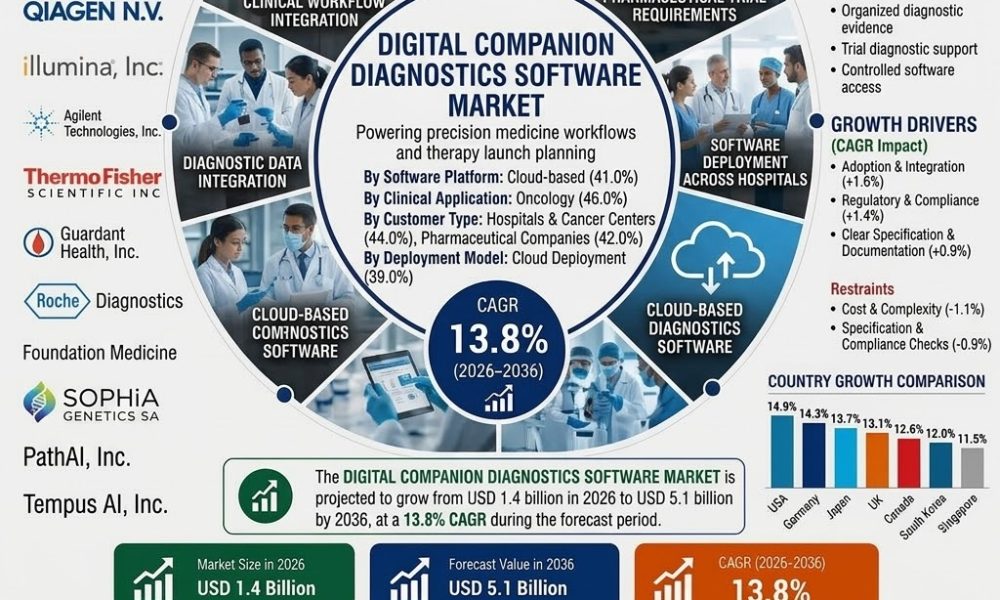
Digital Companion Diagnostics Software Market rises from USD 1.4 billion in 2026 to USD 5.1 billion by 2036 at a 13.8% CAGR.
September 21, 2026 — The global Digital Companion Diagnostics Software Market is projected to reach USD 5.1 billion by 2036, rising from USD 1.4 billion in 2026 at a 13.8% CAGR, according to Fact.MR. The market was valued at USD 1.2 billion in 2025.
The market is expected to create a USD 3.76 billion absolute opportunity by 2036. Demand is being shaped by precision medicine workflows, therapy-related biomarker interpretation, pharmaceutical trial requirements, and software deployment across hospitals and cancer centers.
Get detailed market forecasts, competitive benchmarking, and pricing trends: https://www.factmr.com/connectus/sample?flag=S&rep_id=15944
Digital Companion Diagnostics Software Market growth centers on clinical workflow needs
Fact.MR identifies several measurable segments shaping demand through 2036. Cloud-based Companion Diagnostics Software is projected to hold 41.0% share in 2026, while Oncology is expected to account for 46.0% of the market by clinical application.
Hospitals & Cancer Centers are anticipated to represent 44.0% share, while Pharmaceutical Companies are estimated to capture 42.0% by customer type. Cloud Deployment is forecast to hold 39.0% share in 2026.
These figures show where software demand is concentrated. Oncology remains closely connected to biomarker interpretation, while hospitals and pharmaceutical companies require structured diagnostic information for treatment review, clinical trials, and therapy launch planning.
Fact.MR is a market research company that provides syndicated research and industry intelligence across global markets. Its Digital Companion Diagnostics Software Market assessment covers software platforms, clinical applications, end-use settings, customer types, deployment models, and regional demand.
Cloud software holds the leading platform position
Cloud-based Companion Diagnostics Software is projected to account for 41.0% share in 2026. Fact.MR attributes this position to the need for secure access across multiple laboratories and clinical locations, along with easier software updates and consistent versions.
The market assessment covers biomarker analysis platforms and genomic interpretation software within this segment. Clinical Decision Support Software, Data Integration Platforms, and AI-enabled Decision Engines are also included in the software platform analysis.
Oncology is expected to hold 46.0% share in 2026. Targeted therapies can require biomarker interpretation before treatment begins, creating a direct application for software that organizes diagnostic evidence into structured review steps.
Hospitals & Cancer Centers are projected to hold 44.0% share in 2026. These settings handle treatment decisions that depend on diagnostic evidence moving between laboratories and clinical teams.
Pharmaceutical companies account for 42.0% share
Pharmaceutical Companies are estimated to represent 42.0% share in 2026. Fact.MR connects this position with trial diagnostics and therapy launch planning, where assay evidence needs to be organized alongside treatment eligibility requirements.
Cloud Deployment is forecast to lead the deployment model with 39.0% share. The model can reduce local infrastructure requirements for organizations operating across several users or locations while supporting controlled access and centralized software updates.
Adoption is also linked to measurable market drivers. Adoption and integration carries a +1.6% impact on CAGR, while regulatory and compliance support contributes +1.4%. Clear specification and documentation represents a +0.9% impact.
Cost and complexity remain a restraint, with Fact.MR assigning a -1.1% impact. Specification and compliance checks carry a -0.9% impact, reflecting the additional review required in regulated diagnostic workflows.
USA records the highest country CAGR
The USA is projected to register a 14.9% CAGR from 2026 to 2036, supported by oncology workflow depth and pharmaceutical software adoption. Germany follows at 14.3%, with compliance-focused purchasing and structured laboratory networks contributing to demand.
Japan is forecast to grow at 13.7%, supported by precision medicine programs and documentation expectations. The UK records 13.1%, while Canada reaches 12.6% through hospital diagnostic pathways and cross-site care coordination.
South Korea is projected to post a 12.0% CAGR, followed by Singapore at 11.5%. Fact.MR notes that comparable growth rates can create different entry conditions because clinical workflow depth and customer evidence requirements vary by country.
Analyst highlights documentation and use-case fit
Shambhu Nath Jha, Principal Consultant at Fact.MR, states, “Digital Companion Diagnostics Software companies need to prove fit inside each clinical and commercial use case.”
Jha adds, “Buyers are expected to reward suppliers that show documentation strength and measurable values.”
The report profiles QIAGEN N.V., Illumina, Inc., Agilent Technologies, Inc., Thermo Fisher Scientific Inc., Guardant Health, Inc., Roche Diagnostics – Foundation Medicine, SOPHiA GENETICS SA, PathAI, Inc., and Tempus AI, Inc.
The analysis covers 120+ sources, 35+ company portfolios, 25+ countries, and more than 20 industry interviews. Primary research includes discussions with manufacturers, service providers, technology developers, distributors, end users, procurement teams, and subject-matter experts.
The Digital Companion Diagnostics Software Market report covers the forecast period from 2026 to 2036 and includes North America, Latin America, Europe, East Asia, South Asia and Pacific, and the Middle East and Africa.
Top Reports:
About Fact.MR
Fact.MR is a market research and consulting firm providing syndicated and customized research across industries and geographic markets. Its research combines primary interviews, desk research, market sizing, forecasting, company analysis, and data validation.



