
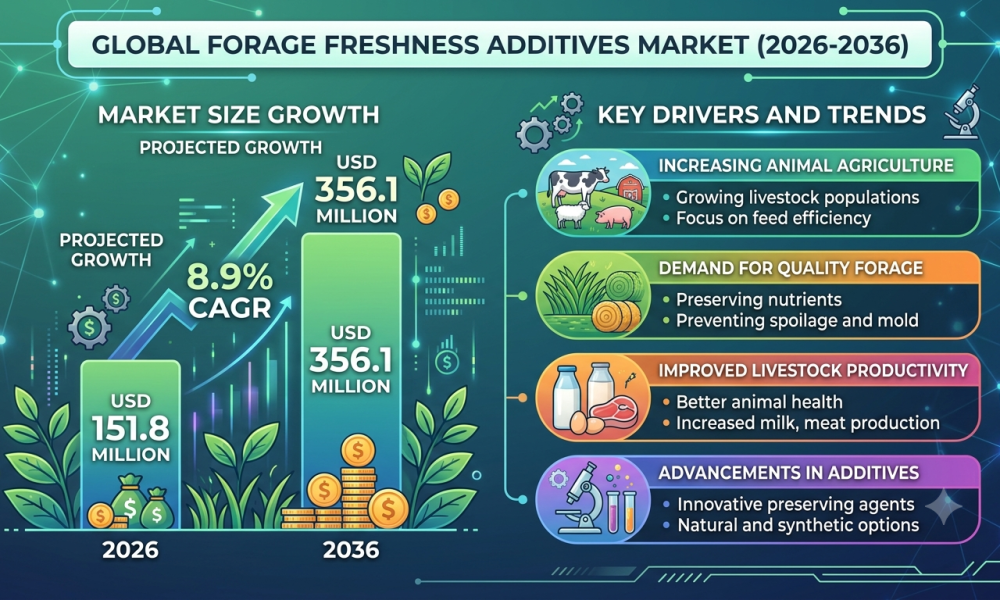
The global forage freshness additives market is projected to grow from USD 151.8 million in 2026 to USD 356.1 million by 2036, registering an 8.9% CAGR, according to a new report by Future Market Insights (FMI). Demand is being shaped by the need to protect stored forage value as dairy and livestock operations manage feed inventories, variable harvest conditions, and storage losses.
The market is seeing greater attention as farms seek to limit dry matter losses, heating, mold, and deterioration during fermentation and feedout. The commercial case for treatment is particularly relevant when forage losses could increase purchased-feed requirements or affect ration consistency.
Get detailed market forecasts, competitive benchmarking, and pricing trends: https://www.futuremarketinsights.com/reports/sample/rep-gb-35229
Market Snapshot
Key figures for 2026:
- Market value: USD 151.8 million
- Projected value by 2036: USD 356.1 million
- CAGR, 2026–2036: 8.9%
- Leading product type: Inoculant-based (LAB), with 41.1% share
- Leading forage type: Corn silage, with 44.9% share
- Leading application: At-harvest applied, with 42.3% share
- Leading end user: Dairy operations, with 46.0% share
- Leading sales channel: Feed & forage distributors, with 43.4% share
Inventory conditions are another factor affecting preservation economics. USA hay stocks stood at 23.287 million tons on May 1, 2026, down 3.3% from the previous year, according to USDA NASS data cited in the FMI report. When forage reserves are tighter, avoidable storage losses can carry a greater cost for farms that depend on conserved feed.
Product and Application Trends
Inoculant-based LAB products are projected to account for 41.1% of the market in 2026. Their role in controlled fermentation makes them particularly relevant for crop-specific preservation strategies. Homofermentative strains support rapid acidification, while heterofermentative strains can address aerobic stability during feedout.
Corn silage is expected to represent 44.9% of the market in 2026. The segment benefits from high stored volumes and the economic visibility of heating and feedout losses. USDA NASS reported a record 136 million tons of USA corn silage production for 2025, providing a substantial volume of forage exposed to fermentation and oxygen-related losses.
At-harvest application is forecast to hold 42.3% share. Applying treatment during chopping or baling allows preservation measures to begin before undesirable fermentation develops. However, moisture measurement, applicator calibration, and consistent dosing remain important to achieving the intended outcome.
Demand Drivers and Market Challenges
Weather and forage inventory pressure are increasing the value of preservation in selected markets. Drought conditions can raise the cost of avoidable hay and silage losses when stored forage is important for ration continuity.
At the same time, the economics of treatment remain closely linked to replacement-feed prices. Lower replacement-feed costs can narrow the financial gap between treating forage and purchasing substitute feed. This creates a need for suppliers to demonstrate measurable farm-level value rather than relying only on formulation claims.
Public support for silage production also creates opportunities in selected countries. In South Korea, supported silage-manufacturing areas were set at 99.6 thousand hectares in the January 2026 budget plan. Machinery and forage-processing support can provide additive suppliers with routes through contractors and cooperatives.
Regional Outlook
South Korea is projected to record the fastest country growth at an 8.6% CAGR through 2036, followed by the USA at 8.3%, the UK at 8.0%, Germany at 7.7%, and Japan at 7.0%.
The USA combines large dairy and beef operations with substantial corn-silage volumes. The UK market is closely linked to grass silage and harvest timing. Germany’s larger operating units support structured forage programs, while Japan’s focus on domestic roughage efficiency creates a distinct preservation opportunity.
Analyst Perspective
“Forage freshness additives earn repeat orders when treatment fits the crop entering storage and the risk expected at feedout. Commercial advantage comes from proving dry matter protection under local harvest conditions and making application repeatable during each cut.”
— Nandini Roy Choudhury, Principal Consultant, Future Market Insights
Competitive Landscape
The market includes Volac, Schaumann, Lallemand Animal Nutrition, Pioneer Hi-Bred International (Corteva Agriscience), BASF, ADDCON EUROPE GmbH, Josera GmbH & Co. KG, and Microferm Limited.
Competition spans microbial inoculant and acid-led preservation routes. Recent developments include Lallemand Animal Nutrition’s July 2026 launch of MAGNIVA Platinum for Mexican dairy and beef producers, Microferm Limited’s January 2025 positive EFSA renewal assessment for Pediococcus acidilactici NCIMB 30005, and Volac’s January 2026 planned ERP upgrade for its forage additives order-and-despatch operations.
Access full Report in PDF Format@ https://www.futuremarketinsights.com/reports/brochure/rep-gb-35229
Report Scope
The FMI study analyzes the forage freshness additives market by product type, forage type, application, end user, sales channel, and region. Regional coverage includes North America, Latin America, Western Europe, Eastern Europe, East Asia, South Asia and Pacific, and the Middle East and Africa.
Read the full Forage Freshness Additives Market report:
https://www.futuremarketinsights.com/reports/forage-freshness-additives-market
About Future Market Insights
Future Market Insights (FMI) provides market intelligence, syndicated research, and custom research across industries. Its research helps businesses understand market dynamics, emerging opportunities, competitive developments, and long-term growth patterns.



