
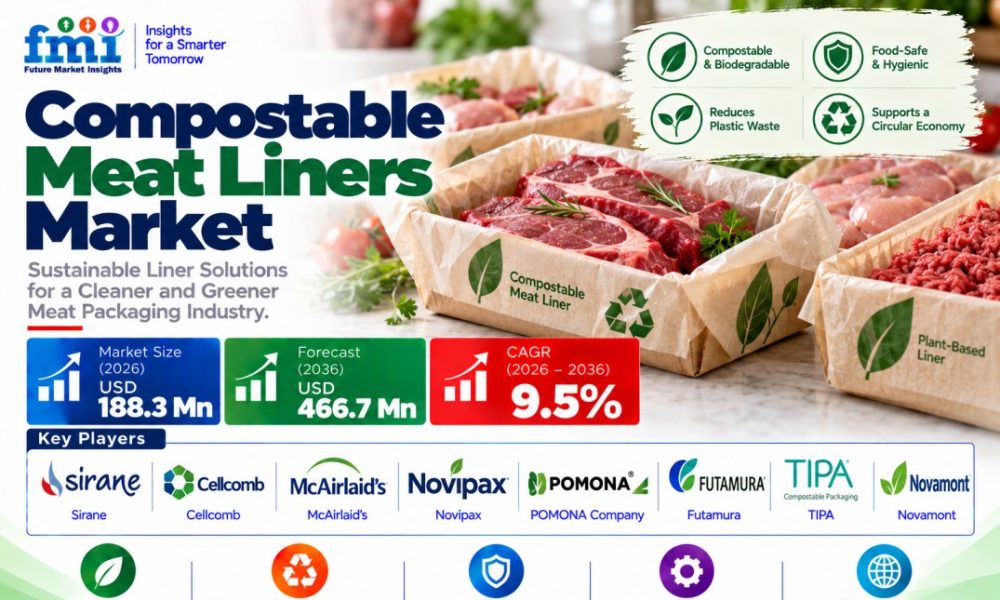
The global Compostable Meat Liners Market is projected to grow from USD 188.3 million in 2026 to USD 466.7 million by 2036, expanding at a 9.5% CAGR during the forecast period, according to Future Market Insights. Demand is being supported by protein processors seeking liquid-control solutions that reduce reliance on conventional plastic while maintaining pack presentation and normal packing-line performance.
Compostable meat liners are being evaluated as part of complete chilled-protein packaging systems. The commercial requirement extends beyond compostability. Processors need liners to contain purge under expected meat loads, maintain seal stability, fit established tray geometry, and provide a disposal route accepted by the relevant waste operator.
>> Get Detailed Market Forecasts, Competitive Benchmarking, and Pricing Trends: https://www.futuremarketinsights.com/reports/sample/rep-gb-34651
Certified Compostable Absorbent Liners Lead Product Demand
Certified compostable absorbent liners are projected to account for 32.0% of product-type demand in 2026.
Their position is supported by familiar pad geometry and established liquid-control requirements. Processors can evaluate compostable absorbent liners within existing trays and sealing sequences without necessarily redesigning the complete retail pack.
Commercial approval depends on whether the liner manages the specified meat load without slowing line speed or changing tray presentation.
Airlaid Cellulose Holds a 30.0% Material Share
By material, airlaid cellulose is estimated to account for 30.0% of demand in 2026.
Airlaid cellulose provides an adjustable fiber web for liquid capture. Converters can tune basis weight and uptake while producing sealed liner structures suited to chilled protein packaging.
Seafood applications also require testing under extended cold storage and sustained liquid exposure. FMI cites McAirlaid’s March 2024 report that its MAP Enhancer Pads kept white tiger prawns acceptable after 14 days and supported a minimum shelf-life increase from five to ten days.
Industrial Compostability Accounts for 56.0%
Industrial compostable certification is expected to represent 56.0% of the certification category in 2026.
Controlled time-and-temperature testing provides packaging teams with documentation that can support repeatable qualification across multiple sites.
However, certification does not complete the commercial approval process. Retailers and processors still need to confirm collection instructions and contamination rules at the receiving facility, particularly for food-soiled liners.
FMI Principal Consultant Nandini Roy Choudhury states:
“Compostable meat liners earn approval once absorbency remains stable under the pack’s expected purge load and sealing conditions. Commercial value depends on aligning food-contact evidence with a disposal route accepted by each processor and receiving waste operator.”
Grocery Retail Represents 36.0% of End-Use Demand
The grocery retail segment is projected to account for 36.0% of end-use demand in 2026.
Retailers have direct exposure to leaks, visible purge, presentation issues, and markdowns. Centralized packaging specifications can allow one approved liner configuration to scale across several processors and store networks.
For repeat orders, retail teams need both processor trials and disposal instructions that store personnel can apply consistently.
Purge Control Remains a Core Market Driver
Protein processors need liquid-control solutions that reduce conventional plastic use without increasing leaks or visible purge.
The restraint is equally practical: certification loses commercial value if the liner fails plant trials or if the receiving facility rejects food-soiled compostable packaging.
FMI identifies a commercial opportunity in combining custom absorbency with retailer-led collection programs for high-volume protein packs.
Packaging rules are also increasing scrutiny at the component level. Meat processors are reviewing absorbency, material composition, and disposal wording as part of the same commercial approval file.
Country Markets Show Different Growth Profiles
FMI forecasts the following country CAGRs for 2026–2036:
- Brazil: 10.0%
- United Kingdom: 9.6%
- Germany: 9.3%
- United States: 8.8%
- Japan: 8.0%
These figures represent forecast growth rates rather than current market-size rankings. Local processing capacity, retail structures, waste contracts, labeling requirements, and composting acceptance influence commercial adoption in each market.
Brazil benefits from large meat-processing networks and can repeat validated liner specifications across facilities and export programs. The UK offers opportunities for retailer-led pilots but requires attention to site-specific waste instructions.
Germany combines detailed material records with established food-packaging controls. The United States has substantial protein volumes but fragmented state-level labeling requirements and uneven commercial composting acceptance. Japan applies more precise pad and tray reviews across compact retail formats.
👉 Access the Complete Report in PDF Format: https://www.futuremarketinsights.com/reports/brochure/rep-gb-34651
Competitive Landscape
The market remains divided between finished absorbent-pad manufacturers and compostable material platforms.
Notable companies profiled by FMI include Sirane, Cellcomb, McAirlaid’s, Novipax, POMONA Company, Futamura, TIPA, and Novamont.
Sirane, Cellcomb, McAirlaid’s, Novipax, and POMONA Company provide finished pads with application-specific absorbency for fresh proteins.
Futamura supplies certified cellulose films for converter-led food-contact structures, while TIPA and Novamont provide compostable polymer platforms for liner films, interleaves, and other converter-led food-pack structures.
Recent developments include Futamura’s April 2026 expansion of its Biopap relationship around NatureFlex-lined compostable food trays, TIPA’s October 2025 acquisition of SEALPAP, and Cellcomb’s March 2025 European home-and-garden compost certification for Cellsorb CIRCULAR.
About the Compostable Meat Liners Market
The FMI report analyzes the market by product type, material, certification, application, end use, sales channel, and region. Applications include fresh red meat, poultry, seafood, and processed meats. End-use segments include grocery retail, meat processors, and foodservice.
The study covers North America, Latin America, Europe, East Asia, South Asia and Pacific, and the Middle East and Africa, with country-level analysis across Brazil, the United Kingdom, Germany, the United States, Japan, and more than 20 countries overall.
To explore how FMI Custom Research can support your strategic priorities, connect with our team at – [email protected]
About Future Market Insights (FMI)
Future Market Insights, Inc. is an ESOMAR-certified, ISO 9001:2015 market research and consulting organization trusted by Fortune 500 companies. With a global presence across the U.S., UK, India, and Dubai, FMI delivers data-driven insights across 30+ industries and 1200 markets worldwide.



