
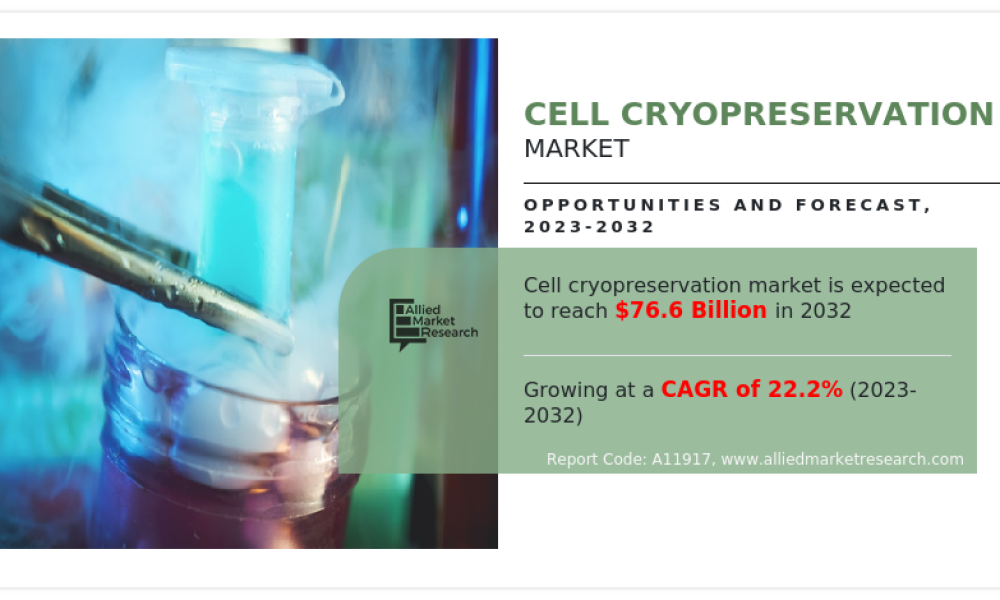
The global cell cryopreservation market is undergoing rapid transformation, with its size valued at $10.3 billion in 2022 and projected to reach an impressive $76.6 billion by 2032, growing at a remarkable CAGR of 22.2% from 2023 to 2032. This growth underscores the expanding importance of cryopreservation technologies in biotechnology, fertility treatment, regenerative medicine, and personalized healthcare.
What is Cell Cryopreservation?
Cryopreservation is a technique used to freeze and preserve cells, tissues, and other biological materials at ultra-low temperatures—typically in liquid nitrogen—to maintain their viability and prevent degradation. It plays a critical role in ensuring the long-term storage of vital biological samples by halting cellular activity and preventing the formation of harmful ice crystals that can rupture cell membranes.
Key cryoprotectants such as glycerol and dimethyl sulfoxide (DMSO) are commonly used to shield cells during the freezing process. These agents are often mixed with serum or culture media to enhance cell preservation before the samples are stored in advanced freezers.
Key Drivers of Market Growth
1. Rising Egg Freezing Cycles
Egg freezing, or oocyte cryopreservation, has gained widespread popularity, especially among women opting to delay pregnancy for personal or medical reasons. According to the Society for Assisted Reproductive Technology, the number of egg freezing cycles in the U.S. rose from 7,193 in 2016 to 12,438 in 2020—an increase of over 72%. This trend is fueling the demand for efficient cryopreservation technologies in fertility clinics.
2. Surge in Stem Cell Research
Stem cells, known for their regenerative capabilities, are at the forefront of breakthrough therapies in regenerative medicine, oncology, and tissue engineering. Cryopreservation is essential to maintaining stem cell viability for future therapeutic use. Increased investments in stem cell R&D—particularly for pluripotent and mesenchymal stem cells—are driving the growth of cryopreservation solutions across research institutes and biotech firms.
3. Expansion of Biobanks
Biobanks have become central repositories for biological samples used in genetic research, drug development, and epidemiological studies. Developed countries now have at least 11 biobanks per million population, and global initiatives like the Global Biobank Meta-analysis Initiative (GBMI), involving 24 biobanks across five continents and data from over 2.2 million individuals, are further catalyzing demand for advanced cryopreservation infrastructure.
4. Personalized Medicine
Personalized medicine, which tailors treatments based on a patient’s genetic profile, is another major driver. Cryopreservation enables the long-term storage of cells and tissues for personalized cell-based therapies, including cancer immunotherapies and gene editing solutions.
Market Restraints and Opportunities
While the market outlook is highly optimistic, some challenges persist. The availability of alternative preservation techniques, coupled with high capital and operational costs, may hinder market penetration in developing regions. Additionally, handling complexity and ethical concerns around sample storage can pose hurdles.
However, government support for R&D, especially in countries like India—where multiple agencies such as ICMR and DBT are promoting advanced stem cell research—offers lucrative opportunities. The post-COVID era has further highlighted the importance of cryopreservation in supporting vaccine and therapeutic R&D, solidifying the market’s role in global health preparedness.
Segmental Analysis
By Type
Cryopreservation Media: This segment held the largest revenue share in 2022. Applications include stem cell regeneration, regenerative medicine, and drug discovery.
Equipment: This segment is projected to grow the fastest due to rising demand from biobanks and research labs for reliable freezers, liquid nitrogen tanks, and thaw systems.
By Application
Other Applications (e.g., blood product storage, tissues): Accounted for the largest share in 2022 due to increased use in treating traumatic injuries.
Stem Cells: Expected to witness the highest growth due to escalating research activity in stem cell-based therapies for chronic and degenerative diseases.
By End User
Other End Users (including cell banks and clinical centers): This segment dominated in 2022 and is set to lead in the future, driven by increased demand for cell culture and storage facilities.
Pharmaceutical and Biotechnology Companies: Also hold a significant share due to ongoing drug development efforts requiring cell preservation.
Regional Outlook
North America leads the global market due to a high prevalence of chronic diseases, robust healthcare infrastructure, and early adoption of biotechnological advancements.
Asia-Pacific is anticipated to experience the fastest growth due to rising healthcare investments, expanding biopharma sectors in countries like China and India, and improved awareness about regenerative therapies.
Competitive Landscape
Key players are focused on innovation, strategic acquisitions, and product launches to maintain competitive advantage. Major companies include:
Merck Group KGaA
Thermo Fisher Scientific Inc.
BioLife Solutions, Inc.
Lonza
HiMedia Laboratories
Eppendorf Corporate
Sartorius AG
Creative Biolabs
PromoCell GmbH
Recent Developments:
Product Launch: In June 2023, BioLife Solutions introduced a large-capacity controlled-rate freezer to meet growing demand for cell therapy manufacturing.
Expansion: In 2022, BioLife received 7 new patents and filed 43 new applications to expand its IP estate in cryopreservation technologies.
Acquisitions:
BioLife acquired Stirling Ultracold in 2021, boosting its portfolio in energy-efficient ultra-low temperature freezers.
Danaher Corporation acquired GE’s Biopharma division in 2020, now operating as Cytiva, enhancing its footprint in cell and gene therapy tools.
Conclusion
The cell cryopreservation market is on an impressive trajectory, powered by advances in regenerative medicine, the increasing popularity of fertility preservation, and the expanding role of personalized medicine. With strong support from research institutions, governments, and biopharma companies, cryopreservation is set to become an indispensable pillar in future healthcare systems. As innovations continue to reshape the landscape, this market is not just preserving cells—it’s preserving possibilities.




