
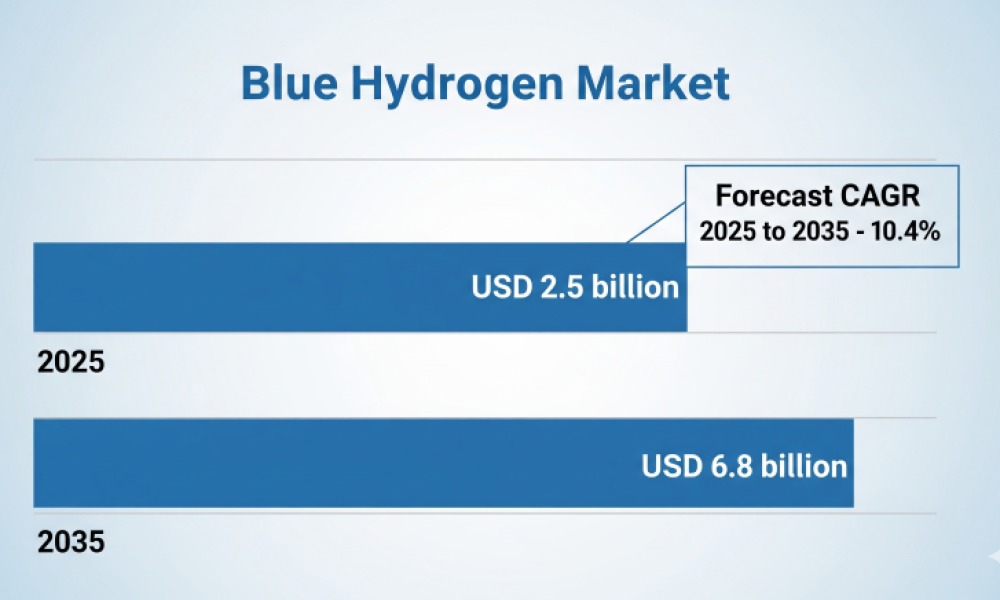
The blue hydrogen market is poised for substantial growth, with a projected value increase from USD 2.5 billion in 2025 to USD 6.8 billion by 2035. This represents a compound annual growth rate (CAGR) of 10.4%, reflecting a global push toward cleaner energy and sustainable industrial practices. Regional growth patterns show marked differences, influenced by varying policy frameworks, infrastructure readiness, and energy transition priorities.
Full Market Insights Available. Inquire for Customization or Purchase: https://www.futuremarketinsights.com/reports/sample/rep-gb-24470
Market Dynamics and Growth Drivers
The demand for blue hydrogen is increasingly tied to global industrial decarbonization efforts. The petroleum refinery sector remains the leading application, projected to contribute 46.2% of the market share by 2025. Hydrogen’s role in desulfurization and hydrocracking within the refining process aligns well with the need for emission reduction in traditional operations. Blue hydrogen offers a sustainable alternative without requiring massive changes to existing refinery infrastructure.
Steam methane reforming (SMR) remains the dominant technology for blue hydrogen production, accounting for 52.8% of the market share by 2025. SMR’s established infrastructure, scalability, and cost efficiency make it the most attractive technology for large-scale blue hydrogen production, especially when combined with CCS technologies.
Regional Competitive Landscape
In terms of market share, Asia-Pacific is set to capture the largest share, particularly through strong growth in China and India. China’s blue hydrogen market is expected to grow at a CAGR of 14%, driven by large-scale production plants and favorable government policies. India follows closely with a 13% CAGR, focusing on the industrial and transportation sectors as key adoption areas for blue hydrogen.
Germany leads in Europe with a forecasted CAGR of 12%, driven by its focus on decarbonizing chemical, refining, and steel industries. The United States, while experiencing a slower pace, is expected to grow at 8.8% CAGR due to federal incentives and private sector involvement in large-scale hydrogen projects.
Technological Advancements and Policy Support
The increasing adoption of carbon capture and storage (CCS) technologies is a key driver of the blue hydrogen market. Innovations in CCS efficiency, along with substantial government funding, are enabling large-scale blue hydrogen production while reducing carbon emissions. Carbon pricing mechanisms, subsidies, and tax credits have incentivized industries to shift toward blue hydrogen, making it an attractive alternative to conventional fossil fuels.
Strategic partnerships between governments, energy corporations, and technology providers are further accelerating the global rollout of blue hydrogen infrastructure. By integrating hydrogen into power generation, transportation, and industrial processes, blue hydrogen has cemented its place as a vital component in the global energy transition.
Download Brochure for Full Insights: https://www.futuremarketinsights.com/reports/brochure/rep-gb-24470
Competitive Analysis
The competitive landscape of the blue hydrogen market is dominated by established energy majors such as Shell, BP, and ExxonMobil. These industry giants leverage their extensive upstream operations and integrated infrastructure to deliver large-scale blue hydrogen projects. Companies like Equinor and Eni are also significant players, establishing regional hydrogen hubs and utilizing CCS technologies to reduce emissions.
Industrial engineering firms such as Bechtel Corporation, Technip Energies, and thyssenkrupp Industrial Solutions are instrumental in the design and implementation of large-scale hydrogen plants. Their expertise in project execution and turnkey solutions is vital in meeting the market’s demand for scalable and sustainable blue hydrogen production.
Emerging players like Air Products, Air Liquide, and Johnson Matthey play a critical role in integrating cutting-edge technologies and process optimization for efficient hydrogen production. Meanwhile, companies like Woodside and SK E&S focus on regional projects, building strategic partnerships to secure a foothold in the competitive market.
About Future Market Insights (FMI)
Future Market Insights, Inc. (ESOMAR certified, recipient of the Stevie Award, and a member of the Greater New York Chamber of Commerce) offers profound insights into the driving factors that are boosting demand in the market. FMI stands as the leading global provider of market intelligence, advisory services, consulting, and events for the Packaging, Food and Beverage, Consumer Technology, Healthcare, Industrial, and Chemicals markets. With a vast team of over 400 analysts worldwide, FMI provides global, regional, and local expertise on diverse domains and industry trends across more than 110 countries.



