
Definition
Glass and plastic greenhouses are controlled-environment structures designed to optimize plant growth by regulating temperature, humidity, and lighting. These structures provide year-round crop production capabilities, overcoming challenges posed by seasonal weather and climate variability.
- Glass greenhouses: Known for durability, light transmission efficiency, and long-term reliability.
- Plastic greenhouses: Favored for cost-effectiveness, flexibility, and suitability for small and medium-scale farms.
They are widely used for vegetables, fruits, floriculture, and research, and have become a cornerstone of controlled-environment agriculture (CEA). With urban farming and sustainable agriculture gaining traction, greenhouses are now essential to global food security strategies.
Recent Developments in the Glass and Plastic Greenhouse Market
The glass and plastic greenhouse market is being reshaped by a wave of technological advancements aimed at improving efficiency and sustainability. A major trend is the integration of smart technologies, including IoT sensors, AI, and automated climate control systems, which allow for real-time monitoring and optimization of growing conditions. Innovations in material science are also playing a significant role; for plastic greenhouses, this includes the development of multi-layered, UV-stabilized, and anti-drip films that extend the lifespan and enhance light diffusion. For glass greenhouses, the focus is on “smart glass” that can automatically adjust its transparency to manage sunlight and heat, as well as new coatings that improve insulation and light transmission. These developments are enabling growers to increase yields, reduce energy consumption, and grow crops year-round in various climates.
Major Distribution for the Glass and Plastic Greenhouse Market
The distribution of glass and plastic greenhouses is handled through a diverse set of channels, catering to both large-scale commercial growers and individual hobbyists. For large, complex projects, direct B2B sales from manufacturers to commercial nurseries and agricultural firms are common. This approach allows for custom design, engineering, and installation support. A vast network of specialized industrial and agricultural equipment distributors also plays a key role, providing local sales, technical expertise, and maintenance services. Additionally, the growing “urban farming” trend has increased the importance of online retail and e-commerce platforms, which offer a wide range of pre-fabricated kits and smaller greenhouse systems to a global clientele. This multi-channel distribution model ensures that customers, from large corporations to small-scale farmers, can access the right products and support for their specific needs.
Market Size
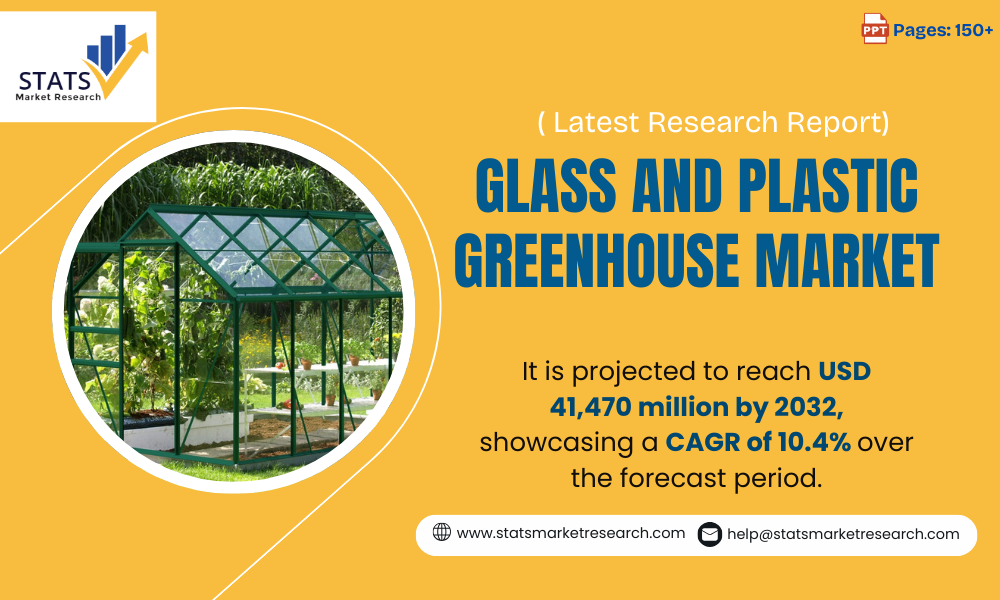
Global glass and plastic greenhouse market size was valued at USD 21,020 million in 2024. It is projected to grow to USD 23,150 million in 2025 and reach USD 41,470 million by 2032, registering a CAGR of 10.4% during the forecast period.
Download FREE Sample of this Report @ https://www.statsmarketresearch.com/download-free-sample/8056165/global-glass-plastic-greenhouse-forecast-market
- Plastic greenhouses dominate with 68% market share in 2024 due to affordability and ease of installation.
- Glass greenhouses retain a stronghold in large-scale commercial operations for premium crop production.
- Vegetable cultivation accounted for 42% of applications in 2024, followed by fruits (28%), flowers (18%), and research (7%).
The Netherlands leads global adoption with 10,000+ hectares under greenhouse cultivation, while China dominates in scale, reaching 4.5 million hectares in 2024.
Growth is also driven by technological integration, including IoT sensors, AI-driven irrigation, and smart climate control systems introduced by leaders such as HortiMax and Netafim.
Market Dynamics
➤ Market Drivers
- Rising demand for year-round crop production to mitigate risks of climate change and erratic weather.
- Advanced greenhouse technologies: IoT sensors, smart irrigation, LED grow lights, and automated ventilation.
- Government subsidies and policies: For example, European programs cover up to 40% of greenhouse setup costs.
- Growth of urban farming and local food production in metropolitan centers.
➤ Market Restraints
- High initial investment: Commercial glass structures cost $25–50 per sq. ft..
- Operational complexity requiring expertise in irrigation, pest control, and climate management.
- Energy consumption challenges, especially in colder regions.
➤ Market Opportunities
- Emerging markets (Asia-Pacific, MENA) prioritizing food security and controlled-environment agriculture.
- Renewable integration: Solar-powered and geothermal-assisted greenhouses.
- Urban vertical farming: Combining greenhouses with high-density vertical crop production.
➤ Market Challenges
- Supply chain disruptions: Rising costs of steel, glass, and polycarbonate (up 15–20% since 2022).
- Labor shortages in agriculture, limiting expansion in developed economies.
- Limited supplier base for specialized materials and equipment.
Regional Analysis
- Europe: Pioneer in glass greenhouse adoption, led by the Netherlands and Spain. EU subsidies drive market growth.
- Asia-Pacific: China dominates in greenhouse acreage, while India is emerging as a fast-growth market with government-backed initiatives.
- North America: Strong demand for premium crops, urban farming, and advanced automation.
- Middle East & Africa: Rising greenhouse installations (12% annual growth) to reduce food import dependence.
- Latin America: Mexico and Brazil adopting plastic greenhouses for vegetable and fruit exports.
Get the Complete Report & TOC @ https://www.statsmarketresearch.com/global-glass-plastic-greenhouse-forecast-market-8056165
Competitor Analysis (in brief)
The market is moderately fragmented with global leaders and regional challengers.
- HortiMax and Netafim lead in advanced automation and irrigation solutions.
- Chinese players like Guangdong Hongke and Shandong Fufeng dominate low-cost plastic greenhouse production.
- European firms such as Baike Greenhouse invest in sustainability with solar-integrated models.
- Strategic partnerships and IoT integration are reshaping competition.
Global Glass and Plastic Greenhouse Market: Market Segmentation Analysis
This report provides a deep insight into the global Glass and Plastic Greenhouse Market, covering all its essential aspects. This ranges from a macro overview of the market to micro details of the market size, competitive landscape, development trend, niche market, key market drivers and challenges, SWOT analysis, value chain analysis, etc.
The analysis helps the reader to shape the competition within the industries and strategies for the competitive environment to enhance the potential profit. Furthermore, it provides a simple framework for evaluating and assessing the position of the business organization. The report structure also focuses on the competitive landscape of the Global Glass and Plastic Greenhouse Market. This report introduces in detail the market share, market performance, product situation, operation situation, etc., of the main players, which helps the readers in the industry to identify the main competitors and deeply understand the competition pattern of the market.
In a word, this report is a must-read for industry players, investors, researchers, consultants, business strategists, and all those who have any kind of stake or are planning to foray into the Glass and Plastic Greenhouse Market in any manner.
Market Segmentation (by Application)
- Vegetable
- Fruit
- Flower
- Research
- Others
Market Segmentation (by Type)
- Plastic Greenhouse
- Polyethylene
- Polycarbonate
- Others
- Glass Greenhouse
- Single-layer glass
- Double-layer glass
- Others
Key Company
- HortiMax (Netherlands)
- Netafim (Israel)
- Guangdong Hongke Agricultural Machinery R&D Co.,Ltd (China)
- Baike Greenhouse (China)
- Yisheng Greenhouse (China)
- Henan Zhonghao Greenhouse Engineering Co.,Ltd (China)
- Shandong Fufeng Agricultural Development Co. LTD (China)
- Shandong Shouguang Jiuhe Agricultural Development Co. LTD (China)
- ORITECH (Germany)
- Trinog-xs (Xiamen) Greenhouse Tech Co., Ltd. (China)
- Beijing Jingpeng Global Technology Co., LTD (China)
- Kunshan Yonghong Greenhouse Co., Ltd. (China)
Geographic Segmentation
- North America (U.S., Canada, Mexico)
- Europe (Germany, France, U.K., Italy, Spain, Rest of Europe)
- Asia-Pacific (China, India, Japan, South Korea, Australia, Rest of Asia-Pacific)
- Middle East & Africa (GCC, North Africa, South Africa, Rest of MEA)
- Latin America (Brazil, Argentina, Rest of Latin America)
FAQs
Q1. What is the current market size of the Glass and Plastic Greenhouse Market?
The market was valued at USD 21,020 million in 2024 and is projected to reach USD 41,470 million by 2032, growing at a CAGR of 10.4%.
Q2. Which are the key companies operating in the Glass and Plastic Greenhouse Market?
Key players include HortiMax, Netafim, Guangdong Hongke, Baike Greenhouse, Yisheng Greenhouse, Shandong Fufeng, and ORITECH, among others.
Q3. What are the key growth drivers in the Glass and Plastic Greenhouse Market?
Growth is driven by year-round food demand, greenhouse automation, government subsidies, and rising urban farming adoption.
Q4. Which regions dominate the Glass and Plastic Greenhouse Market?
Europe leads in technology adoption, while China dominates in scale, and the Middle East shows fastest growth due to food security initiatives.
Q5. What are the emerging trends in the Glass and Plastic Greenhouse Market?
Trends include IoT-enabled smart greenhouses, renewable energy integration, and urban vertical farming models.
About Us
☎️ International: +1 (332) 2424 294
📄 Website: www.statsmarketresearch.com
Join us on LinkedIn:- https://www.linkedin.com/company/statsmarketresearch




