

Biomass Gasification Market Size, Share and Trend Analysis Report : Global Opportunity Analysis and Industry Forecast 2022-2031
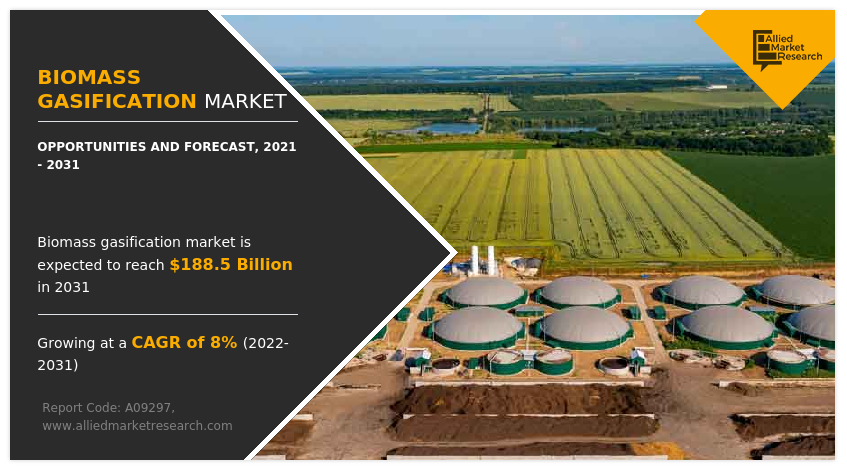
According to a new report published by Allied Market Research, the biomass gasification market size was valued at $88.0 billion in 2021, and is estimated to reach $188.5 billion by 2031, growing at a CAGR of 8% from 2022 to 2031.
Biomass Gasification: Converting Organic Materials into Energy
Biomass gasification is a thermochemical process that converts organic materials, such as agricultural residues, wood, and waste, into a gaseous fuel called syngas (synthetic gas). This process not only helps manage waste but also provides a renewable source of energy.
Download PDF Brochure: https://www.alliedmarketresearch.com/request-sample/A09297
Europe is projected to grow at the highest CAGR of approximately 8.3%, in terms of revenue during the biomass gasification market forecast period. This is owing to the presence of major players in the market and the fact that Europe is committed to reducing its dependence on fossil fuels for primary energy following its 2030 and net zero 2050 targets.
European Union is a big consumer of primary energy owing to its high energy demands during winter as well as summer seasons owing to its weather, and thus, relying on biomass gasification seems as a much more feasible and environment-friendly option to cut down carbon emissions and produce energy.
The key players in the global biomass gasification industry are Beltran Technologies, Inc., Vaskiluodon Voima Oy, EQTEC plc, Chanderpur Works Private Limited, Ankur Scientific Energy Technologies Pvt. Ltd., Infinite Energy Pvt. Ltd., Valmet Corporation, KASAG Swiss AG, Goteborg Energi AB, and Thyssenkrupp AG.
Biomass gasification market growth is driven by several factors, such as the presence of biomass in abundance. Since biomass is available in massive amounts, rather than being incinerated or ending up in landfills, biomass, especially MSW source of biomass, is combusted to produce heat and gas. This heat and gases are further used as fuel, feedstock, and other such uses.
The market is highly driven by increased activities in solid waste management, increased electrification in urban as well as rural areas, depleting fossil fuels, and rapid commercialization of biomass gasification.
Reducing carbon footprint by producing energy from biomass boosts the growth of the biomass gasification market.
Several governments are considering biomass gasification as a cleaner alternative to producing hydrogen and heat as relatively fewer greenhouse gases are emitted in the process rather than incinerating the biomass.
The carbon monoxide produced is treated in water where it reacts with water molecules to further produce hydrogen and carbon dioxide.
The hydrogen hence produced is used as fuel or feedstock in several applications. Whereas carbon dioxide is used by plants for photosynthesis.
Gasification Process
- Drying: The biomass is dried to reduce moisture content, which improves efficiency.
- Pyrolysis: Biomass is heated to high temperatures (typically 400-800°C) in the absence of oxygen, breaking it down into char, tar, and gases.
- Gasification: The remaining char reacts with steam and air (or oxygen) to produce syngas.
- Cleaning and Conditioning: The syngas is cleaned to remove impurities, making it suitable for use in engines or fuel cells.
By gasifier type, the moving or fixed bed gasifiers segment dominated the market share for 2021. The moving or fixed bed gasifier can be operated at very high temperatures which act as a driving factor for market growth.
They produce a high amount of tar or unfinished char, and thus, during the biomass gasification market forecast, the fluidized bed is expected to grow at a higher CAGR.
Fluidized bed gasifiers are complicated systems but are capable of producing gas with a very high heating value.
Procure This Report (337 Pages PDF with Insights, Charts, Tables, and Figures): https://bit.ly/3Zk6PjB
Advantages
- Renewable Energy Source: Utilizes organic waste materials, contributing to energy sustainability.
- Waste Reduction: Helps manage agricultural and municipal waste, reducing landfill use.
- Versatile Applications: Syngas can be used for electricity generation, heat production, or as a feedstock for chemicals and fuels.
On the basis of source, the market is further divided into solid biomass, liquid biomass, biogas, municipal waste, and others.
The solid biomass dominated the biomass gasification market and is expected to grow at a CAGR of 8.2% during the forecast period.
This is attributed to a large amount of available solid biomass in the forms of wood pellets, wood chippings, corncobs, soybeans, sugar cane, switchgrass, woody plants, and food processing residues.
Depending on the application, the market is divided into chemicals, liquid fuels, power, and gas fuels.
- Electricity Generation: Syngas can be burned in gas turbines or engines to generate electricity.
- Chemical Production: Used as a feedstock for producing chemicals, fertilizers, or synthetic fuels.
- Heat Production: Can be utilized in combined heat and power (CHP) systems to provide both electricity and heating.
The power sectors garnered the largest market biomass gasification market share in terms of revenue for 2021 and is expected to continue to grow at a higher CAGR. This is attributed to the fact that the heat energy produced will majorly be sourced into the production of electricity as it will prove to be a cleaner form of electricity generation, especially in a scenario where reducing carbon footprint and increasing primary energy production is being sought out.
Future Trends
- Technological Advancements: Ongoing research is focused on improving gasification efficiency and reducing costs.
- Integration with Other Technologies: Combining biomass gasification with carbon capture and storage (CCS) to enhance sustainability.
- Policy Support: Increasing government incentives and regulations promoting renewable energy sources are driving interest in biomass gasification.
Conclusion
Biomass gasification represents a promising approach to converting organic waste into valuable energy. By harnessing the potential of biomass, this technology contributes to waste management and renewable energy production, supporting the transition toward a more sustainable energy future. As advancements continue, biomass gasification is likely to play an increasingly important role in the global energy landscape.
Other Trending Reports:-
About Us:
Allied Market Research (AMR) is a market research and business-consulting firm of Allied Analytics LLP, based in Portland, Oregon. AMR offers market research reports, business solutions, consulting services, and insights on markets across 11 industry verticals. Adopting extensive research methodologies, AMR is instrumental in helping its clients to make strategic business decisions and achieve sustainable growth in their market domains. We are equipped with skilled analysts and experts and have a wide experience of working with many Fortune 500 companies and small & medium enterprises.
Pawan Kumar, the CEO of Allied Market Research, is leading the organization toward providing high-quality data and insights. We are in professional corporate relations with various companies. This helps us dig out market data that helps us generate accurate research data tables and confirm utmost accuracy in our market forecasting. Every data company in the domain is concerned. Our secondary data procurement methodology includes deep presented in the reports published by us is extracted through primary interviews with top officials from leading online and offline research and discussion with knowledgeable professionals and analysts in the industry.




