
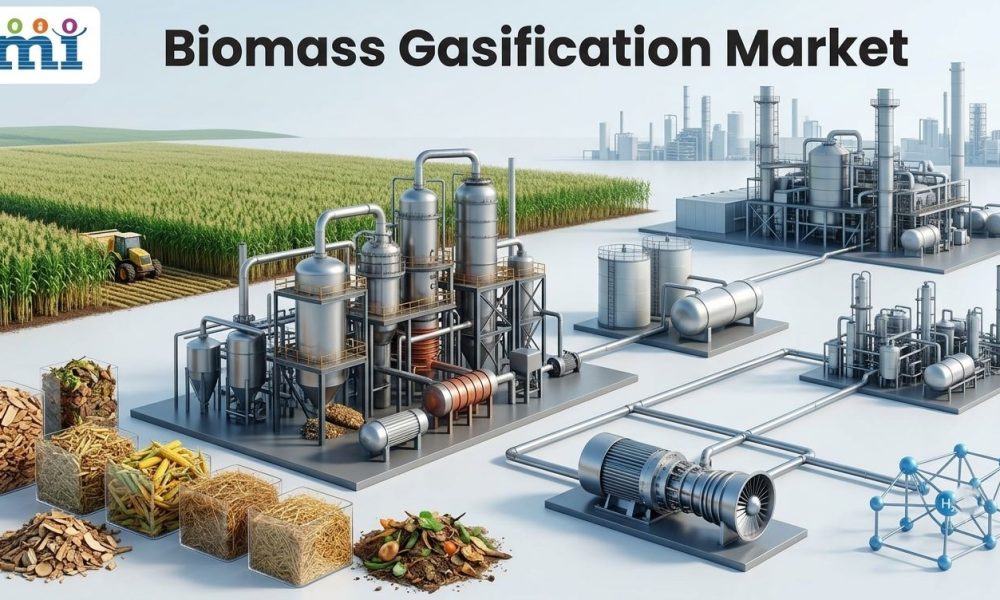
The global biomass gasification market is projected to grow from USD 135.25 billion in 2026 to USD 317.27 billion by 2036, advancing at a 8.9% CAGR during the forecast period. Market demand is being supported by clean energy transition mandates, carbon neutrality targets, and expanding industrial applications for syngas and biochar production.
The diversification of biomass-derived syngas applications is increasing the role of gasification beyond conventional power generation. Industrial customers are exploring syngas for chemical production, hydrogen generation, and transportation fuel synthesis, while waste-to-energy and municipal waste gasification are creating additional project opportunities.
Biomass Gasification Market: Key Growth Drivers
Government clean energy targets and carbon neutrality commitments are supporting investment in biomass gasification as a pathway for renewable energy and low-carbon industrial feedstocks. Gasification converts biomass into syngas that can be used for power generation, heat production, and chemical synthesis.
Policy mechanisms such as feed-in tariffs, renewable energy credits, and carbon pricing can improve project economics and support the development of gasification infrastructure. Regions with established forestry and agricultural industries also benefit from more reliable biomass feedstock availability.
Get detailed market forecasts, competitive benchmarking, and pricing trends: https://www.futuremarketinsights.com/reports/sample/rep-gb-18854
Woody Biomass Leads Source Demand
By source, woody biomass is estimated to account for 34.8% of demand in 2026. Its position reflects established availability, mature supply chains, and the suitability of woody feedstocks for commercial gasification systems.
By gasifier technology, fixed-bed gasification is expected to account for 42.2% of the segment in 2026. Its established performance, operational simplicity, and suitability for small to medium-scale installations support continued demand across biomass gasification projects.
Feedstock and Technology Development Create New Opportunities
Reliable biomass feedstock supply chains are becoming increasingly important as gasification projects move toward larger-scale installations. Sourcing, storage, preprocessing, and logistics infrastructure can determine the continuity and economics of commercial gasification operations.
Capital costs and feedstock supply chain challenges remain important restraints. Gasification projects require investment in equipment, infrastructure, feedstock handling, and supporting systems, while inconsistent biomass availability can affect operating economics.
Country Markets Show Different Growth Patterns
Country-level demand reflects differences in clean energy policy, biomass availability, industrial applications, project economics, and infrastructure development.
China is projected to record a 12.2% CAGR through 2036, followed by India at 11.3%, Germany at 10.4%, Brazil at 9.5%, the USA at 8.6%, the UK at 7.7%, and Japan at 6.8% through 2036.
China’s market is supported by clean energy mandates, carbon neutrality targets, and expanding industrial demand for syngas production from biomass feedstocks. India is seeing similar demand from biomass-to-energy infrastructure and diversified industrial applications for syngas.
Germany’s gasification market benefits from clean energy objectives and industrial applications for biomass-derived syngas.
Access the Complete Report in PDF Format: https://www.futuremarketinsights.com/reports/brochure/rep-gb-18854
Competitive Landscape
The competitive landscape includes Infinite Energy Private Ltd., Ankur Scientific Energy Technologies Pvt. Ltd., Valmet, Royal Dutch Shell Plc., Air Liquide, General Electric, Siemens AG, Mitsubishi Heavy Industries (MHI), ThyssenKrupp AG, KASAG Swiss AG, EQTEC plc, Synthesis Energy Systems, Bellwether Recuperative Gasification Ltd, Shanghai Haiqi Environmental Protection Technology Co. Ltd., Chanderpur Group, Enersol Biopower Pvt. Ltd, SG H2 Energy, Yosemite Clean Energy, SYNCRAFT, ReGaWatt GmbH, and SynTech Bioenergy LLC.
Market competition spans global technology providers, regional gasification specialists, and emerging companies targeting specific feedstocks and applications. Differentiation increasingly depends on technology breadth, project scale, feedstock flexibility, geographic presence, and the ability to provide project development and service capabilities.
“The biomass gasification market is evolving toward multi-application gasification platforms driven by syngas diversification and carbon credit mechanisms. Companies that invest in technology optimization, feedstock flexibility, and project development capability can address changing project requirements across applications and regions.”
— Future Market Insights
Biomass Gasification Market: Report Scope
The report covers the market by source, gasifier technology, application, and region. The source segments include woody biomass, agricultural residues, energy crops, organic wastes, and others. Gasifier technology includes fixed-bed gasification, fluidized-bed gasification, plasma gasification, catalytic gasification, and others.
The application segments include heat generation, power generation, liquid fuel generation, chemical production, and others. The study covers North America, Latin America, Europe, East Asia, South Asia and Pacific, and the Middle East and Africa, with detailed analysis for China, India, Germany, Brazil, the USA, the UK, Japan, and more than 30 countries.
The forecast period extends from 2026 to 2036, with the market projected to increase from USD 135.25 billion in 2026 to USD 317.27 billion by 2036 at a 8.9% CAGR. The market is projected to create an incremental opportunity of USD 182.02 billion between 2026 and 2036.
Business Impact
FMI helps organizations transform market complexity into strategic clarity, enabling leadership teams to identify growth opportunities faster, optimize resource allocation, strengthen competitive positioning, and make high-stakes business decisions with confidence.
To explore how FMI Custom Research can support your strategic priorities, please connect with our team at – [email protected]
About Future Market Insights (FMI)
Future Market Insights, Inc. (FMI) is an ESOMAR-certified, ISO 9001:2015 market research and consulting organization, trusted by Fortune 500 clients and global enterprises. With operations in the U.S., UK, India, and Dubai, FMI provides data-backed insights and strategic intelligence across 30+ industries and 1200 markets worldwide.



