
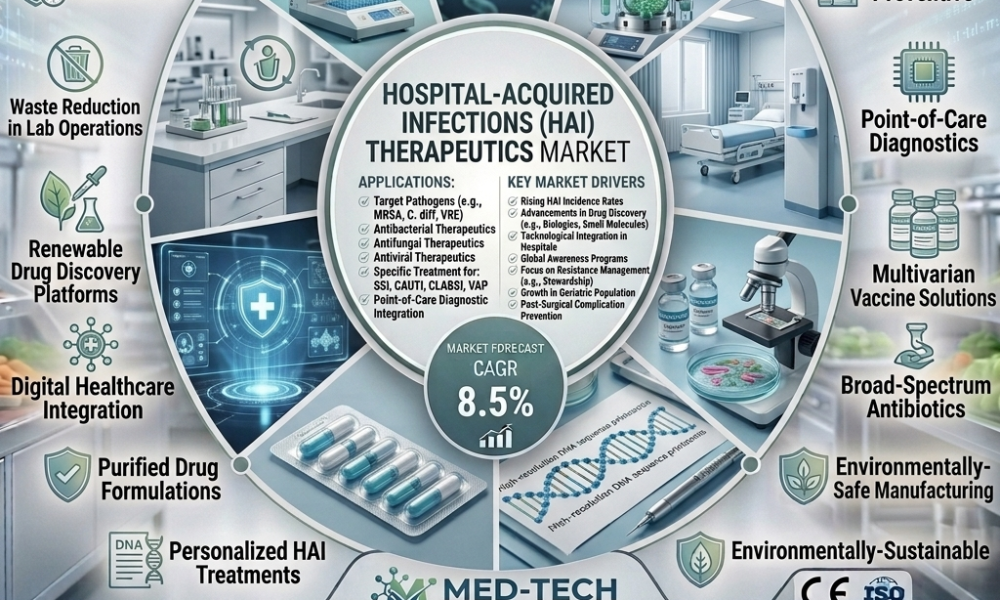
Rockville, MD., September 21, 2026 — The Hospital Acquired Infections Therapeutics Market is projected to reach USD 11.0 billion by 2036, rising from USD 5.47 billion in 2026 at a 7.2% CAGR, according to Fact.MR. The market was valued at approximately USD 5.10 billion in 2025, creating an absolute dollar opportunity of USD 5.49 billion between 2026 and 2036.
The demand for effective treatments for hospital-acquired infections remains closely linked to patient safety and institutional healthcare needs. The U.S. Centers for Disease Control and Prevention (CDC) reported on July 15, 2026, that about 1 in 38 hospital patients had at least one healthcare-associated infection on any given day in 2023. The CDC also estimated 518,000 healthcare-associated infections in U.S. acute care hospitals in 2023.
Get detailed market forecasts, competitive benchmarking, and pricing trends: https://www.factmr.com/connectus/sample?flag=S&rep_id=11467
Antibiotics Account for 49% of Product Share
Antibiotics represent the leading product category, accounting for 49% of the Hospital Acquired Infections Therapeutics Market in 2026, according to Fact.MR. Bloodstream infections lead the application segment with a 44% share, while hospitals account for 66% of end-use demand in 2026.
The market covers antibiotics, antifungal drugs, antiviral drugs, and combination therapies. Key applications include bloodstream infections, urinary tract infections, surgical site infections, and respiratory infections. Hospitals, specialty clinics, and ambulatory surgical centers form the principal end-use categories.
The study uses a combination of secondary research, primary interviews, and forecast modelling to assess the global market. Fact.MR’s methodology incorporates 120+ secondary sources, 65+ company product portfolios, 30+ countries, and 25+ primary interviews across manufacturers, distributors, institutional buyers, and end users.
This research provides insight into changing procurement patterns and competitive conditions. Fact.MR identifies a shift toward contract-based supply models, while manufacturers are prioritizing formulation optimization and clinical validation. Reimbursement expansion, institutional purchasing, and advances in formulation and delivery technologies are also identified as opportunity areas.
Clinical Evidence Shapes Procurement Decisions
Shambhu Nath Jha, Principal Consultant at Fact.MR, said, “The hospital acquired infections therapeutics market is entering a phase where clinical validation and formulary access will matter more than product novelty.”
According to the report, procurement decisions are increasingly influenced by clinical outcome data, cost-effectiveness analysis, and supply reliability. Healthcare institutions are also placing greater importance on dependable product availability when establishing supply arrangements.
Contract-based purchasing and institutional supply agreements are changing how manufacturers compete for recurring demand. These arrangements can influence supplier selection, pricing structures, distribution planning, and long-term customer relationships.
Jha added, “The shift toward contract-based purchasing and institutional supply agreements is compressing margins for undifferentiated suppliers while creating durable revenue streams for those with established clinical credibility.”
The report identifies Merck & Co., Inc., Pfizer Inc., Bayer AG, GlaxoSmithKline Plc, Daiichi Sankyo Company, Limited, AbbVie Inc., F. Hoffmann-La Roche Ltd, Allergan Plc, and Abbott Laboratories among companies operating across the market.
These companies differ in product coverage, geographic reach, institutional relationships, pricing, and distribution capabilities. Their presence reflects the competitive nature of a market serving hospitals and other healthcare providers that require therapeutics across multiple infection categories.
India and China Show Strong Country Growth
India is projected to record an 8.5% CAGR through 2036, making it the fastest-growing country market covered in the report. China follows at 8.0%, while Japan is projected to grow at 7.2%. Brazil is forecast at 7.1%, followed by the United States at 6.9%.
Fact.MR identifies North America as the largest regional market by value. The region benefits from established healthcare infrastructure and institutional demand for infection treatment. Europe maintains steady demand, while Asia Pacific is emerging as a growth area as institutional budgets and distribution infrastructure expand.
The geographic outlook also highlights differences in market development. Countries with expanding healthcare infrastructure and institutional purchasing capacity are expected to contribute to future demand. At the same time, established markets continue to represent important revenue bases for therapeutics manufacturers.
Pricing and Supply Challenges Remain
Despite growth opportunities, the Hospital Acquired Infections Therapeutics Market faces several constraints. Fact.MR identifies reimbursement-related pricing pressure, regulatory complexity across geographies, and supply-chain concentration in selected manufacturing regions as factors that can restrict margin expansion and procurement flexibility.
These challenges make supply reliability and cost management important considerations for manufacturers and institutional buyers. Companies must also account for differing regulatory requirements and reimbursement conditions across countries when developing market strategies.
As the market advances toward 2036, demand is expected to remain connected to healthcare institutions’ need for effective infection management. Clinical validation, formulary access, product availability, and established institutional relationships are becoming important considerations in procurement decisions.
About Fact.MR
Fact.MR is a market research and consulting firm providing industry analysis, market forecasts, competitive assessments, and strategic intelligence across global markets. Its research combines secondary research, primary interviews, demand-side analysis, pricing assessment, and forecast modelling.



