
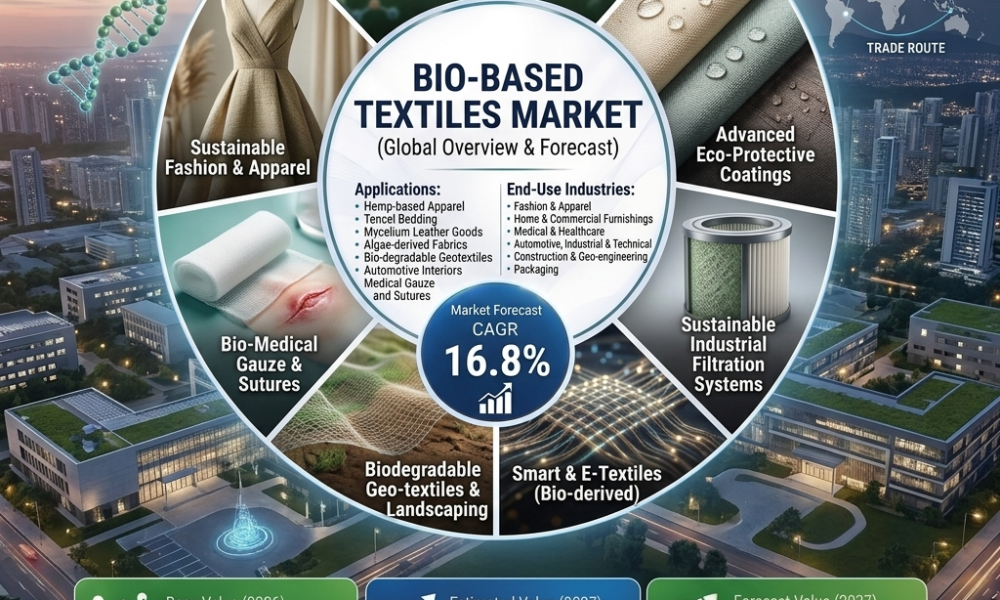
Rockville, MD., September 22, 2026 — The global bio-based textiles market is projected to increase from USD 54.0 billion in 2026 to USD 122.1 billion by 2036, expanding at a 8.5% CAGR during the forecast period. The market reached USD 49.8 billion in 2025, according to the latest Fact.MR assessment.
The market is being shaped by textile brands and processors evaluating renewable fibers as alternatives to conventional materials. Natural bio-based fibers are gaining attention because they can provide a familiar substitution route for apparel and home textile applications. At the same time, brands are placing greater focus on documented fiber origin and mill-level processing compatibility.
Get detailed market forecasts, competitive benchmarking, and pricing trends
Natural Fiber Substitution Supports Market Expansion
Natural bio-based fibers are projected to account for 39.6% of the market by fiber type in 2026. Their position reflects their familiarity among textile manufacturers and brands looking for renewable inputs that can work within established spinning and finishing processes.
The apparel sector provides an important testing ground. Apparel is projected to account for 34.0% of the market by application in 2026. Clothing brands increasingly evaluate fiber origin alongside comfort and fabric performance when qualifying materials for new collections.
Plant-based sources are expected to hold 44.3% of the market by source in 2026. Cotton and hemp remain familiar options for buyers and mills, while flax provides another route for durable fabric programs. The report notes that familiar feedstocks can make material approval easier when mills assess new fiber inputs.
Apparel Qualification Shapes Purchasing Decisions
Material qualification remains central to adoption. Brands and textile processors need to confirm that renewable fibers can meet established expectations for comfort, yarn performance, fabric quality, and processing behavior.
Fashion & apparel is estimated to represent 33.9% of the market by end use in 2026. Public-facing fashion brands face direct customer scrutiny over material claims, making fiber origin and documentation important parts of procurement decisions.
Direct supplier relationships also play a significant role. Direct sales are forecast to account for 39.0% of the distribution channel in 2026. Large textile accounts often require trials before converting to larger orders. Direct engagement gives fiber suppliers an opportunity to address technical questions around spinning, dyeing, certification, and fabric performance.
USA Records the Fastest Country Growth
The USA is projected to record the highest CAGR among the countries assessed, at 11.1% from 2026 to 2036. Germany follows at 10.0%, while the UK, France, and Japan are expected to expand at 9.0%, 8.0%, and 7.0%, respectively. Canada is projected to record a 6.0% CAGR.
In the USA, demand is being supported by apparel brands testing targeted renewable-fiber collections before wider sourcing decisions. Mills continue to evaluate how new fiber blends behave during processing, making consistent material performance and reliable documentation important for adoption.
Germany’s market is expected to benefit from compliance-led sourcing and stronger emphasis on material proof. German textile customers are evaluating renewable fibers through qualification processes that consider documentation and stable fabric behavior.
The UK is seeing growth through selective apparel renewal programs. France’s market is influenced by fashion customers seeking material provenance and fabric quality, while Japan places greater emphasis on quality consistency, yarn performance, and documented material origin.
Cost and Processing Risks Remain Challenges
The shift toward bio-based textiles is not without operational barriers. Raw-material cost movement is identified as a key restraint because renewable fibers can face pricing pressure when their premium is not matched by perceived garment value.
Mill process-change risk is another challenge. New fiber blends may require trials to verify dyeing behavior, fabric performance, and defect responsibility before manufacturers approve wider use.
The report also identifies weak claim documentation as a restraint. Brands can face adoption delays when fiber origin cannot be clearly connected to certificates and product labels. Limited production scale for newer fibers can further restrict availability in specialized applications.
These challenges create opportunities for suppliers that can provide stable sourcing, mill-compatible fiber formats, and clear documentation.
Opportunities Extend Beyond Apparel
The market opportunity is expanding into specific yarn programs, verified apparel collections, home textiles, medical textiles, and hygiene applications.
Bio-based specific yarn programs can provide a clearer approval route when spinning and dyeing behavior is already understood. Verified apparel renewal collections can allow fashion brands to test renewable fibers in limited product lines before wider seasonal adoption.
Home textile conversion is another opportunity. Bedding and upholstery programs can support demand when fabric durability and wash behavior are established. The report also identifies medical and hygiene textile pilots as a longer-term opportunity in selected regulated accounts.
Competitive Landscape
The competitive landscape includes Lenzing AG, Toray Industries, Inc., Indorama Ventures Public Company Limited, Teijin Limited, NatureWorks LLC, BASF SE, and Eastman Chemical Company.
Lenzing supports the market through regenerated cellulosic fibers used in apparel and home textiles. Eastman contributes cellulosic textile materials, while NatureWorks provides polylactic acid capabilities for bio-based synthetic applications.
Toray Industries and Teijin strengthen the market through advanced textile materials. Indorama Ventures and BASF extend the competitive landscape through polymer, fiber, and materials technologies.
According to Shambhu Nath Jha, Sr. Consultant at Fact.MR, “Bio based textiles must prove that renewable origin does not weaken comfort or repeat supply. Acceptance is expected to depend on verified fiber claims and mill-level fit.”
Top Reports:
Bio-Enzymatic Cleaners Market:
Report Scope
The study analyzes the bio-based textiles market by fiber type, application, source, end use, distribution channel, and region.
Fiber types include natural bio-based fibers and other bio-based textile materials. Applications cover apparel and other textile uses, while sources include plant-based, wood-based, and other renewable inputs.
The study evaluates fashion and apparel, home textiles, and other end-use areas. Distribution channels include direct sales and other routes. Geographic coverage spans North America, Latin America, Western Europe, Eastern Europe, East Asia, South Asia & Pacific, and the Middle East & Africa, with detailed country analysis for markets including the USA, Germany, UK, France, Japan, and Canada.



