
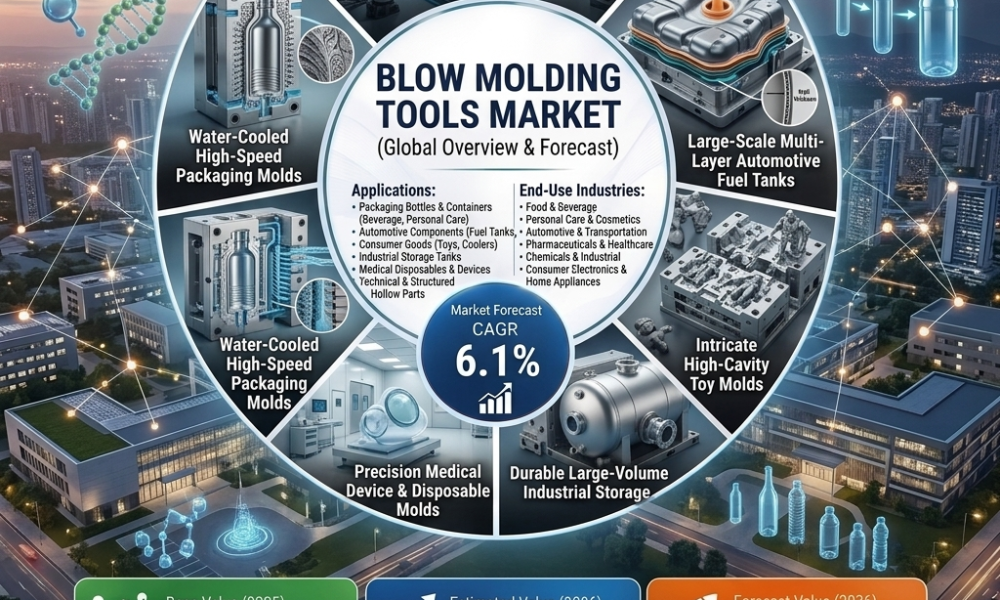
Rockville, MD., September 22, 2026 — The global blow molding tools market is projected to increase from USD 2.2 billion in 2026 to USD 3.9 billion by 2036, expanding at a 5.8% CAGR during the forecast period. The market reached USD 2.1 billion in 2025, according to the latest Fact.MR assessment.
Blow molding tools are used to produce hollow plastic parts such as bottles, food containers, automotive ducts, fuel tanks, medical bottles, and industrial containers. Demand is being shaped by recurring packaging programs, mold replacement requirements, complex hollow-part production, and the need for consistent dimensions across long production runs.
Get detailed market forecasts, competitive benchmarking, and pricing trends
Packaging Replacement Demand Supports Market Growth
Packaging converters need molds that maintain bottle shape, wall distribution, and dimensional consistency over repeated production cycles. Food, beverage, personal care, and household product manufacturers also require timely mold changes when packaging formats are updated.
Packaging tool replacement is identified as the primary demand driver. Repeated container formats create opportunities for new mold sets, replacement inserts, refurbishment, polishing, and inspection services.
Extrusion mold specification is another growth factor. Customers increasingly require tools that can support wall-distribution control while reducing production interruptions. This is particularly relevant for high-volume bottles, containers, ducts, and technical hollow parts.
The market is projected to gain an additional USD 1.7 billion in absolute opportunity by 2036. Direct engineering support also remains important because tooling orders often require drawings, resin selection, machine-fit checks, sampling, and commissioning support before approval.
Extrusion Tools Hold the Leading Product Share
Extrusion Blow Molding Tools are projected to account for 36.5% of the product-type segment in 2026. Continuous extrusion, accumulator-head, injection, and stretch variants serve different requirements related to geometry, resin behavior, and neck-finish specifications.
Extrusion tools remain important for high-volume bottle and container production. They are also used for ducts and other technical hollow parts where consistent shape and production repeatability are required.
Packaging is expected to hold 31.6% of the application segment in 2026. Recurring bottle and container formats create steady requirements for tool replacement, maintenance, and refurbishment.
Within the end-user segment, Packaging Manufacturers are anticipated to account for 30.0% share in 2026. These customers must maintain production molds for repeat orders, customer approvals, audits, and line changeovers.
Tool Steel Remains the Leading Material
Tool Steel is forecast to capture 36.9% of the material segment in 2026. Customers value tool steel for wear resistance, repairability, dimensional stability, polish retention, and stable thermal behavior during repeated production.
H13 steel, P20 steel, aluminum alloys, copper inserts, and other specialty materials serve applications with different cooling, precision, and production requirements.
Direct Sales are estimated to represent 31.3% of the distribution channel in 2026. Engineering discussions often form part of the purchasing process because suppliers need to assess drawings, machine compatibility, resin selection, and sampling requirements before a tool is accepted.
Germany Leads Country Growth
Germany is projected to record the highest CAGR among the countries assessed, at 7.5% from 2026 to 2036. Brazil follows at 7.0%, while the USA, Canada, UK, Japan, and Mexico are forecast to grow at 6.4%, 4.6%, 5.8%, 5.2%, and 4.0%, respectively.
Germany’s market reflects engineering-led purchasing practices. Customers place emphasis on mold-life evidence, sampling records, dimensional validation, and repair planning before wider adoption.
Brazil’s demand is connected to packaging conversion activity, service availability, and replacement requirements. Local support remains relevant for converters that need dependable access to tooling and maintenance.
In Mexico, nearshoring and packaging-linked manufacturing are supporting localized tooling requirements. Customers require faster engineering response and service availability for production programs.
The USA has a large installed base where replacement tools and service contracts contribute to demand. The UK and Japan show more quality-focused purchasing patterns, with customers assessing tooling cost against production life and reliability.
Raw-Material Costs and Approval Cycles Present Challenges
Blow molding tool suppliers face several operational constraints. Raw-material cost movement is identified as a key restraint. Steel, aluminum, copper, machining time, and polishing labor can influence quotations for custom tooling.
Long tool approval cycles can also delay orders. Sampling, dimensional checks, customer sign-off, and machine compatibility assessments may extend the period between quotation and repeat production.
Machine-to-tool compatibility is another consideration. Older blow molding equipment can require additional engineering work before a new mold delivers the expected production performance.
Limited local service depth can further affect customers operating dispersed production sites. These factors make technical support and after-sales service important parts of the purchasing process.
Opportunities Extend Beyond New Tool Sales
Mold refurbishment packages represent an opportunity for suppliers to build recurring service relationships. Planned repair, insert replacement, polishing, and inspection can help customers manage tool life.
Packaging format changeovers can also create demand for faster quotation, sample testing, and commissioning support.
Thermal management inserts provide another opportunity. Improved cooling layouts can support shorter production cycles while maintaining required wall distribution.
Digital procurement for repeat tools is expected to develop over the longer term, particularly where customers already have established specifications and supplier relationships.
Competitive Landscape
The competitive landscape includes Kautex Maschinenbau, Uniloy, Bekum Maschinenfabriken, Jomar Corporation, Magic MP S.p.A., and Aoki Technical Laboratory.
Kautex Maschinenbau provides blow molding equipment and technical support for packaging and industrial applications. Uniloy brings extrusion and injection blow molding expertise across bottles, containers, and technical parts. Bekum Maschinenfabriken focuses on extrusion blow molding systems.
Jomar Corporation has expanded its capabilities through in-house moldmaking operations. Aoki Technical Laboratory serves injection blow molding and container mold applications, while Magic MP S.p.A. provides equipment and tooling support for specialized production requirements.
According to Shambhu Nath Jha, Sr. Consultant at Fact.MR, “Blow molding tool purchases are expected to depend on machine fit, resin behavior, service response, and replacement timing. Customers are less likely to approve tools on price alone when downtime and late launches carry higher cost.”
Top Reports:
Report Scope
The study covers molds, tooling sets, inserts, trim tools, die heads, and related service packages used to produce hollow plastic parts through extrusion, injection, stretch, and co-extrusion blow molding.
The analysis examines product types including extrusion blow molding tools, injection blow molding tools, injection stretch blow molding tools, 3D blow molding tools, co-extrusion tools, automotive duct molds, and barrier packaging molds.
Applications include packaging, beverage bottles, food containers, automotive components, fuel tanks, air ducts, consumer goods, healthcare products, pharmaceutical containers, and industrial products.
The report evaluates packaging manufacturers, food and beverage packaging companies, automotive manufacturers, OEMs, Tier-1 suppliers, consumer goods manufacturers, medical and pharmaceutical companies, and industrial product manufacturers.
Geographic coverage includes North America, Latin America, Europe, East Asia, South Asia and Pacific, and the Middle East and Africa, with detailed country analysis for Germany, Brazil, Canada, Mexico, the USA, UK, and Japan. The study draws on 120+ sources, 35+ company portfolios, 25+ countries, and more than 20 industry interviews, using a hybrid top-down and bottom-up approach.



