
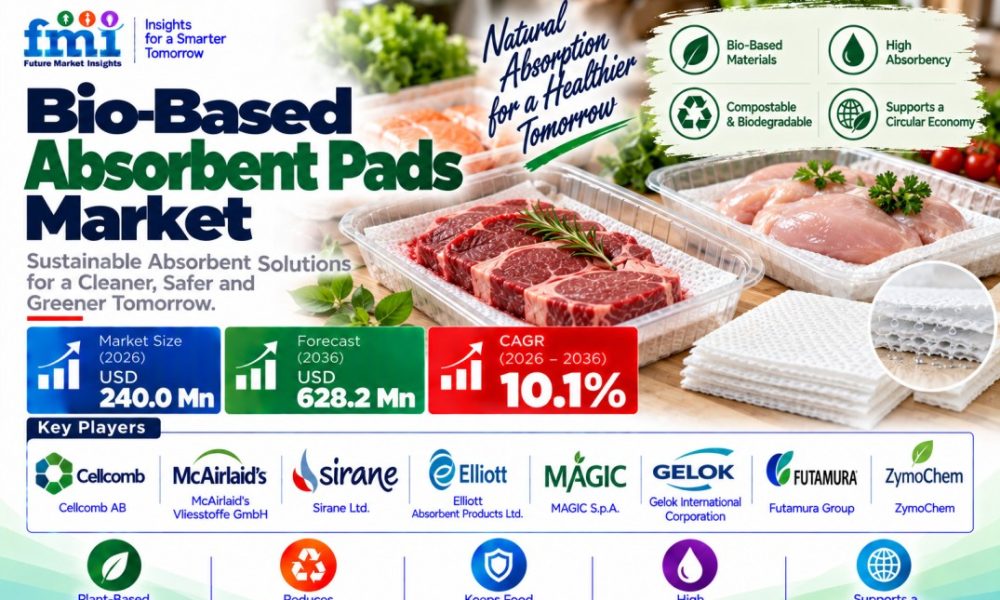
The global Bio-Based Absorbent Pads Market is projected to grow from USD 240.0 million in 2026 to USD 628.2 million by 2036, expanding at a 10.1% CAGR during the forecast period, according to Future Market Insights. Demand is being supported by fresh-food processors seeking to reduce fossil-derived components while maintaining fluid retention across high-volume retail tray programs.
The commercial shift is not simply about replacing conventional absorbent materials. Processors need bio-based pads to withstand protein purge, compression, chilled transport, and commercial tray speeds. Food-contact records and destination-specific disposal instructions are also becoming part of routine qualification.
>> Get Detailed Market Forecasts, Competitive Benchmarking, and Pricing Trends: https://www.futuremarketinsights.com/reports/sample/rep-gb-34655
100% Cellulose Pads Lead Product Demand
100% cellulose pads are projected to account for 36.0% of product-type demand in 2026.
Cellulose-only architectures offer a familiar renewable construction while allowing processors to maintain existing tray geometry and automated placement equipment. Sealed cellulose structures can also simplify composition records and end-of-life instructions for large retail programs.
However, cellulose retention can weaken under protein purge and compression if density or cover design is unsuitable. Processors therefore require food-specific trials before replacing an approved pad in recurring commercial contracts.
Airlaid Cellulose Holds a 36.0% Material Share
By material, airlaid cellulose is estimated to capture 36.0% of demand in 2026.
Its open web structure supports controlled fluid distribution while allowing converters to adjust basis weight and layer density for meat, produce, and seafood applications.
The commercial qualification process still needs to examine retention under stacking pressure and chilled transport. FMI notes that application-specific airlaid designs can connect fluid control with longer selling windows in seafood packaging.
Fully Bio-Based Content Represents 46.0%
Fully bio-based content is anticipated to account for 46.0% of demand in 2026.
The category provides packaging teams with a direct way to measure renewable material substitution across the finished pad.
However, bio-based content does not remove food-contact or recovery requirements. Cover films, sealing materials, and other components can influence retention and end-of-life performance.
Regulation (EU) 2025/40, which entered into force in February 2025, is increasing the importance of complete composition records across retailer packaging programs.
Meat and Poultry Account for 36.0%
Meat and poultry are forecast to represent 36.0% of application demand in 2026.
These products generate recurring purge during chilled storage and high-volume retail distribution. Absorbent pads must therefore retain liquid under compression to help prevent leakage, rework, and rejected packs.
Pad capacity is typically matched to the cut type and pack weight during food-specific trials. This makes application-specific design important for commercial adoption.
FMI Principal Consultant Nandini Roy Choudhury states:
“Bio-based absorbent pads earn repeat orders when renewable content survives protein purge, compression and commercial tray speeds. Suppliers should qualify each pad against the food chemistry and disposal route that governs the processor contract.”
Qualification Remains a Key Market Constraint
The market’s growth is balanced by technical and regulatory qualification requirements.
Renewable structures need to demonstrate food-contact suitability, retention under pressure, sealing performance, and an end-of-life route accepted in the destination market.
The FDA made FCN 2396 effective in December 2024 for crosslinked sodium polyacrylate used with meat and poultry, seafood, and produce. Cellulose alternatives therefore need to demonstrate equivalent suitability for the specific use and temperature conditions when processors consider a commercial tray specification change.
The UK also increased its Plastic Packaging Tax to GBP 228.82 per tonne from April 2026 for components containing less than 30% recycled plastic, adding another material-accounting consideration for packaging programs.
Country Markets Show Different Growth Profiles
FMI forecasts the following country CAGRs for 2026–2036:
- Brazil: 10.6%
- United Kingdom: 10.2%
- Germany: 9.9%
- United States: 9.4%
- Japan: 8.6%
These are forecast growth rates rather than rankings of current market size. Packaging taxes, food-processing structures, recovery systems, and technical qualification requirements differ across these markets.
Brazil’s market is supported by meat and seafood processing volumes serving domestic and export channels. The UK market is influenced by plastic taxation and producer-responsibility fees. Germany places greater emphasis on evidence supporting paper-stream claims.
In the United States, large protein-processing networks create demand for stable supply and technical support. Japan places particular weight on dimensional consistency and retail presentation quality.
👉 Access the Complete Report in PDF Format: https://www.futuremarketinsights.com/reports/brochure/rep-gb-34655
Application-Tuned Cellulose Creates an Opportunity
FMI identifies application-specific development as a key opportunity.
Finished-pad specialists can tailor cellulose cores and covers for individual foods, absorption loads, and commercial line settings. Direct OEM relationships can combine test records with line settings and destination-specific disposal instructions.
This approach allows processors to evaluate renewable materials without treating every fresh-food application as having the same fluid profile or operating conditions.
Competitive Landscape
The market is moderately fragmented across finished-pad manufacturers, absorbent-core producers, and renewable-input developers.
Notable companies profiled by FMI include Cellcomb AB, McAirlaid’s Vliesstoffe GmbH, Sirane Ltd., Elliott Absorbent Products Ltd., MAGIC S.p.A., Gelok International Corporation, Futamura Group, and ZymoChem.
Cellcomb, McAirlaid’s, Sirane, Elliott, and MAGIC compete in finished-pad construction and food-specific qualification. Gelok supplies absorbent cores, while Futamura and ZymoChem provide renewable film or BioSAP inputs that depend on commercial pad-development partnerships.
Recent developments include MAGIC commissioning ANDRITZ in July 2026 for a food-pad line with integrated airlaid technology, with startup planned for the first quarter of 2027. In October 2025, Cellcomb renamed Cellsorb ECO as Cellsorb CORE, while Elliott Absorbent Products launched Echo fruit pads made from crop-residue cellulose in October 2024.
About the Bio-Based Absorbent Pads Market
The FMI report covers the market by product type, material, bio-based content, application, end use, sales channel, and region.
Product types include 100% cellulose pads, Bio-SAP pads, starch-based core pads, bio-film backed pads, and others. Applications include meat and poultry, fruits and vegetables, seafood, and other foods. End users include processors and packers, grocery retail, and foodservice operators.
To explore how FMI Custom Research can support your strategic priorities, connect with our team at – [email protected]
About Future Market Insights (FMI)
Future Market Insights, Inc. is an ESOMAR-certified, ISO 9001:2015 market research and consulting organization trusted by Fortune 500 companies. With a global presence across the U.S., UK, India, and Dubai, FMI delivers data-driven insights across 30+ industries and 1200 markets worldwide.



