
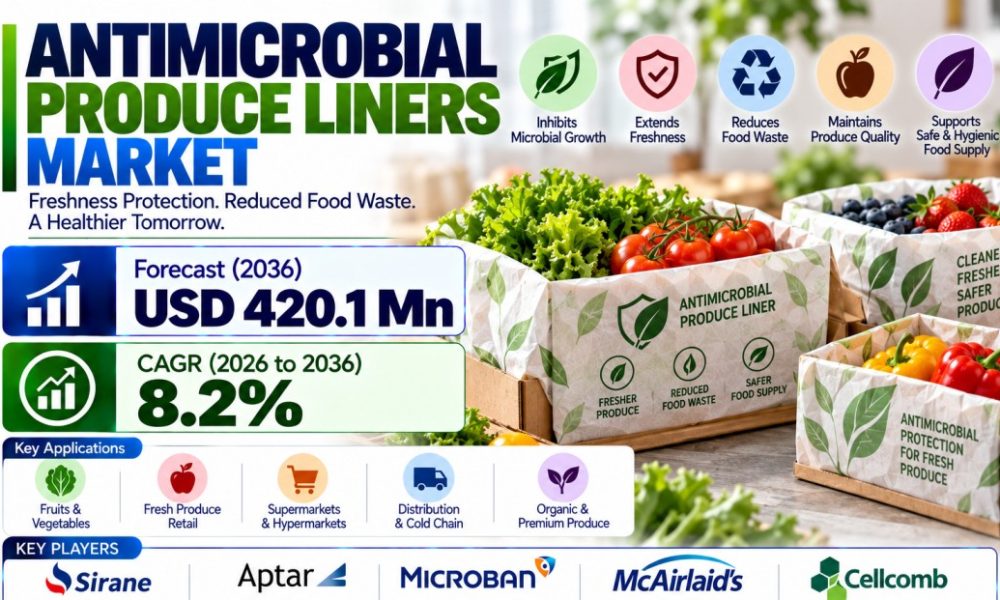
The global antimicrobial produce liners market is projected to grow from USD 191.0 million in 2026 to USD 420.1 million by 2036, registering an 8.2% CAGR during the forecast period, according to Future Market Insights. Demand is being supported by produce packers seeking better control of free moisture and microbial pressure while reducing shrink and destination rejections.
Antimicrobial liners are being evaluated as part of active packaging systems for fresh produce. However, commercial adoption depends on more than antimicrobial performance. Packers must validate food-contact compliance, crop efficacy, sensory neutrality, normal packing-line performance, and the recovery route available in the destination market.
👉 Access the Complete Report in PDF Format: https://www.futuremarketinsights.com/reports/sample/rep-gb-34603
Antimicrobial Absorbent Pads Lead Product Demand
Antimicrobial absorbent pads are projected to account for 32.0% of 2026 revenue, making them the leading product type.
Their position is linked to the ability to combine moisture capture and active protection in one replaceable insert. The format can also be evaluated within existing trays or punnets without requiring a complete redesign of the consumer pack.
Commercial qualification still requires testing absorbency under route temperatures, clean edge sealing, dimensional fit, and normal line speed.
Silver-Ion Technology Holds a 26.0% Share
Silver-ion technology is estimated to represent 26.0% of the active-technology segment in 2026.
Silver-ion systems can be integrated into polymers, coatings, and nonwoven structures during material production. These established integration routes can support converter handling, although they do not remove the need for migration and food-contact review.
FMI notes that manufacturers and packers need application-specific evidence rather than relying solely on the established integration pathway of the antimicrobial technology.
Mold and Fungal Control Represents 36.0%
By function, mold and fungal control is forecast to account for 36.0% of the market in 2026.
Visible decay can result in rejection of an entire punnet even when only a limited portion of the produce is affected. Condensation during temperature changes can increase the exposure of delicate produce to moisture.
As a result, commercial trials need to measure more than laboratory inhibition. Destination incidence, remaining saleable days, sensory effects, and pack performance can provide a stronger connection between liner performance and commercial outcomes.
Berries Account for 28.0% of Produce-Type Demand
Berries are projected to hold a 28.0% share in 2026, making them the leading produce type.
Berries have delicate surfaces and limited tolerance for free moisture during refrigerated storage and transport. Their compact retail formats can also accommodate pads or liners without requiring significant changes to the consumer unit.
This creates a practical environment for route-specific trials that compare treated and untreated packs under controlled conditions.
Food-Contact Qualification Remains a Key Restraint
The market’s growth opportunity is balanced by qualification requirements.
Active liners require food-contact documentation and crop-specific evidence covering migration, sensory effects, and normal line performance. European Commission Regulation (EC) No 450/2009 provides safety and compliance controls for active and intelligent food-contact materials.
For packers, this can extend the purchasing cycle even where the potential loss-reduction case is clear.
FMI Principal Consultant Nandini Roy Choudhury states:
“Antimicrobial produce liners should be qualified as crop-and-route systems instead of interchangeable packaging inserts during commercial evaluation.”
She further notes that strong programs need to connect food-contact evidence with pack-out yield and sensory neutrality while confirming line speed and an accepted destination-market recovery route.
Country Markets Show Different Adoption Conditions
The report profiles five country markets. Brazil is projected to record an 8.6% CAGR, followed by the UK at 8.1%, Germany at 8.0%, the USA at 7.6%, and Japan at 6.8% through 2036. These figures represent forecast growth rates and do not establish equivalent market sizes or commercial conditions.
Brazil’s outlook is connected with long distribution distances and variable refrigeration conditions. The UK market is influenced by retailer waste-reduction commitments and fresh-produce specifications. Germany places emphasis on documented food-contact compliance and verified shrink reduction.
The USA benefits from large-scale produce operations that require consistent supply across growing seasons. Japan’s adoption pathway places particular importance on appearance preservation and sensory neutrality.
Recyclable Active Structures Create an Opportunity
FMI identifies recyclable active structures as an important commercial opportunity.
Cellulose-rich active pads and thinner active layers can potentially combine produce protection with recovery routes accepted in intended destination markets. The commercial model, however, depends on an accepted recovery route and crop-specific protocol, together with a cost case linked to pack-out yield.
>> Get Detailed Market Forecasts, Competitive Benchmarking, and Pricing Trends: https://www.futuremarketinsights.com/reports/brochure/rep-gb-34603
Competitive Landscape
The competitive landscape includes produce-pad specialists, antimicrobial material developers, and produce-atmosphere packaging providers.
Key companies profiled by FMI include Sirane, Aptar CSP Technologies, Microban International, McAirlaid’s, Cellcomb, Novipax, BioCote, and StePac.
Sirane, McAirlaid’s, Cellcomb, and Novipax compete in absorbent pads and liners for food and produce applications. Aptar CSP Technologies, Microban International, and BioCote focus on active-material engineering or antimicrobial additive integration. StePac provides produce-specific liner and film solutions designed to manage humidity or package atmosphere during distribution.
Recent developments include Cellcomb’s June 2025 acquisition of Fatex, its March 2025 European home-and-garden compost approval for Cellsorb Circular, and the February 2024 launch of MP-1000 by Aptar CSP Technologies and ProAmpac for moisture-adsorbing rollstock and premade pouches compatible with high-speed form-fill-seal equipment.
About the Antimicrobial Produce Liners Market
The FMI report covers antimicrobial produce liners by product type, active technology, function, produce type, end use, sales channel, and region. Product categories include antimicrobial absorbent pads, treated paper liners, antimicrobial film liners, essential-oil infused liners, and others.
The study covers North America, Latin America, Western Europe, Eastern Europe, East Asia, South Asia and Pacific, and the Middle East and Africa, with country-level analysis across more than 25 countries.
To explore how FMI Custom Research can support your strategic priorities, connect with our team at – [email protected]
About Future Market Insights (FMI)
Future Market Insights, Inc. is an ESOMAR-certified, ISO 9001:2015 market research and consulting organization trusted by Fortune 500 companies. With a global presence across the U.S., UK, India, and Dubai, FMI delivers data-driven insights across 30+ industries and 1200 markets worldwide.



