

Aluminum Cable Market Overview
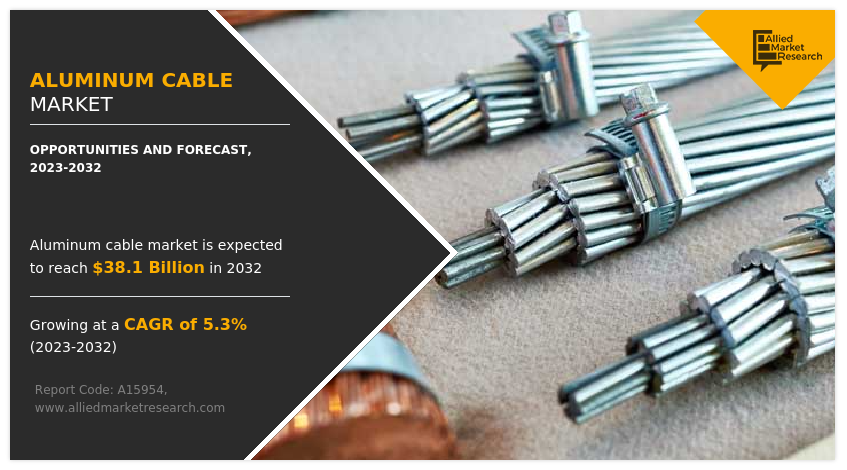
According to a new report published by Allied Market Research, the aluminum cable market size was valued at $22.8 billion in 2022, and is estimated to reach $38.1 billion by 2032, growing at a CAGR of 5.3% from 2023 to 2032.
An aluminum cable is an electrical cable that uses aluminum conductors to carry electrical currents. The conductors are the core elements of the cable responsible for transmitting electricity from one point to another. In aluminum cables, the conductors are made of aluminum, a lightweight and cost-effective metal with good electrical conductivity.
Download PDF Brochure: https://www.alliedmarketresearch.com/request-sample/A15954
Asia-Pacific aluminum cable market share is projected to grow at the highest CAGR during the forecast period. This is attributed to the fact that, Asia-Pacific energy demand is expected to increase at a rapid rate, accompanied by a rise in energy consumption in sectors such as industry, transportation, and households, as well as in newly electrified rural areas in the region’s countries.
North America garnered a share of around 20% in 2022 in terms of revenue.
Key players operating in the global aluminum cable market forecast include Havells India Ltd, Kaiser Aluminum Corporation, Kflex Cables & Conductors, Novametal SA, Priority Cable & Cable, Inc., Sam Dong, Southern Cable Group Berhad, Southcable Company, LLC, Vedanta Resources Limited, and Vimco Plast India.
The aluminum cable market scope is anticipated to be driven by the expansion of the construction industry.
Aluminum cable is widely used as its corrosion resistance, excellent electrical conductivity, reusability, and reflectivity properties.
Aluminum cable is both lightweight and capable of withstanding great strength. These advantages are expected to be important factors driving the global aluminum cable market size.
Characteristics
- Lightweight: Aluminum is significantly lighter than copper, making it easier to handle and install.
- Conductivity: While aluminum has about 61% of the conductivity of copper, it can still be effective for many applications due to its lower weight and cost.
- Corrosion Resistance: Aluminum has a natural oxide layer that helps protect it from corrosion, although additional coatings may be needed in harsh environments.
Aluminum cables are commonly used in various electrical applications, ranging from power transmission and distribution to residential and commercial electrical wiring. They offer certain advantages and are a popular alternative to copper cables in specific scenarios, primarily due to their cost-effectiveness and lighter weight.
In addition to the construction industry, aluminum cable is frequently used in the automobile industry. As a result of the surge in the automobile industry, the global aluminum cable market is expected to experience substantial expansion during the forecast period.
Extensive urbanization and industrialization foster rapid expansion in the construction and vehicle industries, which is anticipated to increase demand for aluminum cable market trends.
Rising improved lifestyles and disposable incomes and robust demand for various commodities and goods utilizing industrial manufacturing are expected to drive the global aluminum cable market during the forecast period.
Aluminum cables are manufactured in various types, configurations, and sizes, depending on the specific application and electrical requirements. Proper installation techniques and consideration of the cable’s properties are crucial to ensure safe and efficient operation.
Copper cables can be used as a substitute for aluminum cables and are more cost-effective than aluminum cables as a result of their qualities, which include high ductility, fracture strength, and high electrical conductivity.
Aluminum cables play a crucial part in residential, commercial, and industrial facilities, as they are utilized to transfer power, data, and voice transmission to electrical devices in a safe manner.
The growth of the world’s population and the increase in the disposable income of consumers are major contributors to the surge in demand for residential homes and other development projects. In the coming years, it is expected that this it will offer new avenues for aluminum cable market opportunities.
Buy This Report (289 Pages PDF with Insights, Charts, Tables, and Figures): https://bit.ly/4fGR8K2
Applications
- Power Distribution: Widely used in overhead and underground power distribution networks.
- Residential Wiring: Often used for service entrance and feeder applications in residential buildings.
- Transmission Lines: Commonly employed in high-voltage transmission lines where weight savings are critical.
Advantages
- Cost-Effective: Generally less expensive than copper cables, making it an attractive option for large-scale applications.
- Weight Savings: Easier to transport and install due to its lightweight nature.
- Energy Efficiency: Suitable for long-distance transmission, reducing energy losses.
By type, the market is segregated into interlocking metal sheathed cable, flame retardant fire-resistant cable, and others. The interlocking metal sheathed cable segment is expected to grow at a CAGR of 5.3%, in terms of revenue, during the forecast period.
By application, the global aluminum cable market is segmented into transformers, motors, circuit breakers, electrical appliances, automobile, and others. The automobile segment is expected to grow at a CAGR of 5.1%, in terms of revenue, during the forecast period.
The use of aluminum cables in the automotive industry is primarily driven by the current developing trends in the automotive industry, namely weight reduction and energy conservation, which also involves the evolutions of automobiles into the demands for luxury, convenience, performance, and safety, leading to an increase in the content, size, weight, and cost of the automotive cable harness.
Since weight reduction directly correlates with fuel economy, and a 10% weight reduction contribute to 3%-4% less fuel for average passenger vehicles and more than 5% of fuel economy improvements be obtained for heavy-duty vehicles such as trucks, some automakers have made efforts to replace heavy materials with lighter weighted ones in order to construct lighter-weighted vehicles
Future Trends
- Improved Alloys: Development of advanced aluminum alloys to enhance performance and reduce weight.
- Smart Grids: Integration of aluminum cables into smart grid technologies for efficient energy distribution.




