
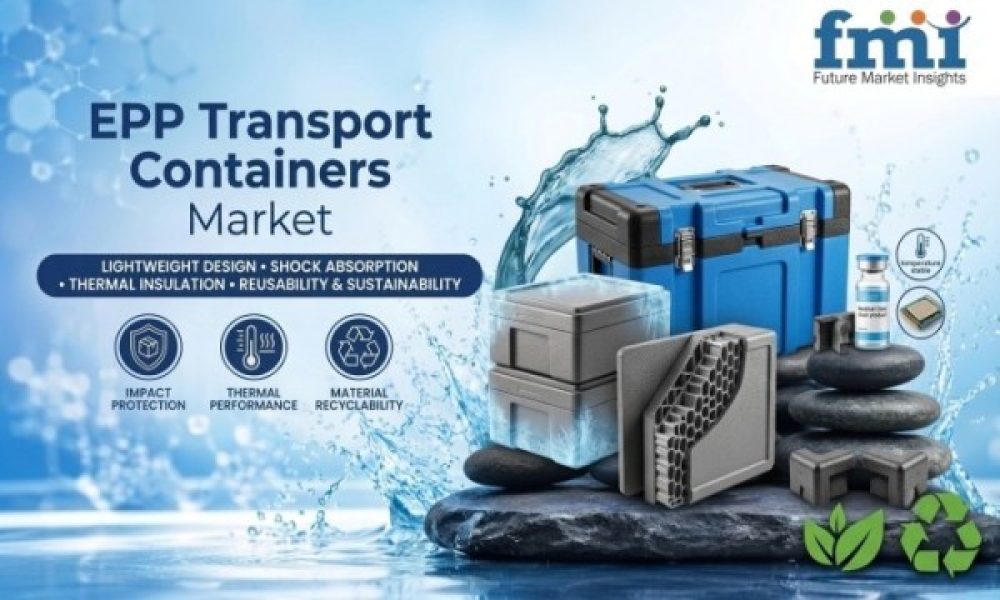
The global EPP Transport Containers Market is projected to increase from USD 356.3 million in 2026 to USD 638.1 million by 2036, registering a compound annual growth rate (CAGR) of 6.0% during the forecast period, according to Future Market Insights (FMI). Demand is supported by reusable packaging economics and regulations encouraging packaging reuse. On February 25, 2026, the European Commission published clarification on the Packaging and Packaging Waste Regulation (PPWR), addressing reuse requirements for transport packaging. The report identifies repeated asset recovery, impact protection and insulation as factors that can reduce costs per trip on established return routes.
California’s SB 54 permanent regulations also took effect on May 1, 2026, introducing a 25% source-reduction requirement for single-use plastic packaging by 2032. Although neither policy mandates EPP containers, both influence procurement comparisons between reusable transport systems and disposable packaging. Adoption remains dependent on route density, collection arrangements, cleaning costs and the ability to return containers for repeated use.
Get detailed market forecasts, competitive benchmarking, and pricing trends:
https://www.futuremarketinsights.com/reports/sample/rep-gb-35064
Global Segment Leaders
- Product type: Foldable EPP boxes, 34.0%. These containers reduce empty-return volume while providing impact resistance on closed-loop transport routes.
- Material: Corrugated and fiber, 31.0%. Established converting capacity, familiar packing-line requirements and existing recovery systems support their position in structural transport packaging.
- Capacity: 200–1,000 L, 43.0%. This range accommodates common warehouse handling equipment, forklifts and vehicle footprints without requiring specialized bulk infrastructure.
- End use: Food ingredients, 23.0%. Repeated processor-to-customer routes support container recovery, while food applications require documented sanitation, material compatibility and temperature protection.
- Sales channel: The report identifies direct industrial accounts, distributors, and rental and pooling as the principal channels. It does not disclose a leading channel’s market share.
The reported segment shares represent 2026 estimates. They reflect different purchasing considerations, including empty-return efficiency, established packaging infrastructure, handling compatibility and the feasibility of recovering assets after delivery.
Country-Level Performance
FMI profiles eight countries, with projected CAGRs sorted from highest to lowest.
- UAE | 7.6% CAGR: Dubai Municipality confirmed on December 24, 2025, that restrictions on polystyrene cups, plates and containers had already entered implementation during 2025 ahead of the final 2026 phase. The report links growth potential to dense trade and food-distribution routes that support asset recovery.
- Saudi Arabia | 7.3% CAGR: The Saudi Food and Drug Authority published and applied its Requirements for Food Transport on June 2, 2025, reinforcing controlled handling requirements for food shipments.
- South Korea | 7.0% CAGR: On April 12, 2026, the Ministry of Climate, Energy and Environment reported 3.83 million tonnes of household plastic waste in 2023 and identified reusable containers among nine plastic-reduction action rules.
- USA | 6.7% CAGR: On January 13, 2025, the Environmental Protection Agency announced Phase I Small Business Innovation Research funding for Bold Reuse to develop inventory management for reusable packaging transitions.
- UK | 6.4% CAGR: The Department for Environment, Food & Rural Affairs and PackUK published extended producer responsibility guidance on July 11, 2025, updated August 25, 2026, requiring large producers to report packaging data every six months and retain records for seven years.
- Germany | 6.1% CAGR: Umweltbundesamt reported on March 5, 2026, that Germany generated 17.9 million tonnes of packaging waste in 2023 and recycled 69.4%.
- Japan | 5.8% CAGR: On August 19, 2025, Japan’s Ministry of the Environment selected eight advanced social-implementation projects addressing plastic collection, reuse and recycling models.
- France | 5.5% CAGR: ADEME opened a national call on March 3, 2025, to address functional and operational barriers and support reusable industrial and commercial packaging.
Regional Context
The UAE, Saudi Arabia and South Korea form the fastest-growing group, with projected CAGRs above 7.0%. The report attributes their prospects to trade-gateway activity, industrial standardization, electronics exports and concentrated distribution networks that can support repeated container returns. However, long intercity routes, cleaning expenses and collection reliability remain relevant constraints.
The USA, UK and Germany occupy the middle growth tier. Their established manufacturing, warehousing and grocery networks provide opportunities for returnable transport systems, while existing packaging infrastructure and differences in regulatory requirements influence adoption. Japan and France record slower projected growth, reflecting established packaging practices, the need for documented performance and competition from familiar fiber-based formats.
The full report covers North America, Latin America, Western Europe, Eastern Europe, East Asia, South Asia and Pacific, and Middle East and Africa, with country-level analysis spanning more than 20 countries.
Competitive Landscape
The companies profiled are BEWI, Smurfit Westrock, Mondi Group, Signode, SCHÜTZ, Greif, Mauser Packaging Solutions and Nefab. Their market positions span molded protective packaging, fiber conversion, load securement, reusable industrial containers and engineered transit protection. Competition depends on protection performance, tooling, cleaning validation, container recovery and geographic service coverage.
Recent developments cited by FMI include a March 2026 agreement between SCHÜTZ and BASF for highly automated intermediate bulk container production and storage at Ludwigshafen, with construction scheduled from the third quarter. In June 2025, Mauser Packaging Solutions opened an on-site facility at BASF’s Tarragona location to recondition intermediate bulk containers and recycle end-of-life industrial plastic packaging into post-consumer resin. These developments concern industrial packaging and recovery capabilities rather than exclusively EPP containers.
FMI Principal Consultant Nandini Roy Choudhury said: “EPP transport containers earn a premium on routes with enough returns to spread moulding, cleaning and recovery cost over repeated trips. The strongest offers pair low empty-return volume with documented shock or thermal performance and an asset-recovery plan.”
About Report
Future Market Insights (FMI) is a leading provider of market research and consulting services, offering syndicated and customized research across industries including packaging, automotive, and chemicals and materials.
For more information on the full report, visit: https://www.futuremarketinsights.com/reports/epp-transport-containers-market
FMI Custom Research: Strategic Intelligence for Confident Decision-Making
In today’s rapidly evolving business environment, leadership teams need more than market data—they need clear, actionable intelligence tailored to their strategic objectives. FMI’s Custom Research solutions are designed around the specific business questions organizations need answered, enabling executives to evaluate growth opportunities, validate investments, assess competitive dynamics, and reduce uncertainty before making critical decisions. By combining deep industry expertise, primary research, and proprietary market intelligence, FMI delivers insights that help organizations move from assumptions to evidence-based strategies with greater speed and confidence.
Business Impact
FMI helps organizations transform market complexity into strategic clarity, enabling leadership teams to identify growth opportunities faster, optimize resource allocation, strengthen competitive positioning, and make high-stakes business decisions with confidence.
To explore how FMI Custom Research can support your strategic priorities, please connect with our team at – [email protected]
About Future Market Insights (FMI)
Future Market Insights, Inc. (FMI) is an ESOMAR-certified, ISO 9001:2015 market research and consulting organization, trusted by Fortune 500 clients and global enterprises. With operations in the U.S., UK, India, and Dubai, FMI provides data-backed insights and strategic intelligence across 30+ industries and 1200 markets worldwide.



