
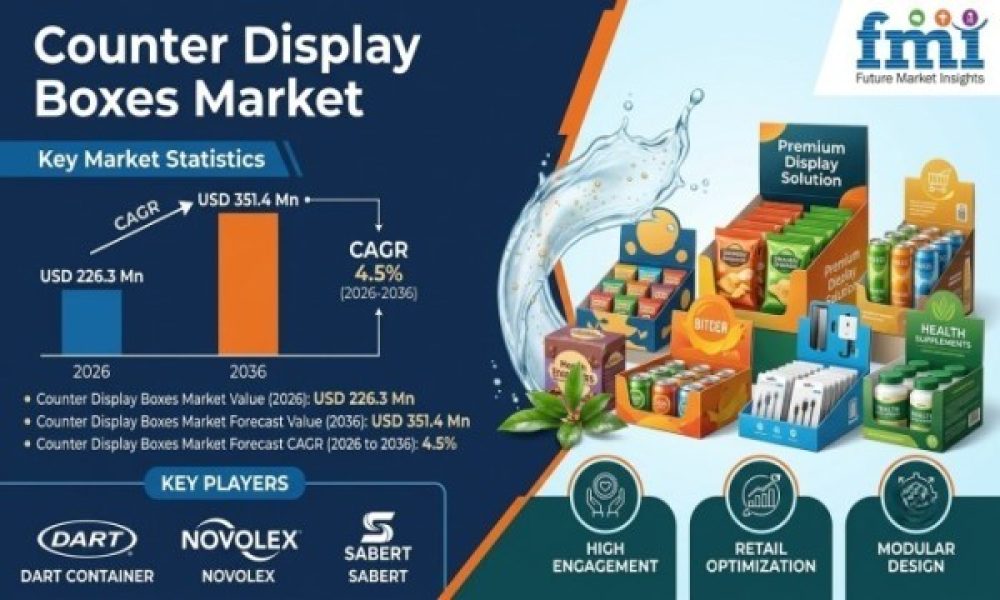
Global demand for counter display boxes is forecast to increase from USD 226.3 million in 2026 to USD 351.4 million by 2036, registering a compound annual growth rate (CAGR) of 4.5% over the forecast period. Demand is supported by foodservice activity, takeaway consumption and the need for visible product presentation at retail counters. In July 2025, the USDA Economic Research Service reported that food-away-from-home sales increased in all 50 states during 2024, supporting the broader foodservice environment in which countertop merchandising and repeat packaging orders operate.
The European Commission also confirmed on February 11, 2025, that the Packaging and Packaging Waste Regulation had entered into force, adding regulatory considerations to packaging material selection and recovery claims.
Get detailed market forecasts, competitive benchmarking, and pricing trends:
https://www.futuremarketinsights.com/reports/sample/rep-gb-35038
Global Segment Leaders
According to Future Market Insights (FMI), the market is segmented by format type, material, format size, end use and sales channel. The report identifies the following leading segments:
- Format type: Standard formats, 38.0% in 2026. Familiar dimensions shorten qualification cycles and reduce the number of box sizes restaurant groups need to stock.
- Material: Paperboard, 33.0% in 2026. Printable fiber structures allow converters to combine graphics with grease and moisture barriers using familiar converting equipment.
- Format size: Standard meal, 41.0% in 2026. Common lunch and dinner portions fit established counter-service and delivery workflows.
- End use: QSR chains, 33.0% in 2026. Centralized purchasing and menu specifications support repeat orders across high-volume restaurant networks.
The report also covers recyclable-optimized, premium and custom-engineered formats; molded fiber and bagasse, rPET and PP, compostable polymers, and aluminium; single-serve and family or catering formats; delivery platforms, coffee and beverage service, institutional catering, and retail deli; and broadline foodservice distributors, direct chain contracts, packaging distributors and online sales. No leading-segment shares are specified for these additional categories in the cited report summary.
Nandini Roy Choudhury, Principal Consultant at FMI, said: “Counter display boxes earn repeat business after one footprint controls heat and leakage without slowing restaurant packing. Commercial value depends on fewer stocked dimensions and disposal claims matching each account’s recovery route.”
Country-Level Performance
The report projects the following country CAGRs for 2026–2036, ordered from highest to lowest. Each growth driver reflects the country-specific analysis published by FMI.
- Saudi Arabia — 5.8% CAGR: The General Authority for Statistics reported in January 2026 that licensed tourism hospitality facilities reached 5,622 in the third quarter of 2025, a 40.6% year-on-year increase. Expanding hospitality capacity supports demand for regular foodservice packaging replenishment.
- United Arab Emirates — 5.5% CAGR: Dubai Municipality confirmed in December 2025 that restrictions on Styrofoam food containers formed part of the staged single-use plastics restrictions, with the final phase beginning in January 2026. The transition increases the need to qualify alternative packaging formats.
- South Korea — 5.2% CAGR: The national environment ministry reported in December 2025 that the disposable-cup deposit programme had 33.1% store participation and a 52.5% return rate by November. Reuse and recovery initiatives influence foodservice packaging decisions.
- United States — 4.9% CAGR: USDA Economic Research Service data published in July 2025 showed that total per-capita food spending increased 3.2% during 2024. Established quick-service restaurant networks and repeat takeaway orders support demand.
- United Kingdom — 4.6% CAGR: The Department for Environment, Food & Rural Affairs reported in July 2025 that paper and cardboard packaging recycling reached 74.3% in 2024. Existing fiber-recovery infrastructure supports paperboard options, although contamination and coatings can affect acceptance.
- Germany — 4.3% CAGR: The German Environment Agency reported in January 2026 that approximately 5.5 million tonnes of dual-system packaging waste were recycled during 2024. Established sorting infrastructure favors packaging with clearly identified materials and suitable recovery routes.
- France — 4.0% CAGR: Insee reported in June 2026 that restaurant and accommodation spending remained more than 20% above its 2019 level. Takeaway activity supports packaging requirements, while reuse rules restrict disposable serviceware in some on-premise settings.
- Japan — 3.7% CAGR: Japan’s Ministry of the Environment reported in March 2026 that 82.4% of municipalities planned separate collection of plastic packaging in fiscal 2026, compared with 51.9% for paper packaging. Municipal sorting requirements influence material selection and disposal instructions.
Regional Context
Saudi Arabia, the UAE and South Korea form the faster-growing group, with forecast CAGRs above 5%. Saudi Arabia’s expanding hospitality capacity creates additional outlets requiring regular packaging supplies, while the UAE’s staged restrictions on single-use plastics encourage packaging replacement. South Korea’s reuse and recovery initiatives add operational considerations for restaurant chains evaluating packaging formats.
The United States and United Kingdom occupy the middle growth tier, supported by established foodservice networks, takeaway activity and recurring packaging purchases. In the United States, differences in local waste collection complicate consistent disposal claims across restaurant networks. In the UK, established paper recycling routes support fiber-based packaging, although food contamination and mixed coatings can limit recovery.
Germany, France and Japan represent the slower-growing group. Germany’s mature dual-system recycling infrastructure favors clearly separated materials, while French reuse requirements narrow some applications for disposable serviceware. In Japan, municipal differences in plastic and paper collection make standardized disposal instructions more difficult to apply nationally.
The full report covers North America, Latin America, Europe, East Asia, South Asia and Pacific, and the Middle East and Africa. Its country coverage includes the eight markets profiled above and more than 25 additional countries.
Competitive Landscape
FMI profiles eight companies in the Counter Display Boxes Market: Dart Container, Graphic Packaging, Duni Group, Huhtamaki, Detmold Group, Novolex, Sabert and Faerch. Competition reflects material capabilities, manufacturing consistency, customization for restaurant chains and regional distribution coverage. Dart Container, Novolex and Sabert are identified as multi-substrate foodservice platforms; Graphic Packaging, Huhtamaki and Detmold Group are categorized as fiber-led foodservice converters; and Duni Group and Faerch are associated with restaurant systems and rigid packaging.
Recent developments identified in the report include Graphic Packaging’s October 2025 production of the first commercial-grade paperboard at its Waco facility, increasing North American recycled-board capacity. In June 2025, Duni Group acquired an 80% stake in LinePack Oy, expanding its presence in automated food-packaging equipment, installation and maintenance. Earlier, in April 2025, Novolex completed its combination with Pactiv Evergreen, bringing two large food-packaging manufacturing networks under common ownership.
These developments illustrate the range of competitive activity surrounding foodservice packaging, from recycled paperboard production to automated packaging equipment and manufacturing scale. For counter display box suppliers, commercial opportunities depend on meeting customers’ performance requirements while providing dependable supply and material documentation suited to regional recovery systems.
About Report
Future Market Insights (FMI) is a leading provider of market research and consulting services, offering syndicated and customized research across industries including foodservice packaging, paper and paperboard packaging, and sustainable packaging.
For more information on the full report, visit: https://www.futuremarketinsights.com/reports/counter-display-boxes-market
FMI Custom Research: Strategic Intelligence for Confident Decision-Making
In today’s rapidly evolving business environment, leadership teams need more than market data—they need clear, actionable intelligence tailored to their strategic objectives. FMI’s Custom Research solutions are designed around the specific business questions organizations need answered, enabling executives to evaluate growth opportunities, validate investments, assess competitive dynamics, and reduce uncertainty before making critical decisions. By combining deep industry expertise, primary research, and proprietary market intelligence, FMI delivers insights that help organizations move from assumptions to evidence-based strategies with greater speed and confidence.
Business Impact
FMI helps organizations transform market complexity into strategic clarity, enabling leadership teams to identify growth opportunities faster, optimize resource allocation, strengthen competitive positioning, and make high-stakes business decisions with confidence.
To explore how FMI Custom Research can support your strategic priorities, please connect with our team at – [email protected]
About Future Market Insights (FMI)
Future Market Insights, Inc. (FMI) is an ESOMAR-certified, ISO 9001:2015 market research and consulting organization, trusted by Fortune 500 clients and global enterprises. With operations in the U.S., UK, India, and Dubai, FMI provides data-backed insights and strategic intelligence across 30+ industries and 1200 markets worldwide.



