
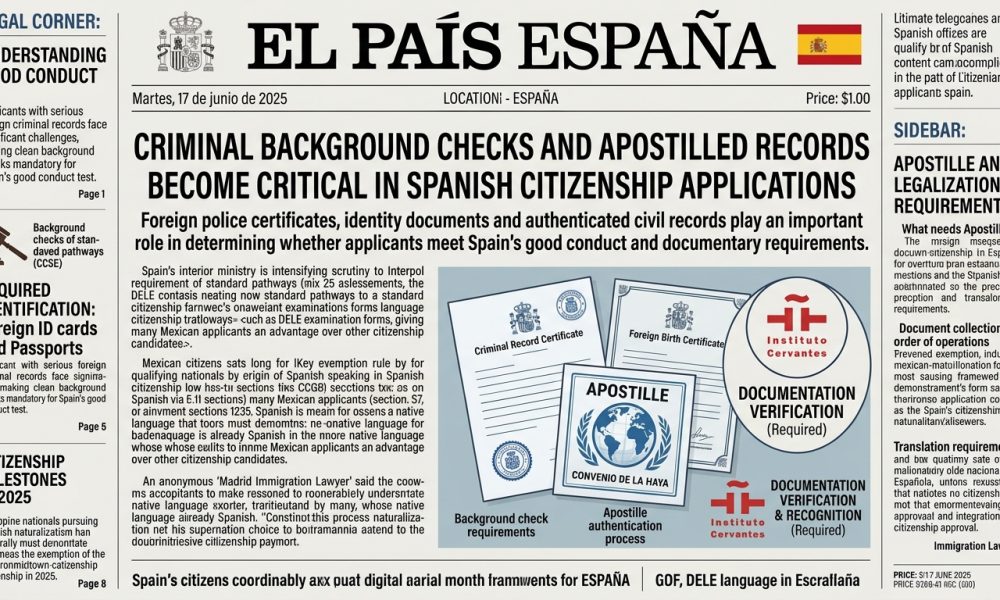
Foreign police certificates, identity documents and authenticated civil records play an important role in determining whether applicants meet Spain’s good-conduct and documentary requirements, particularly when citizenship applications involve multiple nationalities, previous residences or legally changed names.
WASHINGTON, D.C., November 23, 2026
Spain’s residence-based citizenship process demands more than a completed residency period, because applicants must establish their identities through reliable public records, provide properly authenticated foreign documents, and demonstrate the civic conduct required under Spanish nationality law.
For Mexican nationals considering an accelerated citizenship route, and for Americans holding additional nationalities, criminal background checks, apostilles, and civil registration can determine whether a promising application proceeds smoothly or faces substantial administrative scrutiny.
Spain’s Good-Conduct Standard Goes Beyond a Clean Record
Article 22 of Spain’s Civil Code requires applicants to demonstrate good civic conduct and sufficient integration into Spanish society, creating a substantive legal test that extends beyond submitting an apparently clean foreign police certificate with a nationality application.
Spanish authorities may evaluate both an applicant’s documentary history and relevant conduct during residence. At the same time, courts have emphasized that absence of a recorded conviction cannot automatically establish the positive civic behavior required under the governing legislation.
This distinction protects the integrity of naturalization decisions. Still, it also requires careful individualized consideration, because allegations, unresolved proceedings, convictions and rehabilitative developments occupy different legal positions and should never be presented as interchangeable evidence.
A carefully maintained history of compliance, employment, community responsibilities, and other verifiable circumstances may help an applicant explain civic conduct. However, the relevance and weight of particular evidence depend on the individual case.
Foreign Criminal Certificates Have Specific Documentary Functions
Spain’s published residence-naturalization instructions generally call for an authenticated criminal-record certificate from an adult applicant’s country of origin, subject to permitted alternatives and exceptions, rather than an informal screening summary purchased from a commercial information provider.
The certificate must match the applicant’s genuine identity and the issuing government’s competent records system, with the requested format, date, and authentication method assessed against the administrative requirements in effect when the application is filed.
Applicants who have lived in several countries should ask Spanish immigration counsel whether additional certificates or supporting court records are appropriate, rather than assuming that every foreign residence automatically creates an identical legal documentation obligation.
In certain circumstances, Spanish rules allow an appropriately issued consular certificate of conduct as an alternative, provided it is based on consultation with competent authorities and satisfies the required translation and legalization conditions.
An Apostille Confirms a Document’s Origin, Not Its Contents
An apostille issued under the Hague Convention authenticates specified aspects of a public document’s origin, including the responsible official’s signature or capacity, without independently proving that the assertions recorded within the certificate are accurate.
Consequently, an apostilled police record remains subject to substantive review, particularly when names, dates of birth, or criminal case details differ from information in passports, immigration records, and other government-issued identity documents.
Applicants should distinguish the apostille from consular legalization, because the appropriate certification route depends on the issuing jurisdiction and relevant international arrangement. At the same time,e exemptions from formal authentication can apply to particular categories of documents.
Electronic apostilles and online verification mechanisms may help receiving officials establish documentary authenticity. Still, applicants should first confirm that the relevant authority accepts a particular electronic format and submission process.
American Documents Require Attention to Federal and State Authorities
U.S. applicants can obtain federal identity-history information from the FBI. Still, state police certificates, county court dispositions, and birth records come from different institutions, creating separate procedures for certified copies and international authentication.
The U.S. State Department’s apostille instructions explain that eligible federal records can require federal authentication. In contrast, state-issued documents ordinarily follow the competent state authority’s process before their formal use in a Hague Convention country.
An FBI record may identify arrests without clearly establishing final case outcomes, so an applicant with an entry should obtain the relevant official court disposition and seek legal advice before concluding incomplete criminal-history terminology.
Mexican Applicants Must Reconcile Civil and Criminal Records
Mexican citizens pursuing Spanish naturalization should verify that birth certificates, national passports, residence cards, and criminal-record documentation consistently identify the same person, particularly when official records reflect naming conventions that differ between countries.
An apostille for a Mexican civil document must come from the competent authority responsible for that document type. At the same time,e a record already written in Spanish may avoid translation requirements that frequently affect English-language certificates.
The shorter statutory residence period potentially available to qualifying Mexican nationals does not eliminate any background-screening obligation, making early preparation especially useful when applicants must obtain records from multiple agencies before becoming eligible to submit.
Mexican federal and state authorities administer different types of public records, so requesting documents from the wrong office can waste valuable time even when the applicant has supplied complete and accurate biographical information.
Birth Certificates Establish a Verifiable Identity History
A birth certificate provides foundational evidence of legally recorded parentage, birthplace, and date of birth, allowing Spanish authorities to compare later passports, residence permits, marriage registrations, and other records throughout an applicant’s lifetime.
Where adoption, marriage, divorce or authorized name changes have altered identifying information, supporting civil documents should explain the connections between earlier and current details rather than leave an official reviewer to infer those changes independently.
Correct errors through the appropriate registry or judicial procedure, because replacing a document with fabricated information or presenting an invented personal history could undermine the citizenship case and create additional criminal exposure.
Lawful Name Changes Do Not Erase Prior Records
People who have legally changed names may still need to disclose previous names and connect relevant historical records, including criminal matters, to their current identities when a Spanish nationality application calls for that information.
The issue becomes more complicated for dual nationals whose passports use different surname orders, abbreviated given names, or transliteration conventions, since a discrepancy can arise without deception yet still demand reliable official clarification.
Applicants exploring Amicus International Consulting’s new identity services should understand that privacy planning cannot replace truthful disclosure, and that all identity records presented to Spanish authorities must be authentic, legally recognized,d and properly connected to earlier documentation.
Certified Translations Serve a Different Purpose From Apostilles
Foreign records written in English or another non-Spanish language may require an officially accepted Spanish translation, and applicants should verify the rules governing sworn translators rather than assume any fluent bilingual person can certify legal documents.
A translation communicates the document’s contents to the reviewing authority. In contrast, an apostille authenticates its official origin; therefore, a technically accurate translation alone does not resolve a missing or defective authentication certificate.
Attention should extend to supplementary seals, annotations and court explanations where relevant, ensuring that the submitted record conveys the complete administrative meaning rather than selectively translating favorable passages while omitting potentially significant information.
Pending Charges and Convictions Demand Distinct Assessments
An arrest, criminal investigation, pending prosecution, and final conviction represent different legal circumstances, and a nationality assessment should avoid treating them as equivalent evidence of wrongdoing without reviewing the underlying procedural status and relevant documentation.
A pending charge does not establish guilt, although authorities may assess reliably documented facts under applicable law, making coordinated advice from criminal and immigration lawyers essential for applicants facing unresolved proceedings or disclosure obligations.
Where a case ended in dismissal, acquittal or another final disposition, an appropriately authenticated judgment may clarify the outcome, but applicants should avoid claiming that every adverse historical record becomes irrelevant merely because a prosecution ended.
Expungement and Rehabilitation Need Individual Analysis
A conviction expunged, sealed, or canceled in one jurisdiction may carry different consequences under Spanish nationality law, because the legal effect of a foreign record-management procedure cannot be assumed to be identical across national criminal justice systems.
Relevant considerations may include the nature and age of an offense, its disposition, subsequent behavior and legally documented rehabilitation, with the particular significance of those factors requiring case-specific assessment rather than promotional assurances.
Applicants should preserve authentic judgments and proof of record cancellation when available, because truthful explanations supported by competent documentation offer a defensible response to questions that cannot be resolved through a simplified clean-record declaration.
Spanish Government Checks Remain Necessary
Foreign police certificates do not tell the whole story, because Spain’s nationality procedure also incorporates records and reports from Spanish authorities that address lawful residence, possible criminal history, and good civic conduct within the country.
A May 2026 ruling by Spain’s Supreme Court reaffirmed the importance of including a Spanish criminal-record certificate and the required Interior Ministry report when deciding whether the applicant satisfies the good-conduct and integration standards.
That ruling should not be mistaken for a rule automatically rejecting every applicant with an unfavorable historical entry, since judicial assessment concerns the evidentiary basis and lawful evaluation of an individual’s actual circumstances.
When a government report is missing from the official file, the problem may concern procedural completeness rather than proof of misconduct. This difference becomes especially important when administrative decisions face judicial review.
Residence Regularization Does Not Equal Citizenship
Public discussion of criminal screening intensified during Spain’s 2026 immigration regularization initiative, which offered qualifying undocumented residents a route toward lawful status while incorporating a clean-criminal-record condition within that separate and distinct administrative framework.
A June Associated Press report on Spain’s regularization program described applications from more than one million immigrants, illustrating the scale of immigration administration without suggesting that lawful status and citizenship follow identical requirements.
Residence authorization, the continuous residence period required for nationality, and the final naturalization decision remain separate legal stages, and satisfying the first does not substitute for the additional evidence required in later citizenship proceedings.
The Two-Year Rule Leaves Documentary Standards Intact
Under Spain’s Civil Code, qualifying nationals by origin from Ibero-American countries may become eligible to apply for citizenship following two years of legal, continuous residence immediately preceding their application, subject to other statutory conditions.
Mexican applicants should distinguish this eligibility threshold from a guarantee of approval, because government review can continue after filing and unresolved problems involving conduct, authentication, or identity may require further evidence before a decision.
Tourist visits and other permissions that do not qualify as legal residence for nationality purposes should not be casually counted toward the statutory period, making the actual immigration category central to realistic planning.
Multiple Nationalities Require Careful Coordination
Applicants with Mexican and American citizenship may hold legitimate passports from both countries. Still, the nationality and identity information in their Spanish residence files must match the documents used for naturalization.
Differences in official names, surnames, issue dates, or birthplace descriptions can result from different administrative conventions rather than misconduct. Yet, a well-prepared file should explain any material inconsistency through authoritative supporting civil records.
People evaluating Amicus International Consulting’s second passport services should clearly separate general mobility planning from the specific substantive legal duties of Spanish naturalization, which cannot be bypassed by holding another passport.
Documents Should Be Collected in a Deliberate Sequence
A disciplined preparation process begins with identifying each required record, the responsible issuing institution, whether apostille or legalization is necessary, and whether an accepted Spanish translation must accompany the original or certified copy.
Because criminal-record certificates may be subject to administrative currency requirements, applicants should verify acceptable issuance dates before ordering them, while obtaining more durable civil records early enough to correct inconsistencies without delaying the intended filing.
Maintaining digital copies, tracking submission dates, and retaining evidence of official requests can help applicants respond accurately to document deficiencies, especially when papers must move among registries, courts, and authentication offices in different countries.
Applicants should also keep the complete submission receipt and any electronic acknowledgments from Spanish authorities, because when documents enter the official file, deadlines, requests for correction, or appeals may arise.
Professional Advice Should Clarify, Not Promise, Outcomes
A qualified Spanish nationality lawyer can identify the relevant rules, assess unusual criminal histories and explain acceptable supporting evidence. Still, neither a consultant nor a private intermediary can direct a government official to approve an application.
Applicants should seek transparent explanations of fees, authentication expenses, and each professional adviser’s responsibilities, and remain cautious of claims that an apostille, legal name change, or clean police certificate guarantees Spanish nationality. When authorities request clarification, a carefully documented,d timely response is usually more useful than an unsupported assertion that a particular criminal matter or identity discrepancy must be ignored because it occurred outside Spain.
Accurate Documentation Remains the Strongest Foundation
Spanish citizenship applicants benefit from treating background checks and civil authentication as central elements of eligibility rather than last-minute paperwork, because reliable records give reviewers a coherent account of identity, residence, a nd conduct.
For Mexican nationals approaching the shortened residence threshold, early, carefully coordinated legal preparation may reduce preventable setbacks while preserving the distinction between an opportunity to apply and an eventual government decision after substantive review.
The enduring requirement is straightforward: authentic documents, properly verified foreign records, and truthful disclosure support an orderly application, while the competent authorities alone determine Spanish citizenship under current law.




