
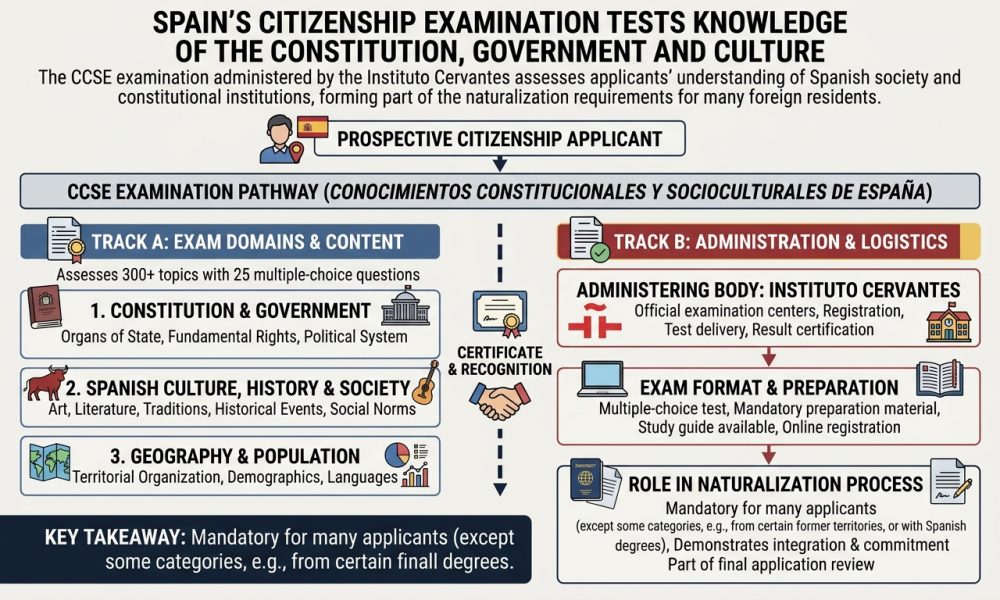
The CCSE, administered by the Instituto Cervantes, assesses applicants’ understanding of Spanish society and constitutional institutions and is an important part of the naturalization requirements for many foreign residents, including Mexican and Filipino nationals seeking European citizenship.
WASHINGTON, DC, November 23, 2026 — Foreign nationals pursuing Spanish citizenship must demonstrate more than qualifying immigration residence, because Spain’s naturalization system generally requires adult applicants to pass an examination assessing their understanding of the Constitution, democratic institutions, civic responsibilities and everyday Spanish society.
The examination, officially called the Prueba de Conocimientos Constitucionales y Socioculturales de España, or CCSE, is administered by the Instituto Cervantes and evaluates whether applicants possess the basic knowledge considered necessary for integration into Spain’s national community.
For Mexican and Filipino nationals who may qualify to apply for citizenship after two years of legal residence, understanding the CCSE examination is particularly important because the preferential residence period does not ordinarily eliminate the government’s integration requirements.
The CCSE Examination Is Part of Spain’s Naturalization Framework
Spain’s nationality legislation requires applicants seeking citizenship through residence to demonstrate sufficient integration into Spanish society, with Royal Decree 1004/2015 establishing a formal administrative process involving recognized language and constitutional knowledge assessments.
Under this framework, the Instituto Cervantes administers the CCSE examination, providing standardized questions that evaluate civic understanding rather than leaving each applicant’s knowledge of government and society entirely to an individual interviewer’s discretion.
However, passing the examination does not, by itself, establish citizenship eligibility, because applicants must also meet the residence, good civic conduct, documentation, and other conditions established under Spain’s Civil Code.
The Test Contains 25 Questions and Lasts 45 Minutes
The CCSE consists of 25 questions organized into five assessment tasks, and candidates have up to 45 minutes to complete questions on Spanish constitutional structures and sociocultural knowledge.
According to the Instituto Cervantes’ published examination specifications, applicants must answer at least 15 questions correctly to pass, representing 60% of the examination’s total possible score.
Exámenes – Instituto Cervantes+1
The assessment uses closed-response questions, including multiple-choice and true-or-false formats, allowing candidates to demonstrate knowledge through structured responses rather than preparing lengthy written essays or delivering formal presentations.
The Passing Score Is Designed Around Basic Civic Knowledge
The requirement to answer 15 of 25 questions correctly establishes a measurable standard that applicants can prepare for using the official study materials published by the Instituto Cervantes.
Incorrect answers do not result in negative points, so candidates generally benefit from attempting every question rather than leaving an uncertain response unanswered for fear of additional scoring penalties.
Nevertheless, candidates should study the full curriculum rather than focus only on a few familiar subjects, because the exam can draw questions from several distinct areas of Spanish public life.
Spain’s Constitution Forms a Central Examination Topic
The CCSE curriculum examines fundamental principles established by Spain’s 1978 Constitution, including the country’s constitutional monarchy, democratic institutions, fundamental rights and the relationship between citizens and public authorities.
Applicants may encounter questions on constitutional guarantees, public responsibilities, and the structure of government. Hence, an introductory understanding of Spanish constitutional principles is more useful than memorizing isolated facts without context.
For Mexican professionals and Filipino residents accustomed to different constitutional systems, the examination provides an opportunity to understand how Spain organizes national political authority and protects rights within its democratic framework.
Government Institutions Are Included in the Assessment
Candidates must understand basic distinctions among Spain’s principal constitutional institutions, including the monarchy, parliament, executive government, and judicial system, along with the different responsibilities each institution exercises.
The examination may cover the Congress of Deputies, the Senate, government ministries, and other public bodies, requiring applicants to recognize their broad constitutional functions without demonstrating the specialized expertise expected of legal professionals.
Understanding these institutional relationships matters for future citizens because nationality eventually creates rights and responsibilities that extend beyond the immigration permissions previously held as foreign residents.
Political Participation and Civic Responsibilities Are Examined
The CCSE examination addresses democratic participation, electoral institutions, and fundamental civic obligations, helping prospective citizens understand how Spanish society organizes public decision-making and protects constitutional freedoms.
Candidates may need to recognize basic voting rights, the role of political parties and the principles governing participation in public affairs, rather than relying solely upon familiarity with Spanish political news.
In June 2026, Cadena SER examined the questions used in Spain’s citizenship examination, including an interview with Instituto Cervantes certification official Inés Sori, who explained how the examination combines constitutional knowledge with questions about ordinary Spanish life.
Regional Geography Is Another Important Subject
Spain’s territorial organization includes autonomous communities, provinces,s and municipalities, creating a governmental structure that foreign residents should understand when navigating public services and administrative responsibilities.
The CCSE examination can assess knowledge of territorial institutions and geography, including the relationship between national authorities and regional governments that administer key responsibilities across Spain.
A Mexican applicant living in Valencia or a Filipino professional working in Madrid may therefore benefit from studying the country’s broader territorial organization rather than focusing exclusively on the region where they live.
Spanish History and Cultural Knowledge Are Also Tested
The examination includes elements of Spanish history, cultural traditions, national symbols and significant features of the country’s social development, extending the assessment beyond legislation and government institutions.
Applicants may encounter questions involving historical landmarks, artistic traditions, or widely recognized cultural institutions, making the official preparation manual an important resource for understanding the scope of examinable material.
The objective is not to require encyclopedic expertise in Spanish history, but to establish a basic level of cultural awareness relevant to individuals seeking membership in the national community.
Everyday Spanish Society Appears in the Examination
The sociocultural component also evaluates knowledge of ordinary life, including education, healthcare, public services, social customs, and administrative procedures that residents commonly encounter after establishing their homes in Spain.
Questions can focus on practical situations rather than abstract legal theories, making the exam relevant to understanding the institutions and everyday responsibilities associated with long-term residence and eventual citizenship.
For applicants who already live in Spain, familiarity with schools, local government offices and public services can support preparation, although lived experience does not replace studying the officially examinable material.
The 2026 Preparation Manual Is Available Without Charge
The Instituto Cervantes publishes an official CCSE preparation manual containing the question material candidates should study, providing a standardized reference rather than requiring applicants to purchase commercial citizenship courses.
The 2026 manual covers the applicable curriculum, allowing prospective candidates to review constitutional principles, territorial geography, history, and Spanish society before registering for an examination session.
examenes.cervantes.es
Applicants should use the manual for their examination year because the question bank can be updated, making older printed study books potentially incomplete even if their general explanations remain useful.
Official Practice Materials Can Improve Preparation
The Instituto Cervantes also provides preparation resources and a mobile application to help candidates become familiar with examination topics and the question format.
Repeated practice can help applicants identify weaker subjects, particularly when their daily professional activities provide limited exposure to Spanish constitutional institutions or the administrative arrangements used in other regions.
However, practice materials should complement the official manual rather than replace it entirely, because unofficial websites may reproduce outdated questions or contain explanations inconsistent with the current examination curriculum.
Registration Is Completed Through the Examination System
Applicants ordinarily register through the Instituto Cervantes examination platform, selecting an available examination center and session while providing the Identification information required by the registration process.
The institution publishes examination dates and registration deadlines, so booking matters when applicants must coordinate their testing schedule with the expected completion of qualifying Spanish residence.
Candidates should confirm available examination centers and deadlines before making travel arrangements, especially if they live outside major metropolitan areas or plan to take the test before relocating permanently.
The Published Examination Fee Is €85
The Instituto Cervantes currently lists a registration fee of €85 for the CCSE examination, which covers the applicable examination rights and associated administrative services under the published conditions.
The registration arrangements generally provide two examination opportunities within the established validity period, allowing unsuccessful candidates a further attempt without automatically paying an entirely new registration fee.
Applicants should verify the current procedure and permitted resit dates when registering, because unused opportunities remain subject to the examination institution’s rules, not an indefinite right to retake the test.
Exámenes – Instituto Cervantes
A Failed Examination Does Not Automatically End Citizenship Plans
An unsuccessful CCSE result does not automatically mean an applicant can never become Spanish, because the examination system provides an opportunity to improve preparation and take another qualifying assessment.
Candidates should review the areas where their knowledge was insufficient, return to the official study materials and select another available session within the permitted registration conditions.
The practical consequence is ordinarily a delay in completing the necessary examination evidence, rather than automatic loss of an otherwise valid immigration residence authorization or permanent exclusion from naturalization.
CCSE Certificates Have a Defined Validity Period
A successful CCSE result is documented through an official electronic certificate, which generally remains valid for four years under the Instituto Cervantes’ published examination arrangements.
This period allows applicants to complete the assessment before submitting their nationality applications, although the certificate must remain acceptable under the relevant administrative requirements when used.
Mexican and Filipino residents should therefore coordinate examination timing with their projected citizenship eligibility, avoiding unnecessary delay while ensuring that an early result does not expire before its intended use.
Identity Information Must Match Official Documents
The Identification information entered during registration should match the candidate’s legally recognized name and relevant travel or immigration documents, because inconsistencies can make it difficult to link examination results to a nationality application.
Mexican surnames, Philippine naming conventions, and marriage-related changes sometimes create differences across passports, residence cards, and civil records, so review carefully before confirming registration details.
Where an error occurs, candidates should use the examination institution’s recognized correction procedures rather than submitting conflicting information or creating a second identity record to bypass an administrative discrepancy.
Some Applicants Qualify for Examination Exemptions
Spain’s nationality procedures recognize exemptions or special treatment for certain applicants, including minors and people whose legal circumstances fall within statutory provisions governing disability or other recognized limitations. Applicants must establish an exemption under the applicable rules rather than assume one based on age, nationality, education, or personal preference not to complete an examination.
Consequently, families should examine the legal requirements for each person independently, especially when a parent’s citizenship application involves an accompanying child whose nationality procedure differs from that of an adult applicant.
Accessibility Accommodations Can Be Requested
The Instituto Cervantes provides procedures for candidates with qualifying disabilities, learning difficulties, or other recognized circumstances requiring examination adjustments, allowing requests supported by appropriate documentation. These arrangements can include accessible materials or other authorized adaptations, depending on the applicant’s needs and the rules governing the specific examination center and testing session.
The institution’s 2026 accessibility guidance describes advance notice and supporting evidence requirements, making early communication important for applicants who cannot complete the examination under ordinary conditions.
CCSE_Programa de atención NNEE _2026.docx
Some Applicants May Seek a Formal Dispensation
Spain’s Ministry of Justice administers specific dispensation arrangements for qualifying applicants who cannot reasonably complete the ordinary examinations because of circumstances recognized under the nationality regulations.
These procedures differ from ordinary registration and may require a formal application, supporting documentation, or a determination of whether the applicant qualifies for exemption or an adapted assessment.
Applicants should establish the applicable legal procedure before relying upon a private adviser’s assurance that advanced age, limited schooling or a medical condition automatically removes every testing obligation.
The CCSE and DELE Examinations Are Different
The CCSE evaluates Spanish constitutional and sociocultural knowledge, while the DELE assesses Spanish-language proficiency at a recognized level under the European language framework.
Many nationality applicants must demonstrate both civic knowledge and language ability, although exemptions from the Spanish-language assessment depend upon the individual’s nationality and other legally recognized circumstances.
The distinction matters because passing the CCSE does not independently establish Spanish-language proficiency, just as receiving a DELE certificate does not automatically satisfy the separate constitutional knowledge requirement.
Mexican Nationals May Qualify for a DELE Exemption
Mexican nationals generally benefit from the recognized exemption from the DELE language requirement available to qualifying nationals of Spanish-speaking countries, reflecting Spanish’s linguistic status in Mexico.
However, this exemption does not ordinarily remove the CCSE requirement, meaning Mexican applicants should still prepare to demonstrate constitutional knowledge and an understanding of Spanish society.
A Mexican professional who has spoken Spanish throughout life may avoid an unnecessary language assessment while still needing to complete the distinct civic examination required under the ordinary naturalization process.
Filipino Nationals Face a Different Language Situation
Qualifying Filipino nationals by origin may benefit from Spain’s preferential two-year citizenship residence requirement. Still, Philippine nationality generally does not grant the automatic DELE exemption available to applicants from recognized Spanish-speaking countries.
A Filipino professional may therefore need both accepted Spanish-language certification and a passing CCSE result, unless another legally recognized exemption or dispensation applies to the individual.
This distinction shows why equal treatment under the shortened residence period does not mean Mexican and Filipino applicants have identical documentary requirements during the subsequent citizenship process.
Passing the CCSE Does Not Establish Legal Residence
A successful examination result does not convert an ordinary tourist stay, student authorization, or expired residence permit into qualifying legal residence, because Spain’s nationality legislation imposes separate immigration conditions.
Applicants must show that the statutory residence period was legal, continuous, and immediately preceded the nationality request, regardless of how successfully they perform on the examination.
A Mexican graduate who passes the CCSE while holding student stay authorization must therefore establish when qualifying immigration residence begins before calculating eligibility for the preferential two-year naturalization provision.
Residence Continuity Remains a Separate Requirement
A valid residence card and a passing examination result cannot independently resolve questions about lengthy periods spent outside Spain, because nationality authorities also assess the continuity of the applicant’s qualifying residence.
Mexican and Filipino professionals on overseas assignments should keep accurate travel and residence records, especially when their work requires substantial international travel in the period before naturalization.
The CCSE measures civic knowledge rather than physical residence, so it is inappropriate to treat exam success as evidence that every immigration requirement has been satisfied.
Good Civic Conduct Requires Independent Documentation
Spanish naturalization legislation also requires good civic conduct, allowing authorities to examine relevant criminal history, immigration compliance, and other information that may affect an applicant’s legal eligibility.
The examination certificate cannot replace required police documentation or explain discrepancies in the applicant’s identity and immigration records, making complete and truthful administrative evidence essential throughout the process.
Applicants should therefore review their full nationality application before submission, ensuring that evidence of residence, personal identity, examination results, and other relevant legal conditions match official records.
American Dual Nationals Have Additional Considerations
Some Mexican and Filipino applicants also hold U.S. citizenship, creating circumstances in which successful Spanish naturalization could create additional nationality relationships with separate passport and legal responsibilities.
The U.S. Department of State’s dual-nationality guidance explains that Americans may possess another nationality while remaining subject to continuing American legal requirements, including applicable passport rules.
Passing a Spanish citizenship examination does not change an American applicant’s nationality, and subsequent Spanish naturalization must be assessed independently under the laws governing the individual’s existing citizenships.
A Spanish Passport Requires More Than Examination Success
After completing the required residence period and examinations, applicants must submit the prescribed nationality documentation and obtain a favorable government decision before completing the formalities associated with acquiring Spanish citizenship.
The later oath or promise and civil registration requirements remain separate from the examination certificate, meaning a successful CCSE candidate cannot immediately request a Spanish passport solely upon receiving passing results.
This distinction matters for Mexican and Filipino families planning international relocation, because the date of examination completion is not necessarily the date Spanish nationality takes legal effect.
CCSE Preparation Can Be Integrated Into Residence Planning
Applicants pursuing the two-year residence route can prepare for the examination during their qualifying immigration period, allowing sufficient time to study constitutional institutions and complete the required assessment before submitting a nationality application.
However, schedule an early examination with the certificate’s validity period in mind, particularly where immigration renewals, overseas travel, or legal complications could delay the expected application date.
A realistic citizenship strategy should therefore coordinate the civic examination with immigration status, residence continuity and documentary preparation rather than treating CCSE registration as an isolated administrative task.
Amicus International Consulting and Citizenship Preparation
Amicus International Consulting discusses international mobility and nationality planning through its second-citizenship advisory overview, providing wider context for families evaluating the legal and practical implications of acquiring another nationality.
Its international relocation and citizenship services also address cross-border planning considerations. Meanwhile, the Instituto Cervantes administers the official CCSE, and competent government authorities handle Spanish nationality decisions.
For Mexican and Filipino residents, effective preparation should begin by verifying qualifying immigration residence and applicable examination obligations before making commitments based on an anticipated Spanish citizenship approval date.
Conclusion: Civic Knowledge Is One Part of Spanish Citizenship Eligibility
Spain’s CCSE examination provides a standardized assessment of constitutional institutions, democratic government, cultural knowledge, and everyday social practices, requiring most ordinary adult candidates to answer at least 15 of 25 questions correctly.
For qualifying Mexican and Filipino nationals, preparation for the examination should accompany the two-year residence strategy, recognizing that preferential naturalization rules do not automatically eliminate civic knowledge or other statutory requirements.
The Instituto Cervantes’ official preparation materials, examination timetable,e and recognized accommodation procedures provide a structured framework for candidates seeking to complete the assessment accurately and within their intended citizenship application schedule.
Ultimately, passing the CCSE can satisfy an important component of Spanish naturalization, but acquiring citizenship still requires qualifying legal residence, good civic conduct, complete documentation, and an independent favorable decision by Spanish government authorities.




