
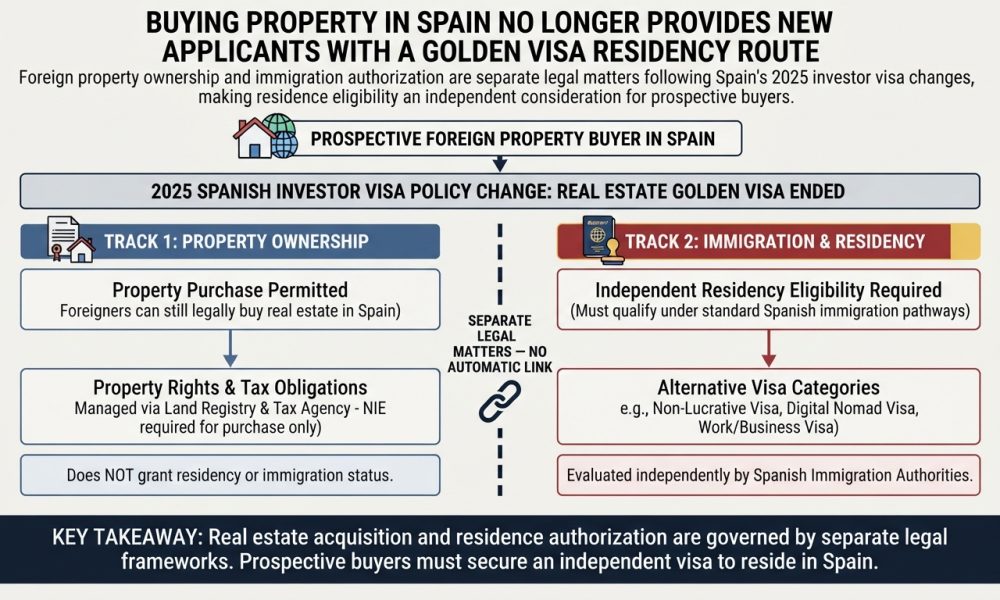
Foreign property ownership and immigration authorization are separate legal matters following Spain’s 2025 investor visa changes, making residence eligibility, financial independence, employment authorization, and existing permit protections important considerations for Mexican and other international property buyers.
WASHINGTON, DC, November 23, 2026 — Foreign nationals purchasing residential or commercial property in Spain can no longer obtain a new Golden Visa simply through their investment, following the closure of the country’s investor residence program on April 3, 2025, under legislation that fundamentally changed immigration planning for international buyers.
The termination means Mexican citizens and other non-European Union investors must distinguish their legal ability to own Spanish property from their eligibility to reside permanently in the country, because a title deed no longer provides an independent route to residence authorization.
Although Spain remains an attractive destination for retirement, international employment, entrepreneurship and long-term family settlement, prospective residents must qualify through an appropriate immigration category rather than relying upon the purchase price of a home or commercial investment.
Spain’s Golden Visa Program Officially Closed in April 2025
Spain’s Organic Law 1/2025, published January 3, 2025, eliminated Articles 63 through 67 of Law 14/2013, effectively ending the investor visa and residence authorization framework after a transition period that ended April 2, 2025.
Beginning April 3, new applicants could no longer obtain investor residence through property purchases, government securities, company investments, or other financial routes previously recognized under the abolished provision. However,h qualifying existing applications and residence authorizations received transitional protections.
The legislative change closed a program introduced in 2013 that had attracted foreign capital through immigration benefits, establishing a significant distinction between the historical availability of investment residence and the legal position facing property buyers in November 2026.
The Former €500,000 Property Threshold Is No Longer Available.
Before the program ended, qualifying foreign buyers could apply for investor residence after acquiring eligible Spanish real estate involving at least €500,000 in qualifying unencumbered investment, subject to additional ownership, documentary and immigration requirements.
The threshold became widely associated with luxury apartments, holiday properties and commercial acquisitions, encouraging some international purchasers to approach Spanish real estate as both a financial investment and an immigration planning instrument.
However, purchasing a property worth €500,000, €1 million or substantially more in 2026 does not recreate the abolished immigration authorization, making historical promotional materials unreliable when they continue advertising residence benefits linked to ordinary real estate acquisitions.
Housing Affordability Influenced Spain’s Policy Decision
Spain’s decision emerged from a broader national discussion of housing affordability, foreign investment, and the growing difficulty residents face finding suitable accommodation in major cities and popular tourism destinations.
In April 2024, Reuters reported Spain’s plans to eliminate Golden Visas for foreign property investors, describing the government’s housing-policy rationale alongside industry arguments questioning whether investor residence transactions materially contributed to nationwide housing pressures.
The policy ultimately became part of a larger political debate over housing availability, although ending the Golden Visa did not prohibit foreign property ownership or independently resolve the structural factors driving Spanish housing prices.
Foreign Nationals Can Still Purchase Spanish Real Estate
Mexican citizens, American investors, Canadian retirees and other qualifying foreign nationals can continue purchasing property in Spain, subject to applicable financial, ownership, taxation and administrative requirements governing transactions involving domestic or international purchasers.
An investor may acquire a residence in Madrid, Barcelona, Valencia or another municipality while maintaining a permanent home abroad, because Spanish property legislation and immigration law regulate different aspects of the individual’s legal relationship with the country.
The decisive distinction is that owning a residence does not automatically grant permission to remain in Spain beyond the travel or residence authorization otherwise available to the buyer under applicable immigration rules.
A Spanish Property Deed Does Not Replace a Residence Permit
A notarized purchase agreement and registration of ownership establish important property rights. Still, those documents do not independently authorize a foreign national to establish indefinite residence, undertake employment, or disregard the conditions governing entry into Spain.
Similarly, a foreign purchaser obtaining a Spanish tax Identification number or a foreigner Identification number does not thereby receive immigration residence, because administrative Identification and authorization to live in the country are separate legal matters.
Prospective buyers should therefore establish an appropriate immigration strategy before assuming that a property transaction will support retirement, family relocation or a future application for Spanish citizenship.
Existing Golden Visa Holders Have Different Legal Rights
Spain’s closure legislation includes transitional provisions that protect certain investors who held qualifying visas or residence authorizations when the program ended, allowing those documents to remain effective for their prescribed validity periods.
Qualifying renewals may also proceed under the earlier investor framework, subject to the applicable transitional provisions and continued compliance with the conditions supporting the original authorization, including relevant investment requirements.
Consequently, the legal position of someone purchasing a Spanish apartment in November 2026 differs significantly from that of an investor who received qualifying government authorization before the April 2025 closure.
Applications Submitted Before the Deadline May Receive Protection
Spain’s transitional rules also cover applications submitted before the program’s termination, allowing qualifying files to be examined under the regulations in force when the original application was lodged.
This Protection depends upon the legal circumstances surrounding the application, making official submission dates, government acknowledgments, and the precise immigration procedure more important than an informal promise from a developer or intermediary.
A buyer who signed a property reservation agreement before April 3, 2025, should not assume the agreement alone establishes a protected immigration application under the former investor residence provisions.
Existing Investors Should Verify Renewal Requirements
Foreign nationals holding residence authorization issued under the former Golden Visa framework should review the renewal conditions before selling property, changing investment structures, or undertaking transactions that could affect their established eligibility.
The government’s transitional approach does not mean every investor can maintain residence indefinitely without meeting the original statutory conditions, so individual documentation and ongoing investment compliance are essential to protecting previously acquired immigration rights.
Investors should preserve property records, original approvals, renewal decisions, and communications from Spanish authorities, particularly when evaluating substantial financial changes or determining whether an accompanying family member remains eligible for residence.
Inheritance Does Not Automatically Transfer Investor Residence
A Spanish property can pass through inheritance, or another recognized legal transaction. Still, the immigration authorization previously associated with the asset does not automatically transfer to every beneficiary who acquires ownership.
An heir may therefore receive lawful property rights without receiving the deceased investor’s personal residence authorization, particularly when the original Golden Visa framework is no longer open to new applicants.
Mexican families incorporating Spanish property into succession planning should therefore distinguish inheritance, property registration, and immigration eligibility, ensuring beneficiaries do not rely on nationality or residence rights that the underlying transaction cannot provide.
Non-Lucrative Residence Remains an Option for Retirees
Spain continues to offer non-lucrative residence authorization for qualifying foreign nationals with sufficient financial resources to support themselves without undertaking employment or professional activity during their stay in the country.
This pathway may suit Mexican retirees and financially independent households supported by pensions, qualifying investment income, or accessible savings, provided they meet health insurance, Identification, and other eligibility requirements.
Purchasing a Spanish residence can support practical accommodation arrangements, but it does not replace the financial and immigration conditions necessary for approval under the non-lucrative residence framework.
The Financial Requirement Is Separate From Property Ownership
Spain generally requires non-lucrative applicants to demonstrate resources equivalent to at least 400% of the monthly Public Multiple Effects Income Indicator, known as IPREM, with additional financial resources required for qualifying accompanying family members.
Using the €600 monthly IPREM benchmark, this corresponds to €2,400 monthly or €28,800 annually for the principal applicant, although applicants should check the applicable official figures and accepted financial evidence before submission.
A family spending most of its available savings on a Spanish property could therefore struggle to demonstrate sufficient remaining resources, even when the home provides secure accommodation and was purchased without financing.
Non-Lucrative Residence Does Not Authorize Remote Employment
Mexican entrepreneurs and professionals should recognize that Spain’s non-lucrative authorization does not permit ordinary employment or professional activity, including remote work performed for qualifying employers or clients located outside Spanish territory.
A property owner who continues managing commercial operations or providing paid consulting services from Spain may consequently need another immigration category, regardless of whether the income originates from Mexico, Canada, or the United States.
The correct authorization should reflect actual working arrangements rather than the applicant’s preferred lifestyle description, because owning a home or possessing substantial savings cannot transform prohibited professional activity into permissible non-lucrative residence.
Digital Nomad Residence Supports Qualifying Remote Workers
Spain’s international teleworking framework offers a separate residence pathway for qualifying foreign professionals who perform authorized remote employment or independent services for organizations located principally outside Spanish territory.
Applicants must meet requirements for professional experience or qualifications, financial resources, employment relationships, and relevant social security arrangements, making the digital nomad category legally distinct from residence based solely on financial independence.
A Mexican software developer purchasing property in Valencia may therefore explore international teleworking authorization, provided the proposed employment meets the applicable criteria, and the applicant submits authentic supporting documentation.
Entrepreneur Residence Requires Genuine Business Activity
Spain also offers specialized residence provisions for qualifying entrepreneurs developing innovative projects or activities considered economically significant, giving founders an option when their immigration plans involve establishing genuine commercial operations.
Unlike the former Golden Visa, this framework does not grant residence simply because an applicant transfers a specified amount into property; instead, it requires an assessment of the proposed project and the founder’s qualifications.
A Mexican entrepreneur purchasing commercial premises for an innovative business must therefore establish eligibility through the entrepreneurial activity itself, rather than treating building ownership as a substitute for the required project assessment.
Employer-Sponsored Residence Provides Another Alternative
Mexican professionals recruited by Spanish companies may explore ordinary employment residence or specialized highly qualified professional authorization, depending on their qualifications, proposed position, and the employer’s ability to meet applicable immigration conditions.
These categories involve genuine employment and appropriate work authorization, making them distinct from the former investor arrangement that allowed qualifying applicants to pursue residence through substantial capital investment.
For applicants considering permanent settlement, employment residence may provide a suitable legal foundation, but the sponsoring organization and worker must complete the government’s procedures before relying upon the authorization.
Family Relationships May Establish Independent Residence Rights
Qualifying spouses, partners, children, and other eligible family members of Spanish citizens or lawful residents may access residence arrangements based on legally recognized family relationships and applicable immigration provisions.
For example, a Mexican citizen married to a Spanish national may explore a family residence procedure without purchasing property, provided the relationship and the applicant’s circumstances meet the relevant legal requirements.
A Spanish home can support practical household planning, but eligibility depends on the qualifying family relationship rather than the property’s value or title ownership.
Property Buyers Must Understand Short-Stay Restrictions
Mexican nationals generally enjoy visa-free entry for qualifying short visits to the Schengen area. Still, that privilege does not establish permission to live in Spain permanently or undertake activities requiring additional authorization.
The ordinary Schengen short-stay framework generally limits qualifying visits to 90 days within a rolling 180-day period, subject to the applicable entry conditions and any specific exceptions governing the traveler.
An owner who repeatedly visits a Spanish apartment must calculate permitted travel time independently of the property’s ownership history, because a deed does not extend the short-stay allowance.
American-Mexican Buyers Face Similar Immigration Distinctions
Mexican investors who also possess American citizenship may enter Spain using the travel permissions applicable to their American nationality, but possessing two passports does not automatically establish lawful long-term residence.
The U.S. Department of State’s Spain travel guidance provides information concerning entry, passport requirements, and other considerations for American travelers, while Spanish authorities determine eligibility for national residence authorization.
A dual-national buyer should therefore distinguish the passport used for a particular journey from the separate government decision permitting extended residence, employment or eventual naturalization.
Property Due Diligence Remains Necessary After the Closure
Foreign investors purchasing Spanish real estate should obtain independent examination of the property’s registered ownership, outstanding charges, planning status and applicable restrictions before signing binding agreements or transferring substantial funds.
The closure of the Golden Visa program makes property valuation an investment decision rather than a way to meet a former immigration threshold, increasing the importance of evaluating the asset on its own merits.
An apartment advertised as suitable for obtaining Spanish residency should raise questions when the seller cannot identify a current, lawful immigration provision connecting the proposed transaction to residence eligibility.
Purchase Taxes and Ownership Costs Affect Financial Planning
Foreign buyers may face property transfer taxes, value-added tax where applicable, notarial expenses, registration fees, and ongoing local charges, with obligations depending on the property and transaction.
Additional costs can involve insurance, maintenance, community charges and professional property management, particularly when the owner maintains a principal home abroad and cannot personally supervise the Spanish investment.
Mexican families should account for these expenses separately from funds reserved for relocation, health insurance and immigration requirements, ensuring that the property purchase does not undermine their financial eligibility for residence.
Spanish Tax Residence Does Not Automatically Follow Ownership
Owning Spanish real estate does not independently determine whether someone becomes a Spanish tax resident, because domestic tax rules examine relevant residence and economic circumstances alongside other legally recognized criteria.
Nevertheless, nonresident property ownership can create Spanish tax obligations, while a later decision to relocate may introduce additional considerations involving worldwide income, investments and international financial disclosures.
Mexican investors should obtain appropriate cross-border financial advice before acquiring substantial assets, particularly when family trusts, business ownership or rental income create responsibilities under more than one country’s tax system.
Owning a Spanish Home Does Not Establish Citizenship or Residence
Spain’s Civil Code requires nationality applicants to demonstrate legal, continuous residence immediately preceding the application, making immigration authorization and actual residence history essential to any proposed citizenship strategy.
A Mexican property owner who visits Spain several times each year cannot automatically count those visits as qualifying nationality residence, even when the property has remained continuously registered in the individual’s name.
The relevant assessment concerns the applicant’s legally recognized immigration status and residence history, not the duration of property ownership or the amount originally paid for the home.
Mexican Nationals by Origin May Have a Two-Year Pathway
Qualifying Mexican nationals by origin may apply for Spanish citizenship after two years of legal, continuous residence under Article 22, provided they satisfy the additional conditions concerning civic conduct, integration and governmental approval.
This provision can provide a significant long-term advantage for Mexican citizens who establish genuine residence through employment, non-lucrative authorization, or another legally qualifying immigration category.
However, the two-year period establishes eligibility to apply, not guaranteed citizenship approval, and holding Mexican nationality acquired through naturalization may require a different assessment under the nationality-by-origin provisions.
Residence Permit Renewal Requires Continued Eligibility
Spanish residence permits generally involve renewal or modification procedures that depend upon the immigration category and the applicant’s continued satisfaction of applicable legal conditions, including financial resources or professional activity where relevant.
A property owner with non-lucrative residence must therefore maintain the conditions applicable to that authorization. In contrast, someone holding an employment residence permit may face different requirements for professional arrangements and Social Security registration.
The former Golden Visa’s comparatively flexible presence arrangements should not be assumed to apply to new residence authorizations, because each category establishes its own obligations and legal consequences.
International Travel Can Affect Citizenship Planning
Mexican entrepreneurs who establish Spanish residence while managing companies abroad should examine how extended international journeys may affect the continuous residence requirement governing Spanish naturalization applications.
A valid residence card or a permanently owned home does not, by itself, establish that every overseas absence is compatible with nationality eligibility, particularly when the individual’s principal daily life remains outside Spain.
Applicants should keep accurate travel records and seek individualized advice about unusual assignments, rather than relying on claims that property ownership automatically proves residence continuity.
Family Immigration and Property Ownership Require Separate Records
A Mexican couple buying a Spanish home should review each family member’s residence eligibility independently, especially when spouses have different nationalities or children have separate immigration and citizenship circumstances.
Property deeds, marriage certificates, birth registrations, and residence permits establish different legal facts, making accurate documentation important when coordinating the household’s eventual move.
A principal applicant’s residence authorization may provide a basis for qualifying family procedures, but it does not automatically transform every co-owner or relative into a lawful Spanish resident.
European Union Citizenship Is Not Granted Through Property Purchase
Purchasing property in Spain does not make an investor a Spanish national or European Union citizen, even when the property serves as a family residence for several years.
European citizenship rights arise through qualifying nationality acquisition. At the same time, residence authorization generally provides a more limited legal position governed by the issuing country’s immigration legislation and the conditions of the particular permit.
Investors seeking eventual European Union citizenship should therefore evaluate naturalization rules separately from property ownership and residence eligibility, rather than treating the three concepts as interchangeable.
Alternative European Programs Follow Different Rules
Some European countries still operate qualifying investment residence arrangements, but those programs maintain independent financial thresholds, holding conditions, and immigration procedures that do not recreate Spain’s abolished investor authorization.
A Mexican family comparing Spanish property ownership with another country’s investor residence should review the destination’s current legislation, especially if property-based eligibility has been modified or discontinued.
Even where investment residence remains available, the ability to acquire citizenship typically depends upon separate naturalization conditions rather than simply holding a residence permit for a specified number of calendar years.
Historical Golden Visa Advertising Deserves Scrutiny
Property advertisements suggesting that a new Spanish purchase automatically qualifies a foreign buyer for Golden Visa residence should be treated cautiously because the enabling investor provisions were repealed effective April 3, 2025.
A legitimate real estate adviser may help foreign buyers acquire property, but the adviser cannot revive an immigration category that is no longer open to new applicants.
Prospective investors should request the precise statutory basis for any proposed residence arrangement and verify it with competent Spanish authorities before paying nonrefundable deposits or professional fees.
Amicus International Consulting and Lawful Relocation Planning
Amicus International Consulting provides information about cross-border residence and international mobility through its relocation and citizenship advisory services, offering a starting point for families evaluating lawful settlement options following changes to investment immigration programs.
For Mexican investors, responsible preparation involves verifying current immigration eligibility before making a major real estate commitment, because financial resources sufficient to purchase a home do not necessarily satisfy the conditions required for residence.
The objective should be a legally sustainable combination of property ownership, immigration authorization, and family arrangements, rather than assuming that a substantial investment alone guarantees admission or future nationality.
Second Citizenship Requires a Distinct Long-Term Strategy
Amicus also examines the broader considerations involved in acquiring additional nationality through its second-citizenship and international mobility analysis, distinguishing international relocation objectives from the legal process of obtaining a foreign passport.
A Mexican buyer seeking Spanish citizenship should set a realistic residence timeline, confirm the appropriate immigration category, and understand the documentary requirements governing eventual naturalization.
Property ownership may support a family’s preferred living arrangements, but it cannot replace immigration approval, genuine qualifying residence or the Spanish government’s independent nationality assessment.
Conclusion: Property Ownership and Residency Must Be Planned Independently
Spain’s April 2025 Golden Visa closure permanently changed the immigration options available to new foreign property buyers, ending the earlier framework that connected qualifying real estate investments with residence authorization while retaining transitional protections for certain existing investors.
Mexican and other international purchasers can continue acquiring Spanish property. Still, they must establish residence eligibility through a separate lawful category involving financial independence, qualifying employment, entrepreneurship, or an eligible family relationship.
For prospective residents in November 2026, central planning priorities include distinguishing real estate ownership from immigration permission, verifying current government requirements, and preserving sufficient financial resources for a residence arrangement that matches their circumstances.
Ultimately, buying a Spanish home can still be part of a legitimate international relocation strategy. Still, the property itself no longer grants new applicants a Golden Visa, so independent immigration planning is essential before committing substantial capital.




