
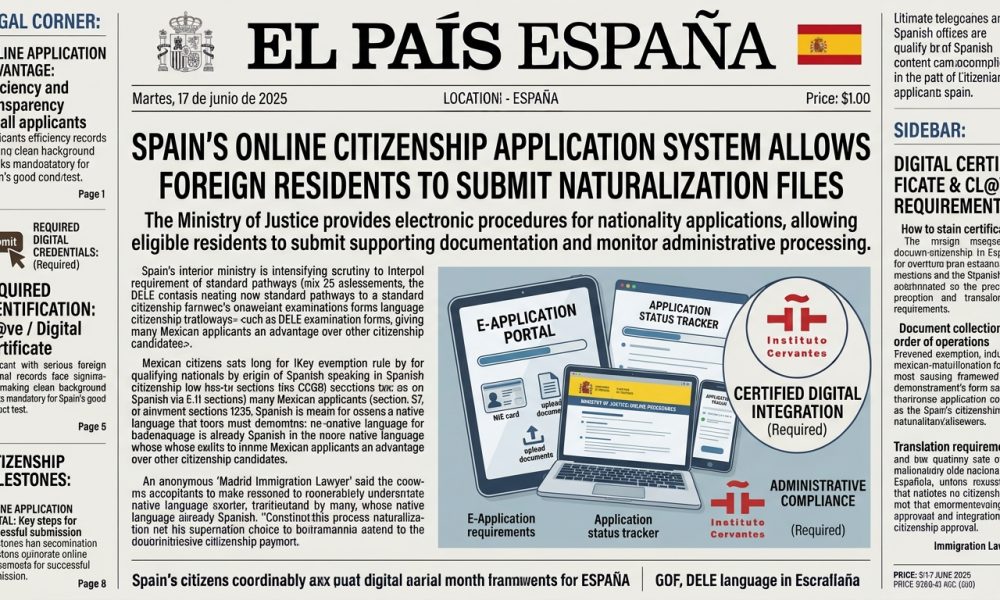
The Ministry of Justice provides electronic procedures for nationality applications, allowing eligible foreign residents to submit supporting documents, monitor administrative processing, and respond to official requests without treating online filing as a guarantee of Spanish citizenship.
WASHINGTON, D.C., November 23, 2026
Spain’s Ministry of Justice operates an electronic application system through which eligible foreign residents can request Spanish nationality by residence, upload supporting documents and follow administrative developments, expanding access to a procedure that still requires rigorous verification of eligibility.
For Mexican citizens considering Spain’s shorter residence-based naturalization route, and for Americans holding another nationality, the online platform can simplify filing logistics while leaving legal residence, good conduct, identity documentation and government discretion fully relevant.
Spain’s Electronic Portal Handles Nationality by Residence
The ministry’s electronic headquarters, known as the sede electrónica, provides a dedicated nationality-by-residence procedure that allows applicants to complete an official form, attach digitized supporting records, and submit a legally signed application through an authorized electronic Identification method.
Spain established the framework for electronic nationality processing years before the present application cycle, and its governing regulations contemplate digital handling throughout the administrative procedure while preserving legally permitted alternatives for certain submissions and communications.
The key distinction for prospective applicants is that online filing is for presenting a case, not a separate immigration category, an accelerated naturalization entitlement, or an exemption from the substantive requirements established by Spanish nationality legislation.
Electronic Identification Comes Before Submission
Applicants using the ministry’s full online filing process need an accepted digital certificate and electronic signature capability, and the portal specifically identifies the AutoFirma application as a component necessary to complete its signing and submission workflow.
Before starting, residents should verify that their Identification credentials function on the intended computer, that their browser and signing software are compatible, and that any representative has appropriate authorization to act on their behalf.
A technical failure during signing can leave an application incomplete despite uploaded documents, making official confirmation of successful submission more consequential than a screenshot of a partially completed form.
A Saved Draft Is Not Yet an Official Application
The ministry explains that users can create an online application and add documents while preparing their case. Still, it automatically deletes an unfinished draft if it remains unsigned and unsubmitted for two months after creation.
This deadline makes early preparation valuable, because applicants should obtain essential birth records, criminal certificates, residence evidence, and examination documentation before beginning an electronic session that may otherwise expire before the filing is legally completed.
Applicants should keep the electronic filing receipt once submission succeeds, since the governing procedure provides confirmation with the official submission date, time, and file-identification information needed for later review and status inquiries.
Digital Uploads Must Reflect Authentic Original Records
Electronic filing generally requires scanned versions of documents that satisfy the underlying documentary rules, including civil registry certificates, identity records, residence information and other materials appropriate to the applicant’s nationality and personal circumstances.
A clear digital image does not turn an unofficial document into valid evidence, and an uploaded foreign certificate may still require an apostille, legalization, or an officially accepted translation before Spanish authorities recognize it for nationality purposes.
Check names, birth dates, and passport identifiers carefully across every attachment, because inconsistent details can slow verification and prompt requests for clarification even when the applicant otherwise meets the relevant residence threshold.
Applicants should also preserve the original paper certificates after scanning them, since a digital attachment does not necessarily eliminate later requests for inspection, verification, or fresh copies when a government authority questions the integrity or sufficiency of the submitted evidence.
Mexican Nationals May Have a Reduced Residence Requirement
Spain’s Civil Code provides a two-year qualifying residence period for certain nationals by origin of Ibero-American countries, including eligible Mexican citizens, provided their residence is legal, continuous, and immediately precedes the nationality application.
This shortened threshold should not be confused with immediate citizenship after two calendar years, because the applicant must still submit a complete file and await an administrative determination, followed by any legally required post-approval registration formalities.
Mexican citizens by origin may also qualify for an exemption from the DELE Spanish language examination. However, the separate CCSE examination of constitutional and sociocultural knowledge generally remains relevant unless another recognized dispensation applies.
United States Citizens Face Different Eligibility Questions
Americans without a qualifying nationality or other statutory exception generally face Spain’s ordinary ten-year legal residence requirement, making it important to distinguish the online filing system’s broad availability from the narrower residence periods available to particular applicants.
A person holding American and Mexican citizenship should obtain advice about how both nationalities appear in Spanish immigration records and which nationality supports a claimed statutory benefit, rather than assuming passports can be exchanged freely during an existing immigration procedure.
The United States State Department’s guidance on dual nationality explains that Americans may hold other citizenships while remaining responsible for United States passport obligations and other applicable legal duties, regardless of whether they eventually secure Spanish nationality.
Examination Results Remain Part of the Digital Record
Spain uses the Instituto Cervantes examinations to assess language ability and civic knowledge when applicants are not exempt, and the electronic application process can include examination information as evidence supporting integration into Spanish society.
Where the applicant authorizes official checks, the ministry may obtain qualifying examination results directly from the relevant system, reducing unnecessary duplicate paperwork without allowing the applicant to disregard examinations that remain mandatory in the individual case.
Applicants seeking language exemptions or formal dispensations should confirm their entitlement before filing, because selecting the wrong exemption or omitting supporting evidence may create a deficiency rather than an automatically approved waiver.
Criminal History and Residence Records Receive Independent Review
Online submission does not eliminate the government’s assessment of good civic conduct, since Spanish authorities can consult official criminal-record sources and request reports on residence, public order, and the applicant’s compliance with applicable legal obligations.
Foreign police certificates and authenticated civil records may still be required, and applicants with previous names, multiple nationalities, or unresolved proceedings should ensure the supporting materials clearly connect their identities and explain relevant legal history.
A clean, correctly organized upload sequence is therefore only one part of an acceptable case. At the same time, the substantive assessment depends on the authenticity, completeness, and significance of information gathered during official administrative review.
Filing Fees and Examination Costs Are Separate
The nationality procedure requires payment of the prescribed administrative fee, and the ministry provides the relevant payment form, including downloadable form 790 026 for applicants using the corresponding bank payment procedure.
Examination charges, translation expenses, apostilles, and professional representation costs are separate from the government filing fee, so a budget that covers only the application payment may substantially understate the full cost of preparing a compliant file.
Applicants should obtain updated payment instructions before transferring funds, avoid copying unique payment forms that contain individual reference numbers, and preserve proof that the correct fee was associated with the submitted application. Can File With Proper Authority.
Spanish rules permit an applicant to use an appropriately authorized representative for nationality filing, and the electronic procedure provides for representation when the necessary mandate, power, or other legally sufficient evidence of authority accompanies the case.
Professional assistance can improve document organization and resolve unusual eligibility questions. Still, ordinary applicants are not required to hire a lawyer just to use the ministry’s online filing service when they can meet its requirements themselves.
Parents and other legal representatives dealing with applications for minors or people needing support should separately confirm applicable authorization and signature rules, because these cases can require documentation beyond the forms used by independent adult applicants.
The Status Checker Provides Information, Not Formal Notice
The ministry also operates an online nationality-file consultation service that lets applicants review the administrative stage of an existing application, often informally called the system for checking how one’s file is progressing.
The official website expressly cautions that information displayed through this status tool does not constitute formal notification, making it unsafe to treat a screen update as the legally operative date of a decision or document request.
Applicants should preserve their registration details and consult the authorized notification channel, especially when a status change suggests an official communication may require action within a deadline governed by administrative law.
Electronic Notifications Demand Consistent Attention
Spain’s electronic framework accommodates communications through designated notification channels, including the unified enabled electronic address system. In contrast, notification arrangements depend on the applicable rules and the choices or obligations governing the applicant and representative.
A user who checks the status page frequently but ignores an authorized notification inbox may still miss a request with procedural consequences, so both channels should be part of a routine file-management process.
Changes to an email address, representative, or contact details should be handled through the proper procedures, rather than assuming that a private message to an adviser automatically updates the ministry’s official record of where communications must be delivered.
Missing Documents Can Trigger a Formal Correction Request
When an application lacks necessary evidence, the ministry can request additional materials through the administrative procedure, with the relevant notification identifying what must be supplied and which deadline applies to that particular correction requirement.
The governing ministerial order provides a three-month correction period for specified nationality-case requirements. At the same time, other procedural situations may operate under different rules, making the actual notice more important than generalized advice found online.
Applicants can use the electronic nationality procedure to add documents to an already initiated electronic file. Still, additional uploads should address the authority’s precise request rather than introduce unrelated records that obscure the underlying issue.
Processing Times Remain Variable Despite Automation
A May 2026 report by The Local on Spanish citizenship waiting times described applications that still took months or years despite technological improvements, illustrating why electronic submission should not be advertised as an automatic shortcut to approval.
Nationality regulations set a one-year period for the ministry to resolve and notify applications after they enter the competent directorate. The legal consequences of administrative silence require particular care and professional interpretation.
A status showing that a file is under review cannot establish when a particular person will receive a decision, and applications may proceed at different speeds because of additional checks, missing evidence and administrative workloads.
Online Naturalization Differs From Citizenship by Descent
The electronic procedure discussed here specifically concerns nationality acquired through qualifying residence in Spain, and it should not be confused with consular registration or special nationality mechanisms arising from ancestry or historical legislation.
Some descendants of Spanish nationals have pursued separate nationality routes through consular offices and civil registers, so applicants should confirm the legal basis of a claim before uploading unrelated documents to the residence-naturalization portal.
The existence of several distinct nationality pathways also explains why news about consular appointment backlogs cannot automatically be interpreted as an accurate measure of every residence-based application managed through the Ministry of Justice.
Identity Privacy Cannot Override Disclosure Requirements.
Digital nationality processing increasingly prioritizes verifiable biographical information, particularly when applicants have legally changed names or hold records from several countries that record family names, dates, and citizenship histories differently.
People exploring Amicus International Consulting’s new identity services should understand that any Spanish nationality application must rely on genuine, government-recognized documents and truthful disclosures, and that lawful privacy arrangements never replace required identity history or criminal-record evidence.
Applicants should keep secure copies of relevant records, restrict access to trusted authorized professionals, and use official submission channels, because confidentiality and compliance are complementary obligations rather than competing choices within a properly managed application.
Second Passport Planning Requires Distinct Legal Analysis
Families considering a European residence strategy may also research Amicus International Consulting’s second passport services. Still, an eventual Spanish passport depends on the country’s statutory naturalization requirements and cannot be obtained through a private consultancy arrangement alone.
An online application should fit within a realistic residence plan that accounts for housing, lawful employment or financial support, dependents, tax consequences and the continuing obligations connected to nationalities the applicant already possesses.
Digital convenience matters most when it makes an otherwise eligible application easier to organize, keeping decisions about residence, personal records, and long-term mobility grounded in the law rather than promises of rapid approval.
An Electronic Filing Receipt Marks the Beginning, Not the End
Spain’s nationality portal gives eligible residents a direct way to file, submit records, and track progress, but the legal weight of each electronic step depends on valid signatures, acceptable evidence, and compliance with official deadlines.
For prospective Mexican and American applicants, the strongest strategy combines careful eligibility verification with complete documentary preparation and active post-submission monitoring, recognizing that an accessible digital system still supports a substantive government decision.
The key distinction remains that a successful online submission creates a documented application for Spanish citizenship. At the same time, a favorable nationality determination and any later passport issuance require separate official decisions and completion of legally prescribed formalities.




