
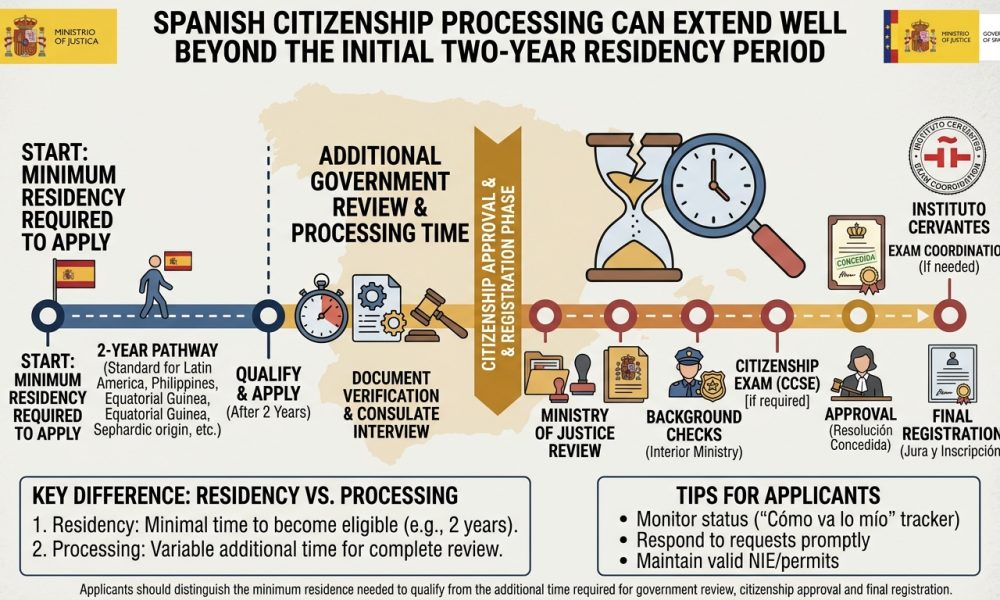
Applicants seeking Spanish nationality should distinguish the minimum qualifying residence period from the separate time needed for documentary review, an official decision, a required oath or promise, civil registration, and eventual passport issuance.
WASHINGTON, D.C., November 23, 2026
Spain’s accelerated nationality rules allow certain Mexican citizens to apply after two years of qualifying residence. Still, that eligibility threshold does not mean authorities must approve the application or issue a passport immediately afterward.
Foreign residents planning their careers, family arrangements and long-term mobility must account for a second administrative timetable involving document verification, government reports, possible requests for additional evidence and formalities that continue after a favorable decision.
Two Years Establish Eligibility, Not Citizenship
Article 22 of Spain’s Civil Code generally allows nationals by origin from Ibero-American countries, including Mexico, to seek nationality after two years of legal, continuous residence immediately before their application, provided they meet additional statutory conditions.
The ordinary threshold for many other foreign nationals is ten years. At the same time, separate five-year and one-year categories apply in specified circumstances, making each applicant’s nationality and personal history essential to calculating the proper eligibility date.
Applicants who mistakenly treat a temporary visit, an unrecognized period of stay, or a residence authorization that begins later than expected as qualifying time risk filing too early and facing a refusal instead of gaining speed.
The Residence Clock Requires Supporting Evidence
A valid immigration card matters, but assessing continuous legal residence may require a clear picture of authorization dates, renewal history, time spent abroad, and the circumstances connecting an applicant to Spain.
Someone who obtains residence through a non-lucrative permit, employment authorization, or a qualifying family relationship should establish the legally relevant commencement date, because initial visa issuance, arrival in Spain, and the effective residence authorization may occur on different dates.
Mexican nationals planning extended travel during their qualifying period should consider how absences might affect continuity, since a permission remaining valid on paper does not automatically resolve every question about actual residence under nationality law.
Documentation gathered throughout the two years can include administrative receipts, renewed residence permits and official registrations. However, applicants should seek advice about which evidence genuinely supports the statutory standard rather than accumulate unnecessary paperwork.
Applications Begin a Separate Government Review
Once the residence threshold is met, an applicant must assemble the required forms and evidence, pay the prescribed filing fee, and submit the nationality request through an authorized channel, including the Ministry of Justice electronic portal.
Spanish authorities can then verify foreign civil records, identity information, criminal-history certificates, examination results and the applicant’s immigration history, while obtaining reports from government bodies charged with evaluating residence and public-order concerns across jurisdictions.
Submitting an apparently complete electronic file therefore begins an administrative procedure, not the final phase of passport production, and the authorities may identify factual discrepancies that require additional explanation before reaching a lawful determination.
A government response may also request explanations about past travel, name changes, or criminal dispositions, and preparing a clear answer can require cooperation among civil registries, translators, and legal representatives in different countries.
Spanish Regulations Specify a One-Year Decision Period
Royal Decree 1004/2015 and the implementing nationality rules set one year for a decision and notification after the application reaches the competent ministry directorate. However, rules on interruption or suspension can affect specific procedural calculations.
That statutory period should not be added to two years as though approval necessarily follows on the third anniversary, because real applications can be resolved sooner, remain pending longer or generate additional proceedings.
The registration and receipt dates shown in official acknowledgments matter when evaluating the administrative timetable, and applicants should distinguish those records from informal estimates from agents, message boards, or commercial immigration advertisements.
The one-year period is a procedural safeguard rather than a guarantee of favorable results, and applicants should avoid financial commitments that depend on an assumed award of nationality on an arbitrarily selected calendar date.
Administrative Silence Is Not Automatic Approval
Where the applicable one-year period expires without an express decision, Spain’s nationality regulations provide for negative administrative silence, a legal mechanism that permits appropriate challenges rather than awarding citizenship by default.
Crucially, that procedural consequence does not mean officials have completed an individualized rejection on the merits, and authorities retain an obligation to issue an express decision under the applicable Spanish legal and administrative review framework.
Anyone considering a challenge should have counsel calculate the operative dates and review possible suspension periods, because an apparent delay cannot be assessed responsibly without the actual filing receipt, subsequent notice, and governing appeal rules.
Reported Waiting Times Vary Substantially
A May 2026 report by The Local on Spanish citizenship waiting times described substantial differences among applications, including legal professionals’ estimates ranging from several months to much longer periods, while noting that earlier backlogs produced multi-year waits.
The article also discussed technological improvements designed to streamline official processing. Still, faster handling of some files should not be mistaken for a universal service standard or evidence that every case follows the same predictable sequence.
Published waiting-time comparisons can also aggregate different nationality routes or applications from different calendar years, potentially producing misleading impressions unless figures distinguish residence-based naturalization from consular nationality by descent and other special processes.
An applicant with straightforward records may experience fewer documentary questions than someone with several nationalities, previous names, or unresolved proceedings. However, individual timelines can vary widely based on circumstances.
Missing Documents Can Extend the Process
Foreign birth certificates, apostilles, accepted translations, and criminal-record documents must meet Spanish filing requirements, and a discrepancy in official names or dates can trigger requests for clarification long after the applicant first submitted an electronic form.
Some certificates are time-sensitive, so ordering everything too early can create another problem when records become outdated before submission, whereas waiting until the last moment can postpone an otherwise eligible citizenship application nearing formal submission.
Applicants should prepare a document inventory that identifies each issuing authority, necessary authentication, translation requirements, and the connection between current identity records and any earlier lawful names appearing in official government databases across multiple jurisdictions.
Examination Requirements Create an Earlier Planning Stage
Applicants who are not exempt may need the DELE Spanish language examination and the separate CCSE constitutional and sociocultural knowledge examination, with eligible Mexican nationals by origin generally benefiting from a DELE exemption.
The testing schedule can affect when the file is ready for submission even after two years of residence, and an examination exemption should never be confused with a waiver of unrelated residence, conduct, or integration conditions.
Background Screening Remains Substantive
Spain’s citizenship authorities assess good civic conduct alongside legal residence and integration, making accurate criminal-history evidence important even when an applicant’s foreign police certificate shows no recorded convictions or has been properly apostilled.
Pending proceedings, court dispositions and changes in personal Identification may call for individualized legal advice, because applicants should not assume that an expungement abroad or a newly issued passport eliminates relevant disclosure duties.
Online Status Updates Do Not Replace Notifications
The Ministry of Justice provides an online nationality-file status inquiry, but expressly distinguishes information shown through that service from formal legal notifications, which can trigger obligations or deadlines when delivered through the authorized channel.
Applicants and their representatives should monitor the appropriate notification system, keep copies of official communication, and respond accurately to any request for additional information rather than rely solely on an online progress tracker.
A missed notification can be especially costly when officials request corrections to an otherwise viable application, because procedural deadlines may continue running. At the same time, the applicant believes the case remains unchanged and requires no immediate response.
Delays May Require a Legal Response
When the statutory decision period has passed, an affected applicant may evaluate administrative reconsideration or judicial review with appropriately qualified Spanish counsel, weighing procedural rules, case merits, and financial costs before choosing a course.
Different deadlines can apply to an express refusal and to negative administrative silence, so generic advice to sue immediately or wait indefinitely may be inappropriate without examining the actual resolution history and legally relevant dates.
Legal proceedings also involve their own schedules and risks, making litigation a procedural option rather than a guaranteed way to obtain rapid approval or turn a deficient nationality application into a successful one.
Approval Starts Another Important Countdown
A favorable nationality resolution does not complete acquisition, because Spanish law makes its effectiveness conditional on subsequent requirements, including a legally prescribed declaration of loyalty and completion of civil-registry procedures within the applicable framework.
The Civil Code provides a 180-day period following notification for the successful applicant to appear before a competent official to fulfill the relevant requirements, making prompt attention to the formal approval notice essential.
The Oath or Promise Must Be Organized
Applicants covered by the declaration requirement must swear or promise loyalty to the king and obedience to the Constitution and laws. In contrast, the associated renunciation declaration has exceptions for qualifying nationals from Ibero-American countries and certain others.
Civil-registry appointment availability can complicate scheduling, and the Ministry of Justice has recognized procedures for documenting timely appointment requests when an office cannot provide a date within the usual statutory appointment and processing window.
Applicants should not assume that an overloaded registry automatically excuses inaction, since preserving evidence of a timely request and following official instructions may be important to protecting the favorable nationality decision already issued.
Civil Registration Completes the Nationality Procedure
After the required declaration, acquisition must be entered in Spain’s Civil Registry, which provides the essential official registration basis for documenting the new nationality and proceeding toward Spanish identity documents issued through subsequent administrative procedures.
The regulatory framework addresses the timing of registration after the oath. Still, practical appointment constraints and individual documentary issues can affect when the applicant receives usable evidence of the completed nationality acquisition process.
A family planning international travel immediately after approval should confirm the civil-registration arrangements, the issuance requirements for Spanish identity documents,, and anyongoingg validity requirementstiedd to the foreign residence status they stillholds.
A Spanish Passport Follows, Rather Than Precedes, Registration
Obtaining a Spanish passport ordinarily requires that nationality acquisition be properly completed and recorded, after which applicants must meet separate identity-document and passport-issuance requirements administered by the competent Spanish authorities.
Travel plans should therefore distinguish an application receipt, a favorable ministry resolution, successful registration, and an issued passport, because none of the earlier milestones should be represented as possession of the final travel document.
Dual Nationality Creates Parallel Responsibilities
Americans who also qualify through Mexican nationality should carefully examine how their citizenships interact, because Spain’s reduced residence category and renunciation exceptions involve specific nationality conditions rather than a universal benefit for every United States passport holder.
The U.S. State Department’s dual-nationality guidance explains that American citizens may hold another nationality while remaining subject to United States passport and other legal obligations, including the requirement to use a U.S. passport when entering or leaving the United States.
Families Must Avoid Compressed Relocation Assumptions
Children, spouses, and dependent relatives may have different residence statuses or nationality options, so one family member’s accelerated eligibility should not be treated as an automatic timeline for everyone in the household.
Parents should evaluate schooling, health coverage, professional obligations, and the financial capacity to remain lawfully resident while a citizenship application is pending, rather than structuring major family decisions around an unconfirmed approval date.
Identity Planning Must Preserve Complete Legal Records
Applicants exploring Amicus International Consulting’s new identity services should distinguish lawful privacy and identity documentation from attempts to conceal previous names, immigration history, or criminal matters, all of which may remain relevant to naturalization.
A legitimate name change does not shorten Spain’s statutory residence period or replace the authenticity checks public authorities perform, so accurate continuity between historical and current records remains central to responsible preparation.
Second Passport Strategies Need Realistic Time Horizons
The Amicus International Consulting second passport services provide a broader context for mobility planning, but acquiring Spanish citizenship through residence requires an individualized legal pathway rather than payment for a predetermined government result.
Applicants should build budgets that cover document preparation, residence renewals, possible professional fees, and a variable period of administrative review, recognizing that access to the European Union ultimately depends on obtaining nationality through lawful procedures.
Citizenship Timelines Should Be Explained in Stages
The most useful planning model separates the time needed to become eligible, the time required to assemble and submit evidence, the ministry’s decision process, and the final oath and civil-registration obligations after approval.
Keeping these stages distinct helps prospective citizens evaluate professional transitions and family priorities without being misled by advertisements that compress residence eligibility, ministerial approval and final passport issuance into a single unrealistic completion date.
For qualifying Mexican nationals, two years may be the earliest point to apply, but a credible forecast must allow time for government review, possible delays, and completion of official formalities before a Spanish passport becomes available.




