
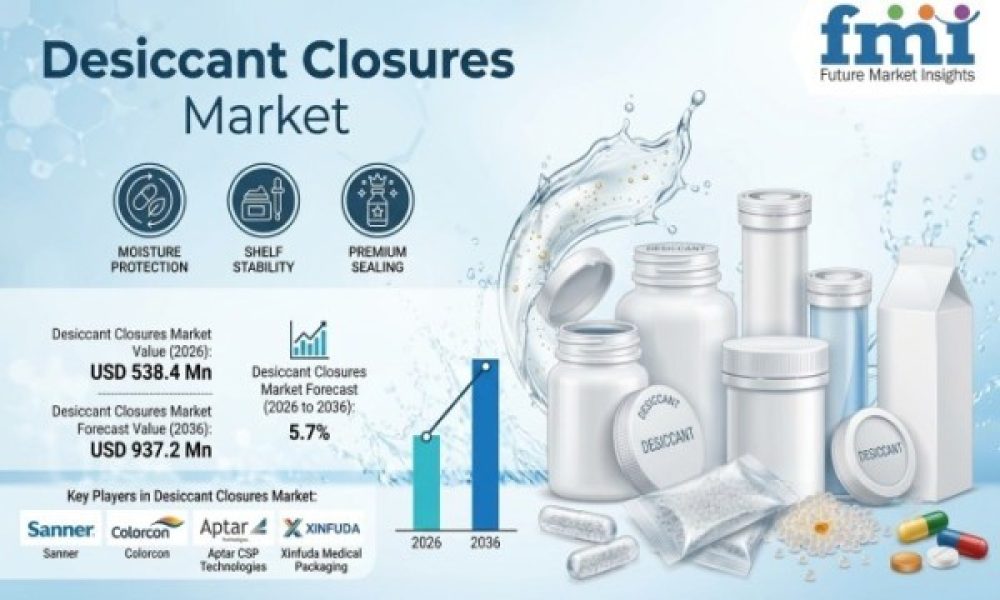
The global desiccant closures market is projected to increase from USD 538.4 million in 2026 to USD 937.2 million by 2036, registering a compound annual growth rate (CAGR) of 5.7% during the forecast period. Demand is supported by pharmaceutical manufacturers seeking to protect moisture-sensitive tablets and capsules after bottles are opened repeatedly. Integrated desiccant closures incorporate moisture-scavenging materials into the closure assembly, reducing the need for a separate desiccant-insertion step in suitable packaging applications.
Regulatory attention to pharmaceutical packaging is another factor influencing product qualification. In August 2026, the US Food and Drug Administration (FDA) issued draft guidance addressing container-closure quality as a complete packaging-system consideration. This approach makes closure fit, stability evidence and filling-line performance relevant to packaging decisions. Manufacturers evaluating alternative closures must therefore assess moisture protection alongside compatibility with established bottle designs and capping operations.
Get detailed market forecasts, competitive benchmarking, and pricing trends:
https://www.futuremarketinsights.com/reports/sample/rep-gb-35041
Global Segment Leaders
- Product type: Screw closures are estimated to account for 32.0% of the market in 2026. Their threaded interfaces support repeated opening and reclosure while retaining compatibility with familiar pharmaceutical bottle formats.
- Material: Polymer systems are projected to hold a 29.0% share in 2026. Molded structures allow manufacturers to integrate moisture-scavenging elements into closure assemblies while supporting established sealing and reclosure requirements.
- Compliance feature: Child-resistant formats are expected to represent 29.0% of the market in 2026. These closures combine access-control requirements with moisture protection for repeatedly opened medicine bottles.
- End use: Retail pharmacy is expected to account for 30.0% of the market in 2026. Multidose medicine packs require reliable reclosure because repeated opening exposes bottle headspace to ambient moisture.
The report also segments the market by sales channel, covering direct pharmaceutical contracts, specialty distributors and online B2B channels. The supplied report content does not specify market shares for these sales-channel categories.
Country-Level Performance
The eight profiled countries are ranked below by forecast CAGR, from highest to lowest.
- UAE: 7.1% CAGR. The Emirates Drug Establishment directory recorded a UAE-manufactured VONACAB 20 mg tablet registration dated May 26, 2025. New medicine registrations create opportunities to qualify closure systems alongside primary packaging for newly introduced products.
- Saudi Arabia: 6.8% CAGR. The Saudi Food and Drug Authority (SFDA) reported in January 2026 that the country’s drug sector included nine licensed factories and 568 warehouses during 2025. Expanding local production and distribution capacity creates additional opportunities for pharmaceutical packaging qualification.
- South Korea: 6.5% CAGR. The Ministry of Food and Drug Safety (MFDS) documented in December 2025 that 45 unapproved overseas medical products received emergency introduction during the year, including 15 medicines. Specialized product access creates packaging requirements for medicines entering domestic distribution channels.
- USA: 6.2% CAGR. The FDA reported that its Center for Drug Evaluation and Research approved 46 novel drugs during calendar year 2025. New drug launches create opportunities to qualify integrated moisture-protection closures before packaging specifications become fixed.
- Germany: 5.9% CAGR. ABDA reported in January 2026 that Germany ended 2025 with 16,601 pharmacies, following 502 closures and 62 openings. The established pharmacy network supports continuing medicine demand, while mature packaging systems favor controlled closure changes.
- UK: 5.6% CAGR. NHS Business Services Authority (NHSBSA) reported in October 2025 that 10,407 community pharmacies were open in England as of March 31, 2025. Community dispensing makes consistent reclosure performance relevant to multidose medicine packaging.
- France: 5.3% CAGR. The National Council of the Order of Pharmacists stated in March 2025 that its DP-Ruptures network connected 99% of pharmacies with manufacturers producing more than 84% of medicines available in France. Established medicine-supply coordination increases the importance of reliable packaging supply and disciplined change control.
- Japan: 4.9% CAGR. Japan’s Ministry of Health, Labour and Welfare reported in August 2026 that written information accompanied 76.7% of in-store category-one over-the-counter medicine sales in its latest survey. Patient handling requirements and established dispensing practices influence closure qualification.
Regional Context
The UAE and Saudi Arabia form the fastest-growing country group, supported by pharmaceutical registrations, local manufacturing activity and investment in drug distribution infrastructure. These conditions create opportunities to qualify packaging for new products, although imported components and limited local technical support can extend trials.
South Korea and the USA occupy the next growth tier, where new drug introductions and specialized medicine access create opportunities for packaging changes. Germany and the UK represent a more mature tier, with established pharmacy networks and approved packaging specifications making unnecessary changes harder to justify. France and Japan have the lowest forecast growth rates among the profiled countries, reflecting established distribution systems and conservative packaging qualification practices.
The full report covers North America, Latin America, Western Europe, Eastern Europe, East Asia, South Asia and Pacific, and the Middle East and Africa, including the eight profiled countries and more than 25 additional countries.
Competitive Landscape
The desiccant closures market includes Sanner, Colorcon, Aptar CSP Technologies, Xinfuda Medical Packaging, ALPLApharma, Gerresheimer, West Pharmaceutical Services and Amcor. Competition centers on integrated moisture protection, closure safety, container compatibility and technical support during pharmaceutical packaging qualification.
Recent developments illustrate activity across specialized closures and adjacent pharmaceutical packaging platforms. In January 2025, West Pharmaceutical Services introduced Daikyo PLASCAP RUV closures in a nested, ready-to-use format for pharmaceutical fill-finish lines. In April 2025, Amcor completed its combination with Berry Global, broadening the group’s healthcare containers-and-closures manufacturing base. In June 2025, Xinfuda Medical Packaging launched a good manufacturing practice (GMP) upgrade project for pharmaceutical packaging materials ahead of tighter production requirements.
Sanner, Colorcon, Aptar CSP Technologies and Xinfuda Medical Packaging have documented routes to integrated moisture protection. ALPLApharma and Gerresheimer participate in broader pharmaceutical container-and-closure programs, while West Pharmaceutical Services and Amcor operate across adjacent regulated closure and healthcare packaging applications. Qualification requirements and compatibility with existing production lines remain important considerations for pharmaceutical customers assessing suppliers.
About Report
Future Market Insights (FMI) is a leading provider of market research and consulting services, offering syndicated and customized research across industries including pharmaceuticals, healthcare and packaging.
For more information on the full report, visit: https://www.futuremarketinsights.com/reports/desiccant-closures-market
FMI Custom Research: Strategic Intelligence for Confident Decision-Making
In today’s rapidly evolving business environment, leadership teams need more than market data—they need clear, actionable intelligence tailored to their strategic objectives. FMI’s Custom Research solutions are designed around the specific business questions organizations need answered, enabling executives to evaluate growth opportunities, validate investments, assess competitive dynamics, and reduce uncertainty before making critical decisions. By combining deep industry expertise, primary research, and proprietary market intelligence, FMI delivers insights that help organizations move from assumptions to evidence-based strategies with greater speed and confidence.
Business Impact
FMI helps organizations transform market complexity into strategic clarity, enabling leadership teams to identify growth opportunities faster, optimize resource allocation, strengthen competitive positioning, and make high-stakes business decisions with confidence.
To explore how FMI Custom Research can support your strategic priorities, please connect with our team at – [email protected]
About Future Market Insights (FMI)
Future Market Insights, Inc. (FMI) is an ESOMAR-certified, ISO 9001:2015 market research and consulting organization, trusted by Fortune 500 clients and global enterprises. With operations in the U.S., UK, India, and Dubai, FMI provides data-backed insights and strategic intelligence across 30+ industries and 1200 markets worldwide.



